Hochob, Mexico.
Entering the Zoomorphic Language of Chenes Architecture
Looking for concrete details and tips? Go straight to the Practical Information section.
It was past 8.30am when I reached the top of the stone stairs leading to the small Maya settlement of Hochob, near Dzibalchen, in one of the most remote areas of the Mexican state of Campeche, and the heat, while still bearable, felt like it had just gotten started.
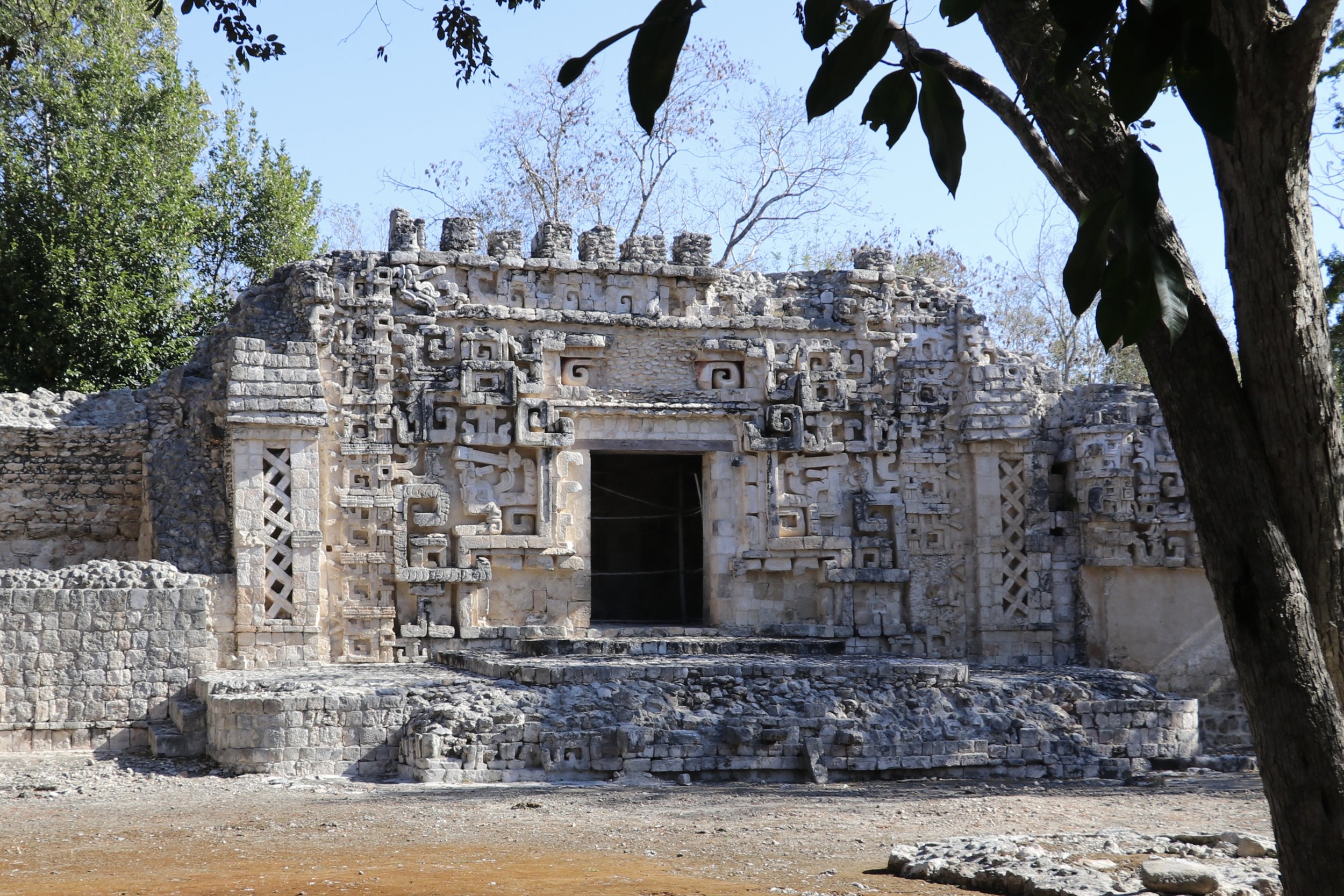
I wasn’t prepared for what I saw. I had seen Chenes-style doors before, notably at Chicanná, and the day before at Santa Rosa Xtampac, but the majestic door of Building 2 in Hochob felt like nothing I had seen before.
Perfectly restored, the door was bathed in the soft morning light, which highlighted every intricate detail of the elaborate sculpture shaping its facade, making it at the same time imposing, delicate and somewhat scary.
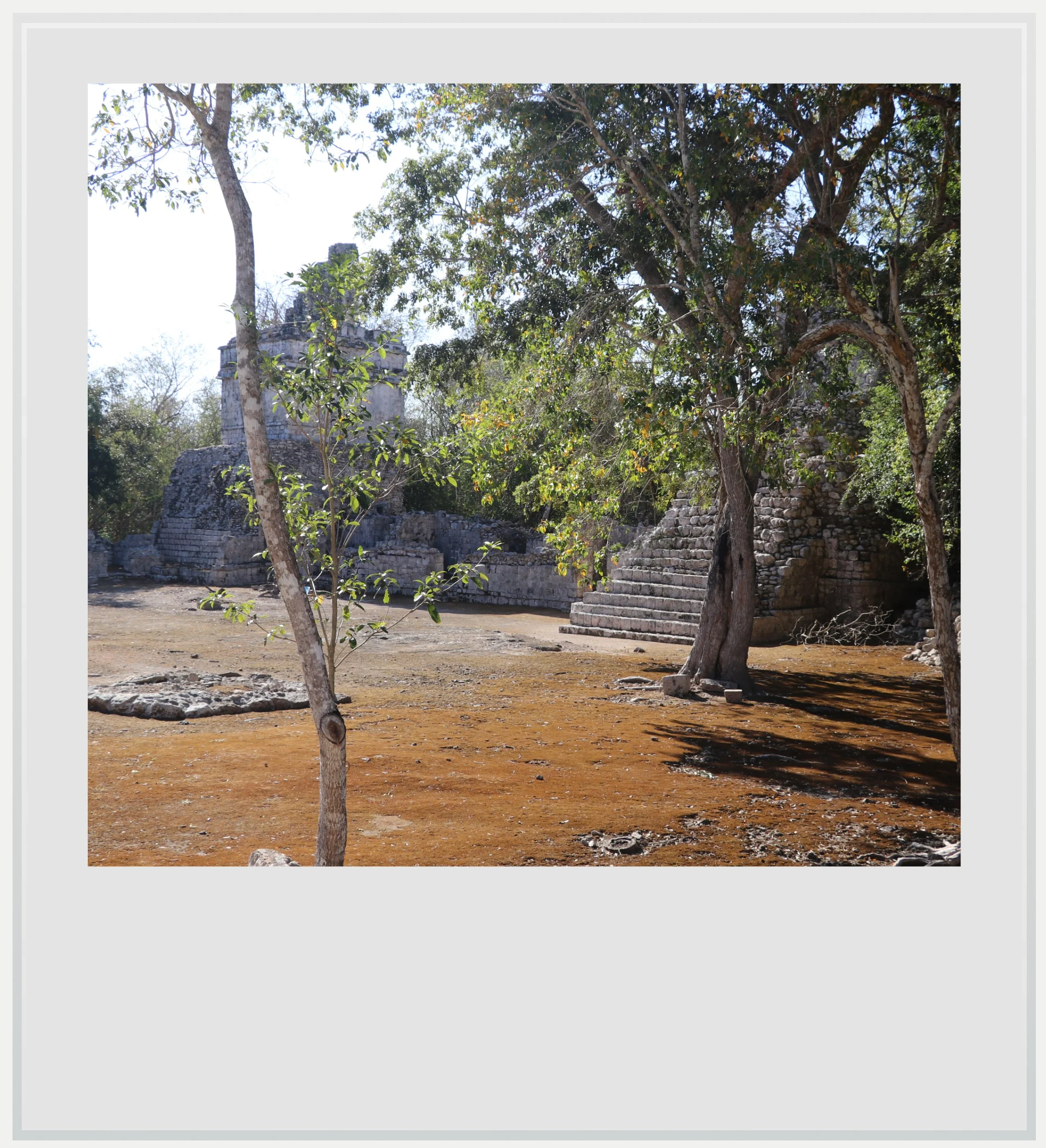
Buildings 5 and 6 behind vegetation on the site’s main platform.
Surrounded by a few other buildings laid out around a compact plaza at the top of a hill, the site felt eerily peaceful - it helped that I was the only visitor, probably for the day if the visitors log of the days before was any indication, and the only noise I could hear was birds chirping.
To understand just how isolated Hochob felt, it helps to step back and look at the wider Chenes region in which it sits: a place of remote roads, sparse villages, and a landscape where human presence remains an afterthought. I had started my day by driving from Hopelchen, the main town in the area, which derives its name from the fact that most settlements in the area end of the suffix -chen, meaning “well” or “pothole” in Yucatec Maya.
Hochob seemed to dominate the landscape without even trying.
Isolated and off the tourist radar, the region is nonetheless home to hundreds of Maya ruins, with only a dozen or so being currently accessible to the public. It has limited services, spotty cell coverage and a landscape that alternates between dry, thick forest and open fields, a lot of them still requiring manual labor.
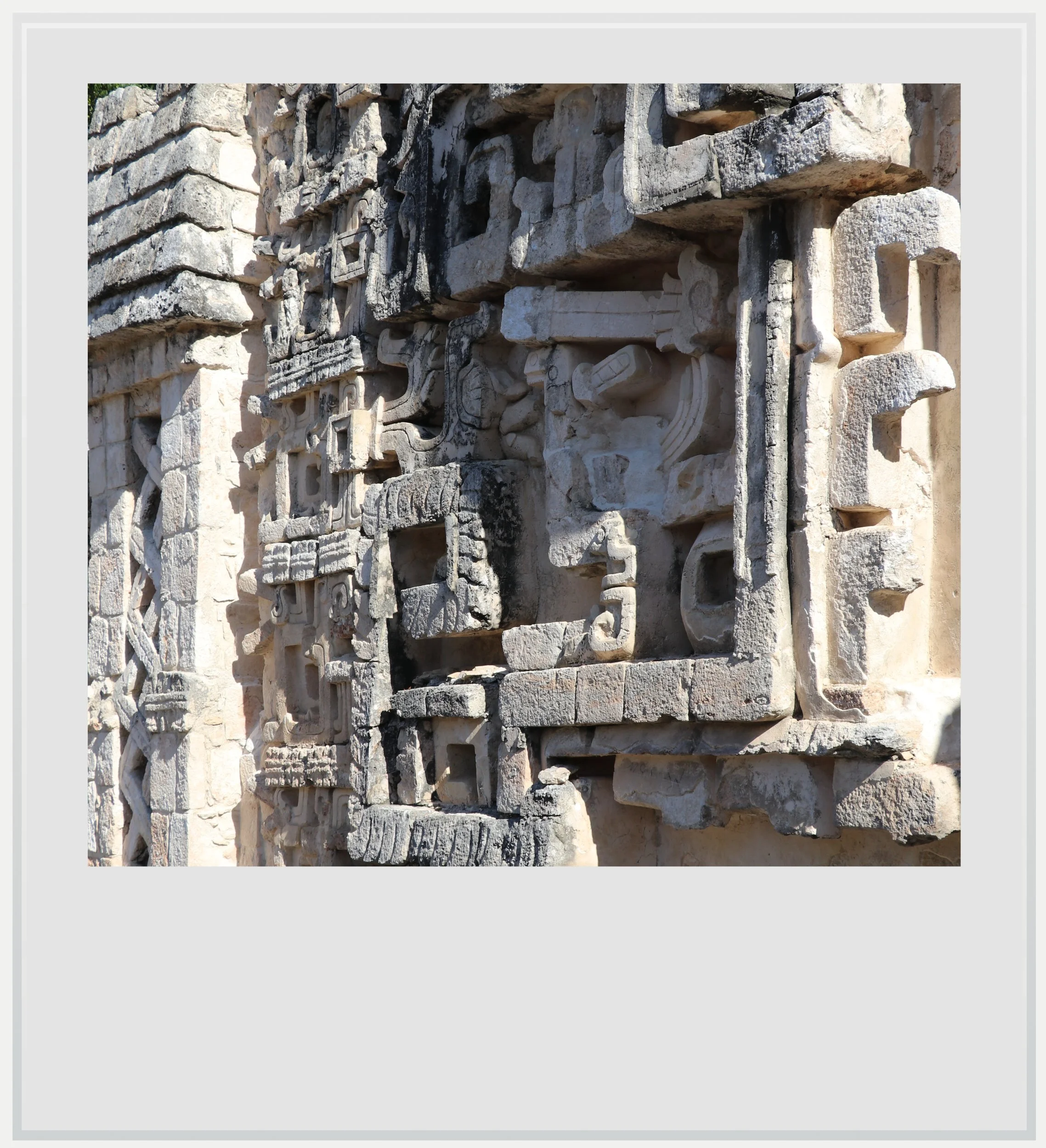
A detailed view of the serpent-mouth facade of Building 2.
The topography and remoteness of the Chenes region makes it a great area for the remaining wild fauna of Yucatan, and it is home to several species of big cats, from the jaguar to the puma to the ocelot.
Minutes after turning right on the outskirts of Dzibalchen towards Hochob, I saw a moving shape cross the road, and I immediately thought it was a dog - we weren’t far from town, after all. I slowed down in case the animal made a sudden move towards the centerline, and, from a distance, realized it had the facial features of a cat, but a rather big one.

As my car slowly got closer, it dawned on me this big cat wasn’t a very well-fed domestic specimen. It suddenly stepped into the nearby maize fields and disappeared, but not before I could take a close look at its tail. I understood it was an ocelot right away - I had seen some in game reserves before, but a quick Google search later confirmed that.
It was fitting to remember this fleeting encounter as I was looking at Building 2, a few minutes later. The Chenes variant of Maya architecture is famous for its zoomorphic facades, and Building 2 is one of its best examples: the front side of the single-story temple is sculpted into excruciating detail to form the head of a snake, a shape taken by the god Itzamná, its open mouth being the door of the building.
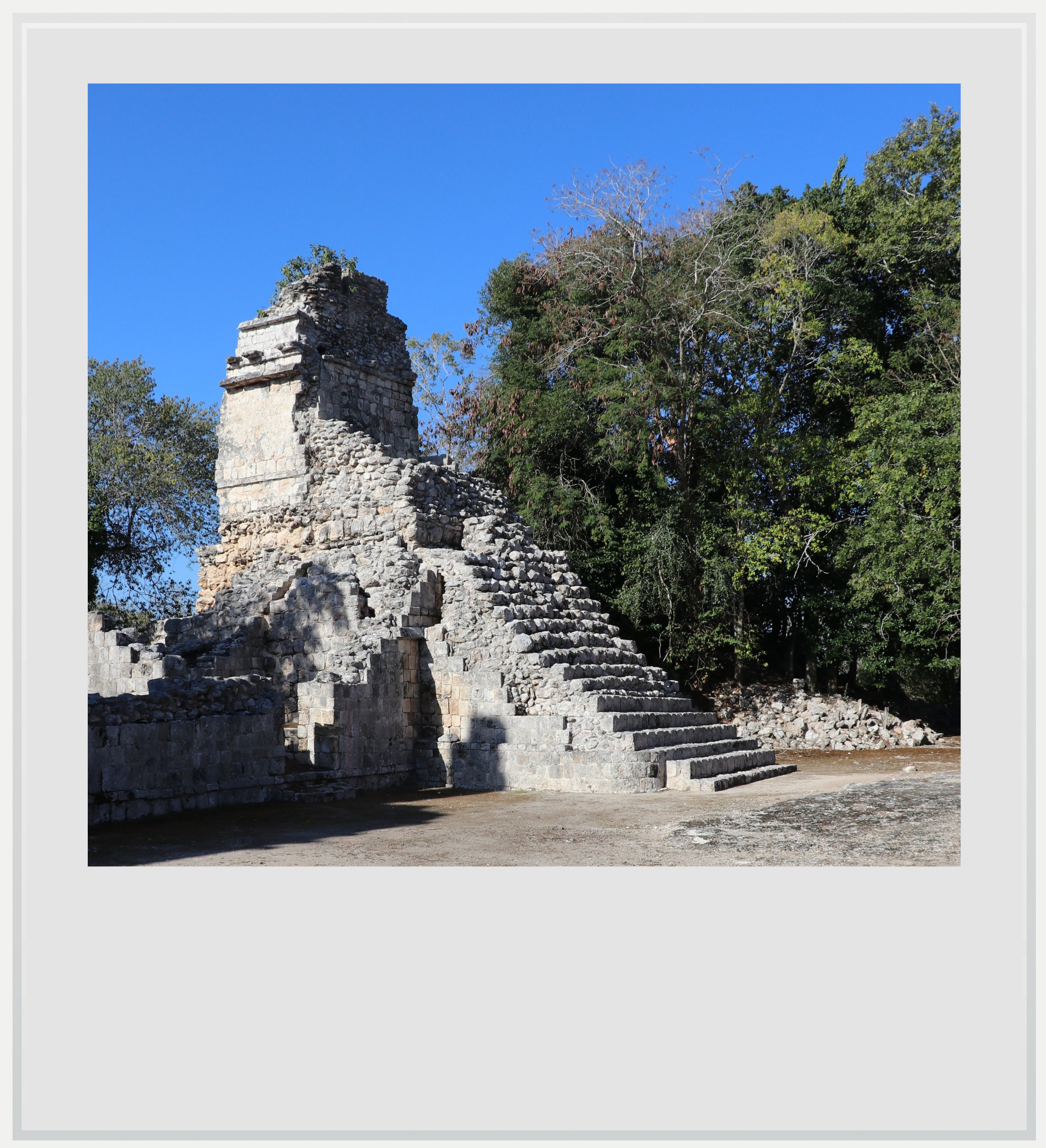
Building 6.
Although the building has been restored - which brought back some of its former glory-, parts of it had been irreparably damaged: above the door, it’s easy to notice the snake-god’s eyes but its nose is missing, and was later filled with the round stones during restoration work.
Another striking feature of Building 2 are the Chaac god masks, seen to the right, along a wall curve. Although they are missing their prominent nose, these are similar to the Chaac masks seen in later buildings in the Puuc hills, most notably in Uxmal and Kabah.
The National Museum of Anthropology in Mexico City features a replica of Hochob’s Building 2, and aims to show in detail what it might have looked like. There the facial features, including the teeth, are much more obvious, and offer a glimpse into the tremendous sculpture work of the Maya architects.
The other buildings in Hochob aren’t as well preserved as Building 2, which was definitely the main focus of my visit, but they are nonetheless remarkable. Like Building 2, Buildings 5 and 6, on the opposite side of the plaza, are shaped as a single story structure, but they differ in featuring a second-floor pyramid-temple complex at each end. These pyramids seemed close conceptually to Rio Bec architecture, although unlike these, the stairs to the temple on the second floor were usable.
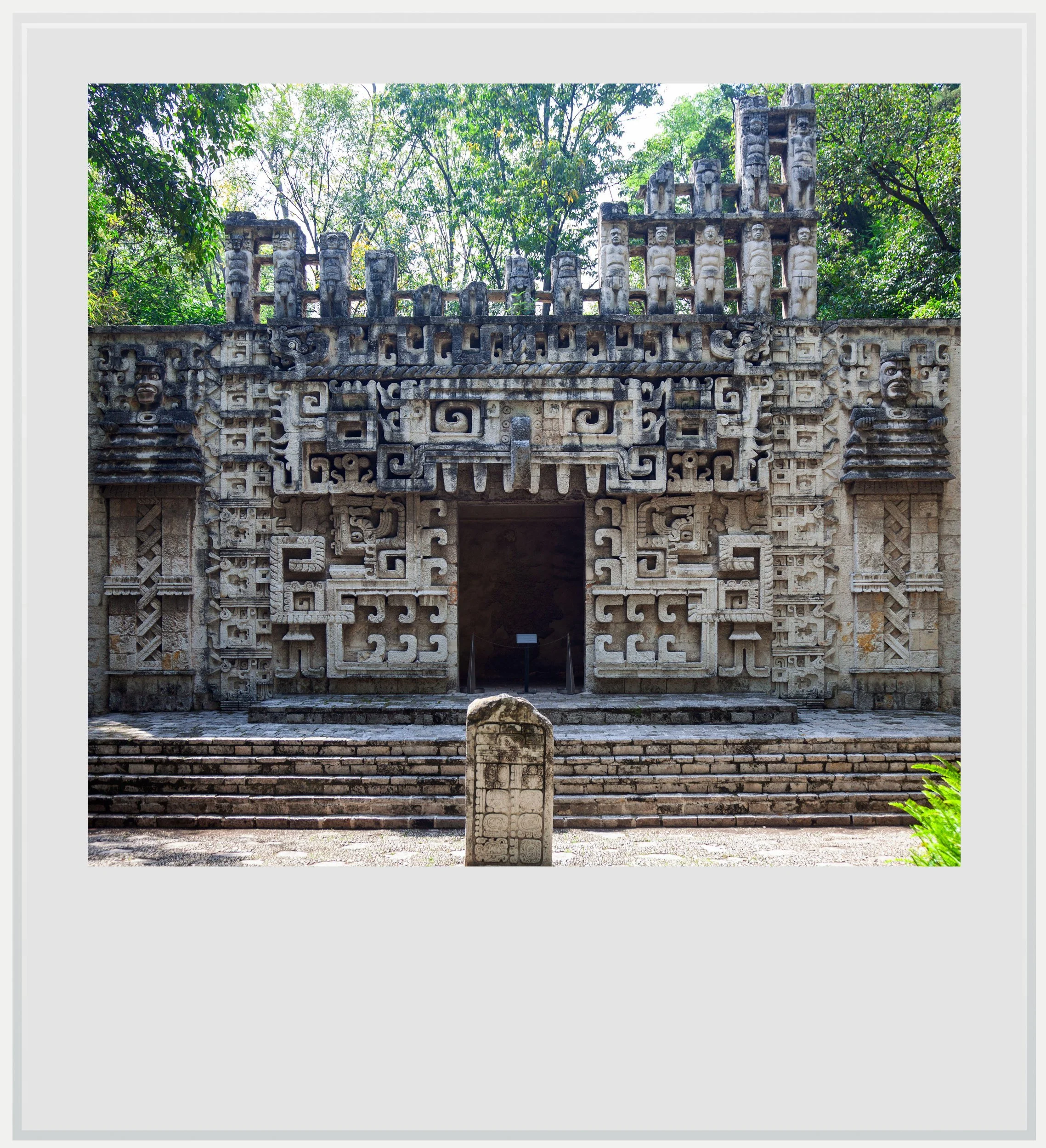
The Hochob Building 2 replica in the National Anthropology Museum in Mexico City. Image: © M. Sobreira via Alamy Stock Photo.
Very few stone carvings and hieroglyphs have been found in Hochob, and as a result, archeologists have had a hard time understanding the purpose of the site, although it is understood, given its compact size, that it probably was a satellite site, answering to what is considered to have been the capital of the Chenes region, Santa Rosa Xtampac.
Where Santa Rosa Xtampac, which I had visited the day prior, had been hidden in the forest, found almost by mistake, this site, at the top of its gentle hill, was existing on another continuum, seeming to dominate the landscape without even trying.
After the massive site of Santa Rosa Xtampak, this morning visit to Hochob brought to life the Chenes Maya architecture style in an even more vivid way. It was hard not to be enthralled by the majesty of the architecture and the solemnity of visiting such a site alone, on such a beautiful day.
I would continue my discovery of the Chenes sites with Dzibilnocac, a fantastic counterpoint to the modestly-sized Hochob.
Practical information
(Everything you could possibly want to know about Hochob - updated March 2026)
In a nutshell
Hochob, a small-sized Maya site in central Campeche, is one of the best example of Chenes architecture within the Maya world. The site is compact and relatively easy easy to access, about 15 minutes from the nearest village of Dzibalchen. It can be a great first stop on a day trip to key Chenes sites in the area, alongside Dzibilnocac and El Tabasqueño.
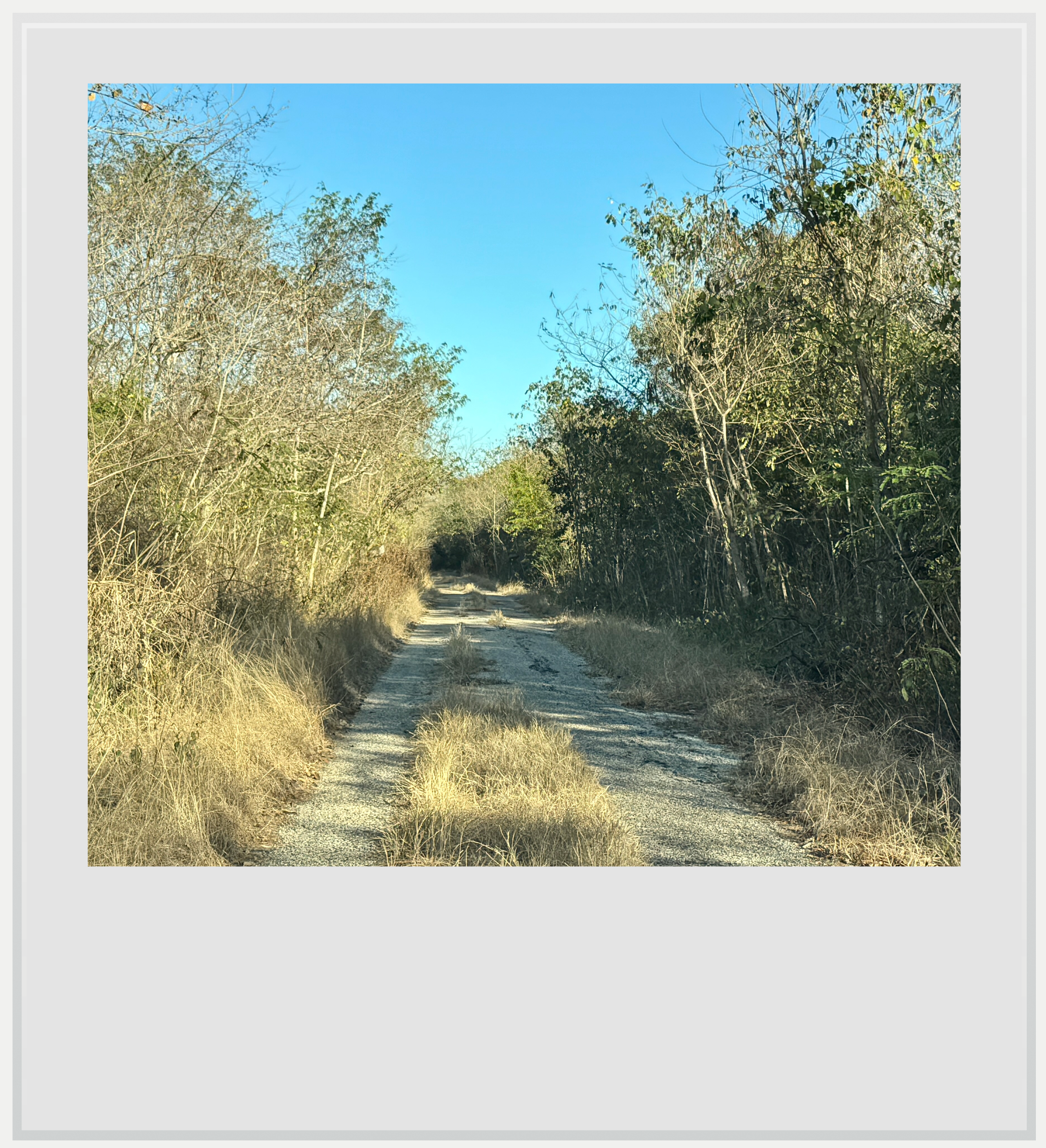
The small road to Hochob past the turn out in Chencoh.
Getting to Hochob
How to get to Hochob from the United States: Hochob, in central Campeche, isn’t easy to reach from the US. The closest airport to Hochob is Campeche (CPE), 1h45 to the north. Campeche is only served by one or two flights a day from Mexico City (MEX), so it isn’t the easiest airport to get in to. Merida (MID) can be an alternative. Travel time to Hochob is 3h, and Merida sees a lot more frequent flights to Mexico City (14 on a random day in March 2026) as well as non-stop flights to the US: AA flies daily to and from Dallas (DFW) and Miami (MIA), United daily from Houston (IAH) and Viva several times weekly to and from Orlando (MCO) and Miami (MIA). For additional directions from each airport, please see below. Note that car rental is your best bet to visit the region, and both Campeche and Merida airports count with several local and international options, which were fairly priced at the time of my visit (about USD 25 per day for a car in the Economy category). While the ADO bus company serves the region with frequent buses between major cities, only SUR, a regional provider, reaches the rural region of central Campeche. As such, bus travel isn’t really an option. More details below.
How to get to Hochob from the Campeche airport: assuming car rental (if not, see why I don’t recommend bus travel in central Campeche below), make a left upon exiting the airport, then another left when you get to the ring road, but don’t get on it as you need to get off at the next intersection, towards Edzná. Once you get to Edzná, follow directions to Hochob. The Google Maps directions are excellent on this route, but don’t forget to download the regional map before leaving the airport, as cellular service is very spotty past Edzná, so you can follow directions offline. The trip should last a little less than two hours.
How to get to Hochob from the Merida airport: assuming car rental (if not, see why I don’t recommend bus travel in central Campeche below), make a left upon exiting the airport, then another left to take the Merida ring road at the next big intersection. Exit the ring road and follow signs to Campeche (highway 180) until you see signs for Uxmal (highway 261). Continue on highway 261 all the way to Dzibalchen, passing by Santa Elena, then Hopelchen but don’t forget to download the regional map before leaving the airport, as cellular service is very spotty on the route, so you can follow directions offline. The Google Maps directions are pretty good. The trip should last a little over three hours.
Can I get to the Hochob archeological zone on a bus: in a nutshell, you cannot. SUR, the regional bus company serving the remote region of central Campeche has service to the nearby town of Dzibalchen, 8 miles (13 km) away. SUR is a regional, second-class bus line operating in the Yucatán Peninsula. It forms part of the broader ADO transport network, serving smaller towns and low-cost routes that are often absent from mainstream tourist booking platforms. SUR line #702 links San Francisco de Campeche with Dzibalchen but details online are very scarce. Rome2Rio mentions the line operates every hour and takes about 2 hours, but that website is known to sometimes not receive timely updates.
I haven’t personally used SUR. I booked a car for this trip because it really didn’t make sense to try and take the bus, although I usually try to when I can, as bus travel in Mexico is usually cheap and convenient.
Let’s assume you took a SUR bus from the Campeche ADO station, getting you to Dzibalchen. ADO doesn’t list the bus timings of its SUR subsidiary.
First, you’d have to check online on AhorroBus, but since there is no way to check which line serves Dzibalchen on there, you’d need to download the AhorroBus app, geolocate yourself near Dzibalchen and notice that line 702 is the one you want. From there, you’d go back to the website and check the line 702 route and its stops. Great but there is no mention of timings or pricing (as I wrote above, SUR caters mainly to locals, who know these details without needing to check the website, which is probably why this information doesn’t appear).
Once you got to Dzibalchen, you’d be about 8 miles away from Hochob. There are very few taxis in Dzibalchen and I am not sure how easy it would be to get one to Hochob, where the driver would have to wait for you at an extra cost because there is no way to call a taxi back (no cell service).
In other words, it may be possible but it would take a lot of time and probably not save as much money, bearing in my mind rental car cost me USD 25 per day. Imagine also that you’d want to visit other sites, and while some like Dzibilnocac are close enough to a bus station, major site like Santa Rosa Xtampac can only, be seen on a tour (if they exist) or with a rental car. That’s why I do not recommend bus travel in central or southern Campeche.
Can I get on a tour to see Hochob: while no tours were available on global platforms such as Viator or GetYourGuide, it may be possible to find local tour groups offering the service. One place to look would be in Campeche, either by the bus station or near the Malecon (close to the Puerta de Mar, here) where there is a decent tourist flow that attracts sellers. Tours will be geared towards Spanish-speaking travelers however, so it is unlikely a tour would be offered in English, but you may get lucky. As I planned from trip a few weeks in advance, I felt like having a car would be the easiest option and didn’t try to look for these options in person while Campeche.
When to go to Hochob
The best months weather-wise to enjoy Hochob are during the dry season, between November and April, with January and February the (relatively) coolest months. This is also peak season but, given its location, the site is never actually crowded.
I went to Hochob in late February. I was the only one on the site during my visit and the visitors log showed only a couple of people had come to the site the days before.
Aim to go to the site early (it opens at 8am) or late (at the latest by 4pm, to give you an hour before they close), to avoid the hottest hours of the day. There are trees on the platform where the buildings are but you need to walk up about forty steps in the sun before getting there, and it could be uncomfortable in the hottest hours of the day.
There are no services whatsoever on the site except bathrooms.
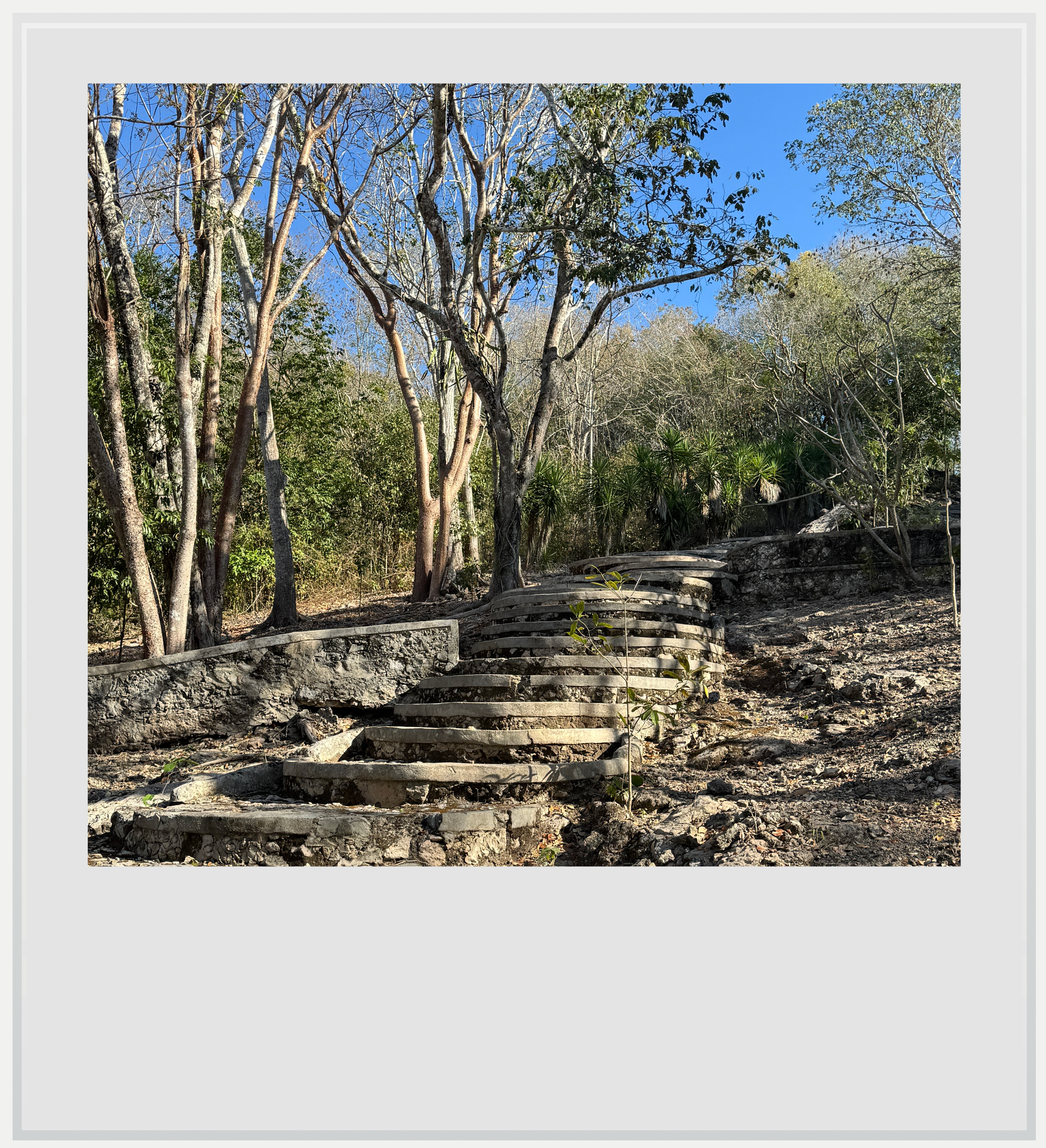
Stairs leading to the site from the parking lot, past the entrance booth.
What’s the best time of the day to visit Hochob
Given the site’s orientation, it is best to hit Hochob in the morning, when sunlight will highlight Building II’s facade. Building II is the most beautiful of the site and its intricate Chenes-style carvings look best in that light. As noted above, a morning visit will also ensure heat isn’t unbearable.
How much does it cost to visit Hochob
At time of publishing, the entrance price was MXN 145 for foreigners and MXN 80 for Mexican citizens and official Mexican residents with proof of residency.
How long should I plan to visit Hochob
Plan to spend 30 minutes on site, as it isn’t very big (but impressive nonetheless). The site sits at the top of a small hill, with four buildings set up around a platform. It isn’t big but the architecture is so stunning that you’ll want to stay a while to enjoy it. There is limited walking, except to hike up to the ruins platform (you’ll need to ascend about forty wide stone steps).
What are the opening times of Hochob
The site is open every day from 8am to 5pm with entry allowed until 4.30pm.
What Other Maya Sites Can You Visit Beyond Hochob?
Hochob sits in the heart of the Chenes hills, a region known for some of the most intricate Maya architecture ever built. Across the region, temple façades were transformed into elaborate stone compositions, with doorways representing symbolic entrances to the underworld.
From Hochob, you have two options. You can continue exploring other Chenes sites such as El Tabasqueño, Dzibilnocac, and Santa Rosa Xtampak, each offering its own variation on the region’s distinctive architectural style. Alternatively, you can head west to Edzna, one of the largest and most impressive Maya cities in the state of Campeche.
It is easy to combine these sites into a one- or two-day road trip through the region. For inspiration, see Days 2 and 3 of this 7-day itinerary from Edzna to Calakmul.
Safety in Hochob
The Yucatan peninsula is one of the safest areas in Mexico, and Campeche is one of the few Mexican states with no specific travel advisory: it is labeled a level 1 “Exercise Normal Precautions” state by the US Department of State, just like anywhere in the US. As such, there is no need to worry beyond taking normal precautions.
Normal precautions include having enough gas in the tank and enough water with you. There is no cell service on the site. Be on the lookout for wildlife: I saw an ocelot cross the road in front of me on the way from Dzibalchen, and while not daily, margay or ocelot sightings can happen (there is about zero risk of a direct animal encounter however: although big cats like jaguar and pumas are present in this remote region, they fear humans and will go to great lengths to avoid contact with us).
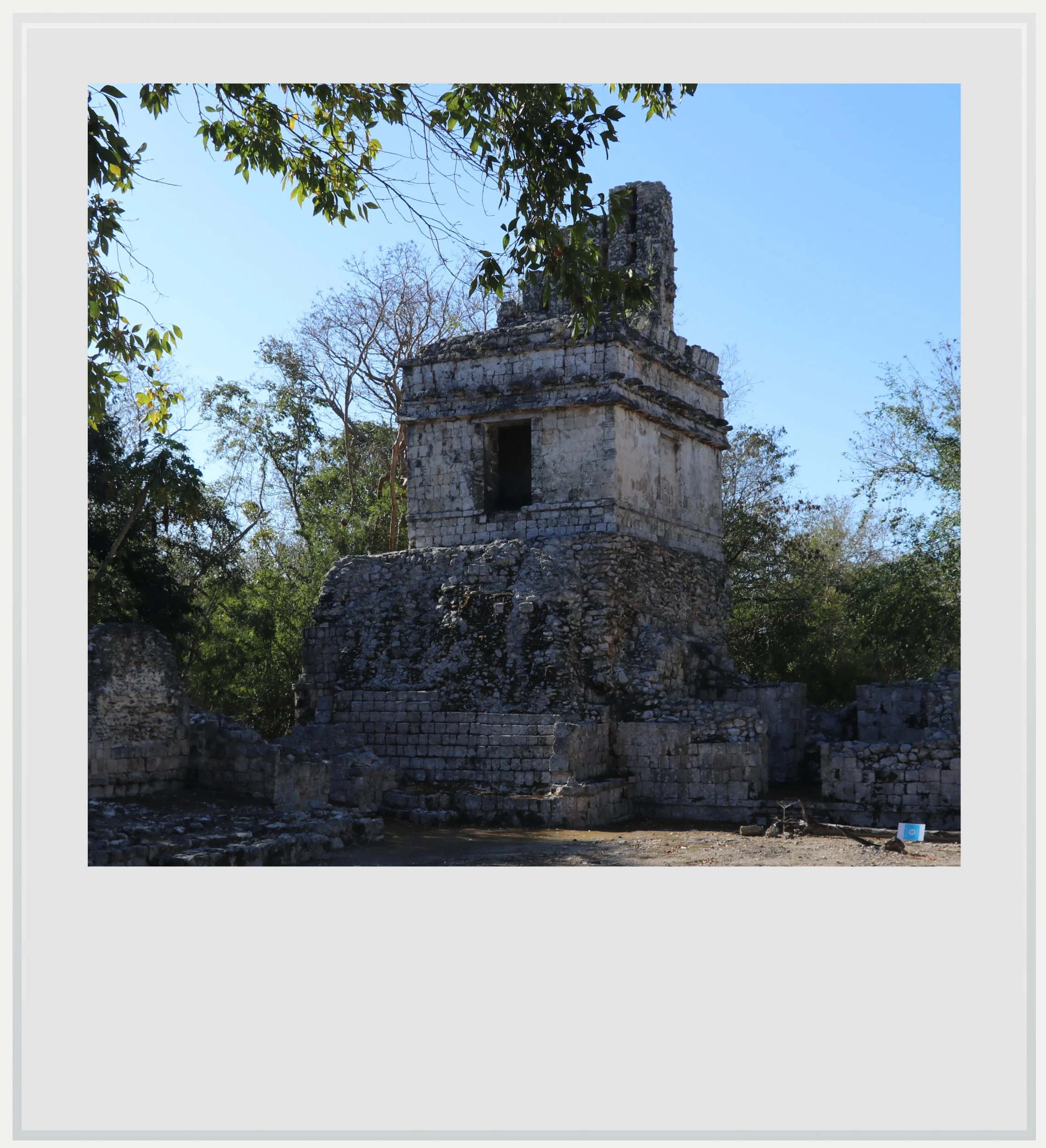
Building 5.
Food & lodging near Hochob
Although I initially wanted to make Dzibalchen my rest stop to visit the Chenes region (which not only includes Hochob but also the Dzibilnocac and El Tabasqueño Maya sites), I wasn’t able to find accommodation there, whether hotel or Airbnb. Instead, I stayed in Hopelchen, about 40 minutes north.
Hotels in Hopelchen (near Dzibalchen)
I wasn’t exactly wowed by the hotel options in Hopelchen. The central hotel Los Arcos, on the main square, has very mediocre Google reviews, and the two best rated hotels, Hotel Lemar and Hotel Jaguar, were located on the main road which saw noisy traffic, so I didn’t think they were good options for a restful night. In addition, they weren’t available to book on global platforms. Instead, I chose this Airbnb which, at the time of research, was the only one in Hopelchen, and which was absolutely fine (super clean, modern if a little sparse, but perfect for a peaceful night’s sleep) except for the loquacious gobblers in a nearby garden. Cost was around USD 70 for a night.
Restaurants
I didn’t eat in Dzibalchen as my plan called for a day trip from Hopelchen. There were very few restaurants available in town, and a bakery that only opened late afternoon. You will find abarrotes, small stores selling basic necessities, cold drinks and snacks to tie you over, but I preferred my options in Hopelchen, even if that meant having lunch Mexican-style, around 4pm.
In Hopelchen, my go-to restaurant was La Palapa, well-rated and clean although fairly basic. Food was really good and portions generous, but of course, don’t expect sophisticated fare or service. I paid about USD 15 for a meal and a liter of fresh pineapple and chaya juice, which was delicious. The restaurant has free WiFi, which was extremely helpful as Telcel service (the only cell network in the area) was down on my first day in town.
Keep in mind these travel tips
The Yucatan peninsula is one of the safest regions in Mexico, and its main roads are well maintained - although that is definitely not the case for secondary roads, where you have to drive with extreme caution to avoid treacherous potholes. No matter what road you’re on, do not forget the #1 driving advice in Mexico: do not drive at night. This is especially relevant for this remote area of the state of Campeche. Driving at night, on poorly maintained roads means you won’t see the motorcycles without lights, the crazy-deep potholes and the ubiquitous topes, these notoriously hard speed bumps that seem to spring out of nowhere. You may encounter wildlife or, more prosaically street dogs crossing right in front of you. Plan your itinerary to be at your next destination before nightfall. It’s critical, and was a key criteria in how I built my itinerary around the region.
No matter the season, there will be bugs in Yucatan. While you may only see the gigantic Tarántula Yucateca spider on the roads leading to Calakmul, you’ll find mosquitoes pretty much everywhere, and especially in the shaded forests surrounding the Maya ruins. Be ready with repellent at any time of the day. It’s also a good idea to wear clothes that cover your limbs (pants, high socks, long sleeve T-shirts) while you’re in the jungle. Wear sturdy shoes. You’ll need it in some of the archeological zones, but I also saw a few snakes, and although they fled when they saw me approach, it’s better to be safe than sorry.
SPF will be your best friend. The UV index may be low in the morning and evening, but during the day, it gets pretty high.
Do not forget to hydrate. While OXXOs aren’t as ubiquitous in this rural region than in other ones, you’ll find plenty of abarrotes, these tiny stores selling cold water and sodas along the way. Make sure you always have water handy and drink to make the heat more bearable.
Cell service is very spotty at best in rural Campeche, with Telcel the only provider with decent service in some places (but service happened to be down one of the days I was in Hopelchen, so plan for this by downloading offline maps in Google Maps and knowing where your key stops of the day are) . If you’re roaming, check that you can roam on Telcel, or investigate a Mexican eSIM that uses this network.
Every photo’s legend will appear if you hover over it (on a computer) or click on it (on a smartphone).
All photos are mine and copyrighted except 3rd photo down (Hochob temple replica in Mexico City): credits to M. Sobreira via Alamy.