Across the Sierra de las Cruces: Riding Mexico’s Insurgente Train.
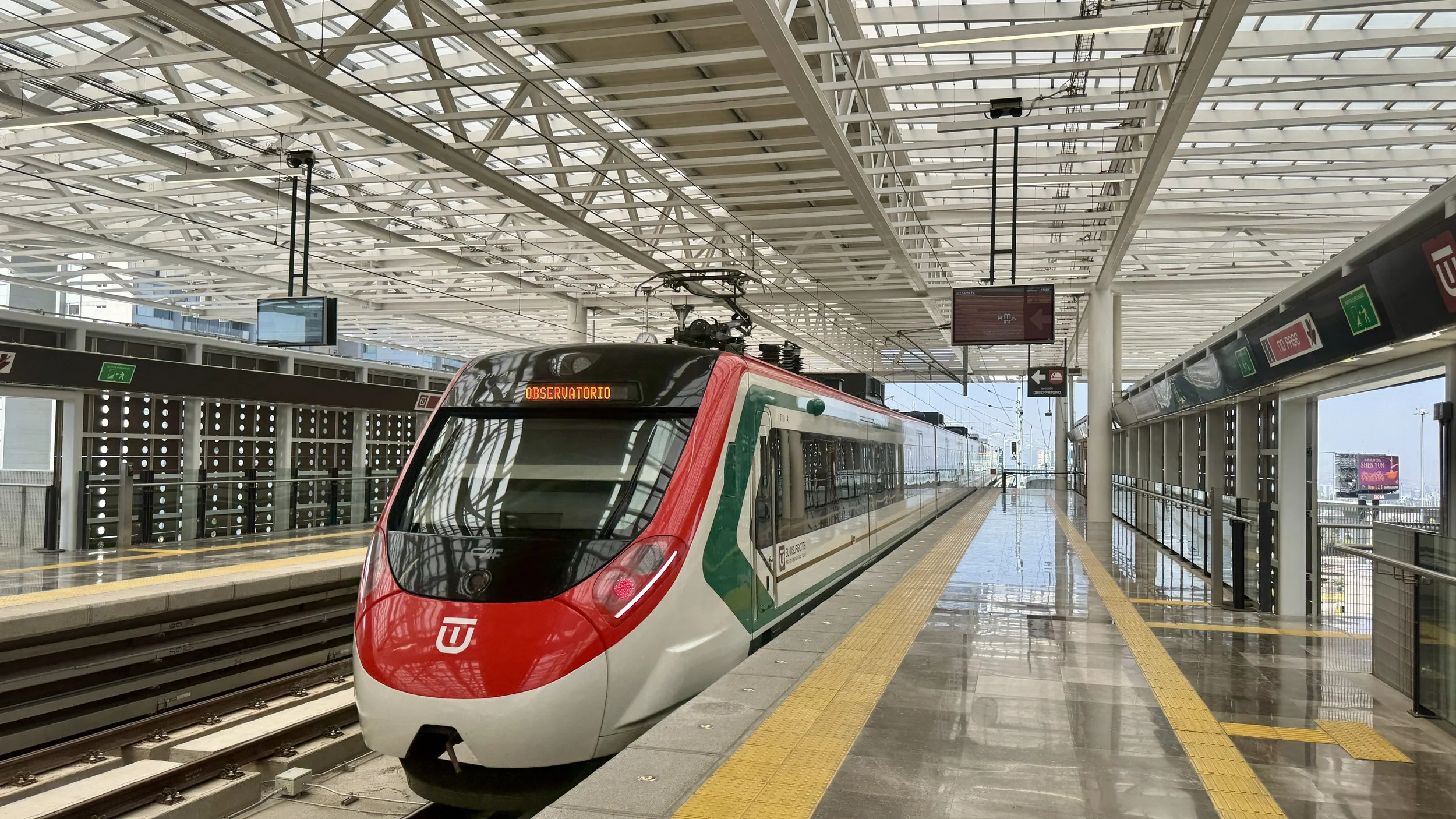
Reshaping the connection between two urban worlds across a mountain divide.
Looking for concrete details and tips? Go straight to the Practical Information section.
It was pitch black in the tunnel dug under the Sierra de las Cruces, separating the valleys of Mexico and Toluca. We had left behind Santa Fe, a busy business district in Mexico City filled with glass-clad high-rises.
Suddenly, the train emerged from darkness into a lush alpine valley that couldn’t have been more different: green meadows, surrounded by dense pine forest and dotted with mountain chalets stretched in every direction. Mexico City felt so far away.
I had left the Observatorio terminal aboard the new Insurgente commuter train about twenty minutes earlier, on a one-hour journey that would bring me to Toluca. The capital of the state of Mexico and an important industrial center, Toluca and its suburbs are also home to tens of thousands of daily commuters going to the federal capital for work.
Up until a few weeks ago, the only way to reach the center of Mexico City was by road, whether in a private car or on one of the many buses linking the two cities daily. During peak time, it wasn’t unusual for the trip to last over two hours.
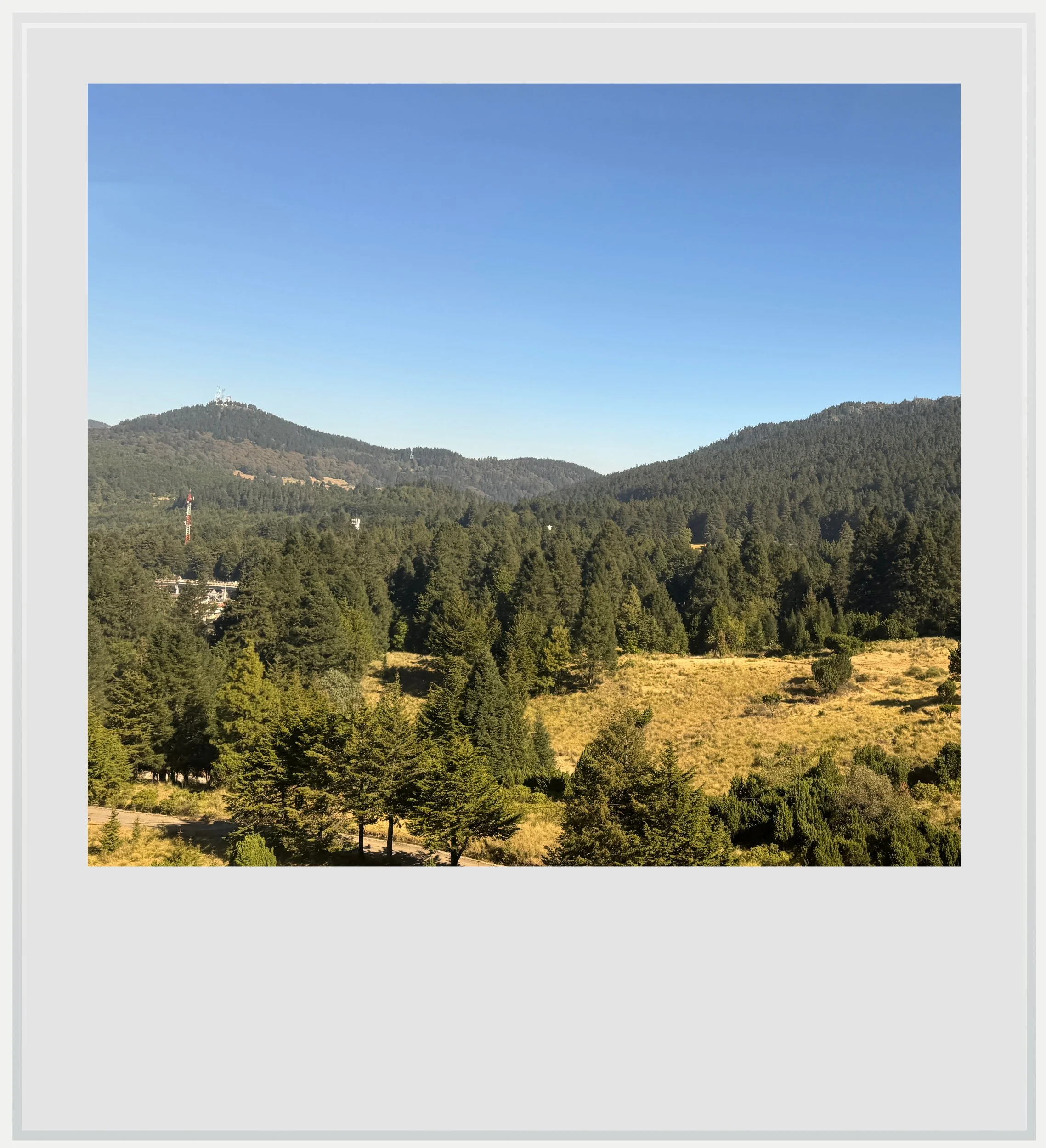
The scenery past the Sierra de las Cruces tunnel, on the way to Toluca.
Plans for a train were initially drafted in the early 2010s by then President Peña Nieto, and more than ten years later, the rail link between Toluca and Mexico City became reality.
The Insurgente train (the Insurgent, in English) is heavy in symbols. It was named after Miguel Hidalgo, the main hero of Mexican independence, who walked towards Mexico City from Toluca in October 1810, and won a decisive battle at the Monte de las Cruces.
Yet on social media, many Mexicans gravitated towards another symbol: the idea of a country capable of building modern, efficient rail lines that wouldn’t look out of place in a developed nation. That sense of pride was notable on television as well where, from the anchors to the interviewees, everyone agreed this train would show the world what Mexico could do.
There is a lot to be proud of in the Tren Insurgente. Although only 36 miles long (58 km), the line snakes through some pretty challenging terrain, from the canyons of Mexico City to the Sierra de las Cruces, the high altitude mountain range marking the natural boundary between the Toluca and Mexico valleys. In fact, almost none of the line was built at grade, and some of the viaducts and bridges one can glimpse at while the train zigzags along the mountains are quite impressive.
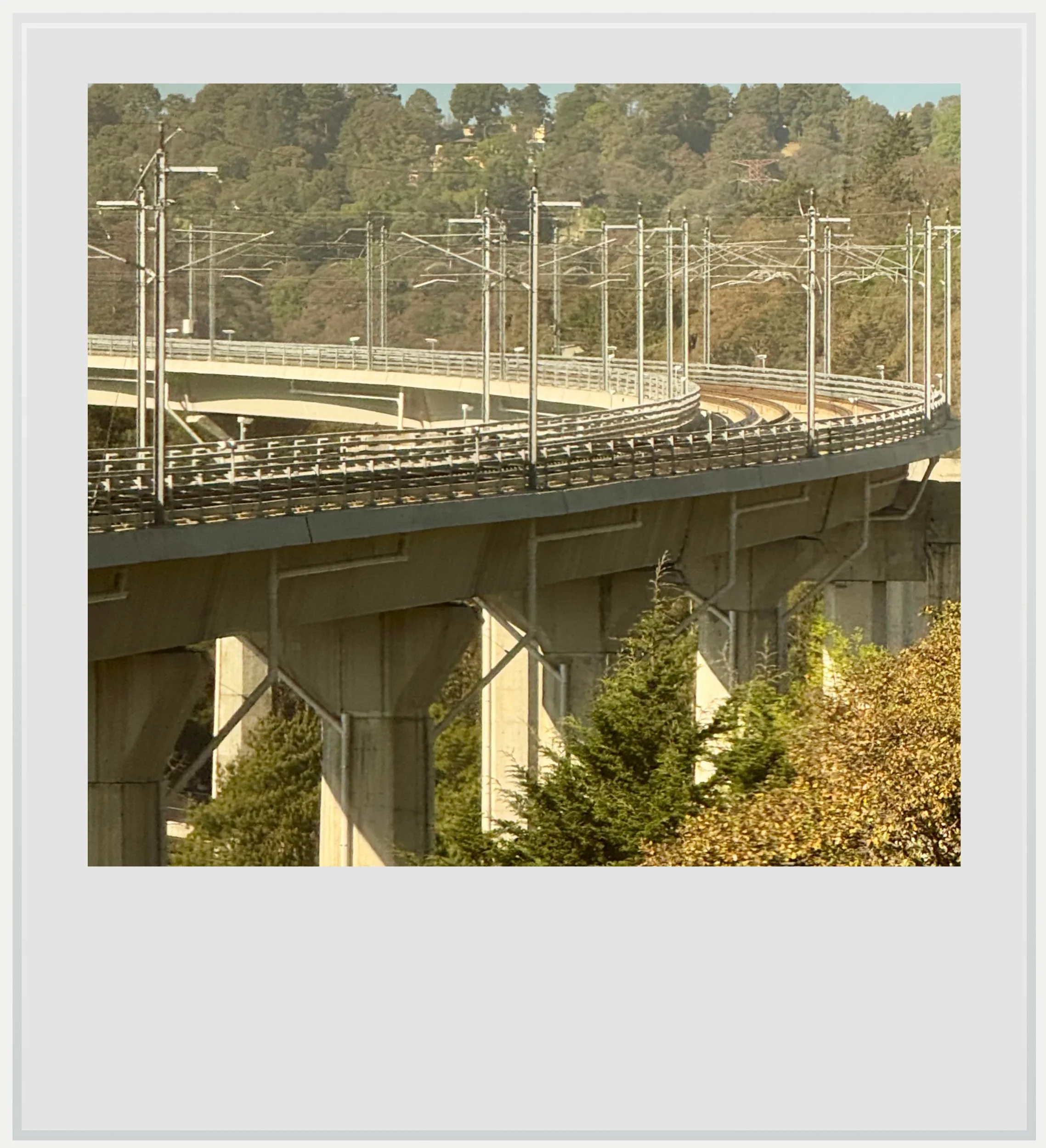
A viaduct near the Santa Fe station.
The newest section of the line is its eastern end: the segment between Observatorio and Santa Fe, inaugurated on February 2, 2026. The rest of the line, the section linking Zinacantepec to Santa Fe has been opened since August 2024. That last section was the most strategic, notably because it would be the first train service between Mexico City’s core and the Santa Fe area, but also because it would enable easy connections from the valley of Toluca into Mexico City, via the interchange station at Observatorio, where the Insurgente train terminates. Direct subway service to the heart of Mexico City is available via line 1, and work is currently being done to lengthen subway line 12 to Observatorio, to enable easier trips towards the southern part of the city as well.
In other words, the opening of the last section of the line enabled easier, faster trips into the capital for people in the Toluca Valley. Where a bus trip could last two hours, the train now takes less than one, no matter what time of day, with service every 10 to 15 minutes. It’s hard to imagine a bigger change to Toluca commuters than saving them two hours of travel time every day.
The train emerged from darkness into a lush alpine valley.
Another sign of the leap taken by Mexico in rail construction - as this project is one of many others recently executed, like the Maya train, or in the works, like the Mexico-Querétaro passenger line - the new Observatorio train terminal sits right next to the Observatorio bus station where buses to and from Toluca depart and arrive. Small and showing its age, the bus station seems like it has given up trying next to its airy and modern, brand new neighbor.
These thoughts weren’t on my mind as I was sitting on the train, watching the scenery go by. My 9.28am service was far from full - I would say about a third of the seats were occupied, which didn’t surprise me. Most commuters come from Toluca in the morning and leave Mexico City in the evening, and my reverse travel pattern allowed for ample personal space. Not that I could spread - like a cherished new proof of Mexico’s modernity, the whole train line is heavily monitored and cared for. Security personnel usher you to the right escalator, check your tickets and, on the train, regularly pass by to remind people not to eat or to put backpacks on an empty seat.
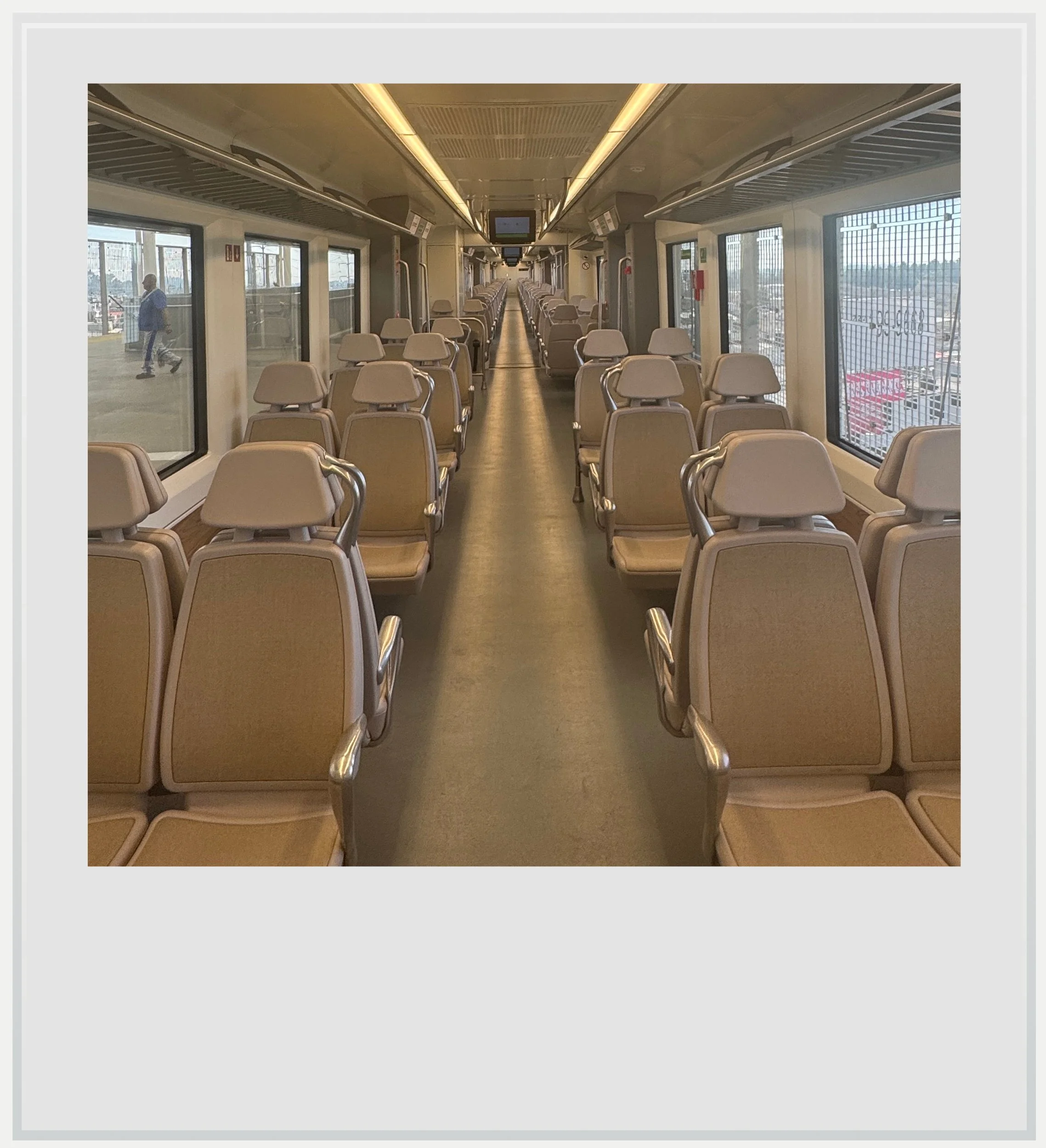
Seating inside the Insurgente train.
The train interior was very pleasant, if blandly so. Large windows let a lot of light in, and the light beige fabric of the seats plus the pristine white of the car walls made the train bright and airy. I could have used a little more padding on the seat (or to be fair, even just some padding at all). I had to remind myself, however, this wasn’t the Orient Express but rather a suburban train made for short trips.
That the train wasn’t full participated in making the journey enjoyable, but even when someone sat in front of me in Lerma, the first station in the valley of Toluca, it never felt like I didn’t have enough personal space, owing, I assumed, to the rather generous seat pitch.
Each train set consists of 5 cars with open gangways, accommodating up to 719 passengers, with 326 seated. Trains can be coupled to bring additional capacity, which doesn’t seem necessary yet, though all platforms are long enough to accept double train sets.
Platforms and trains were squeaky clean, and staff at work everywhere - on the platforms and on the trains as soon as the doors opened at the final station. Absent were street vendors in the stations and sellers aboard trains, unlike on the subway. Instead, passengers were treated to -somewhat loud- ambient music as the train effortlessly rode through the landscape.
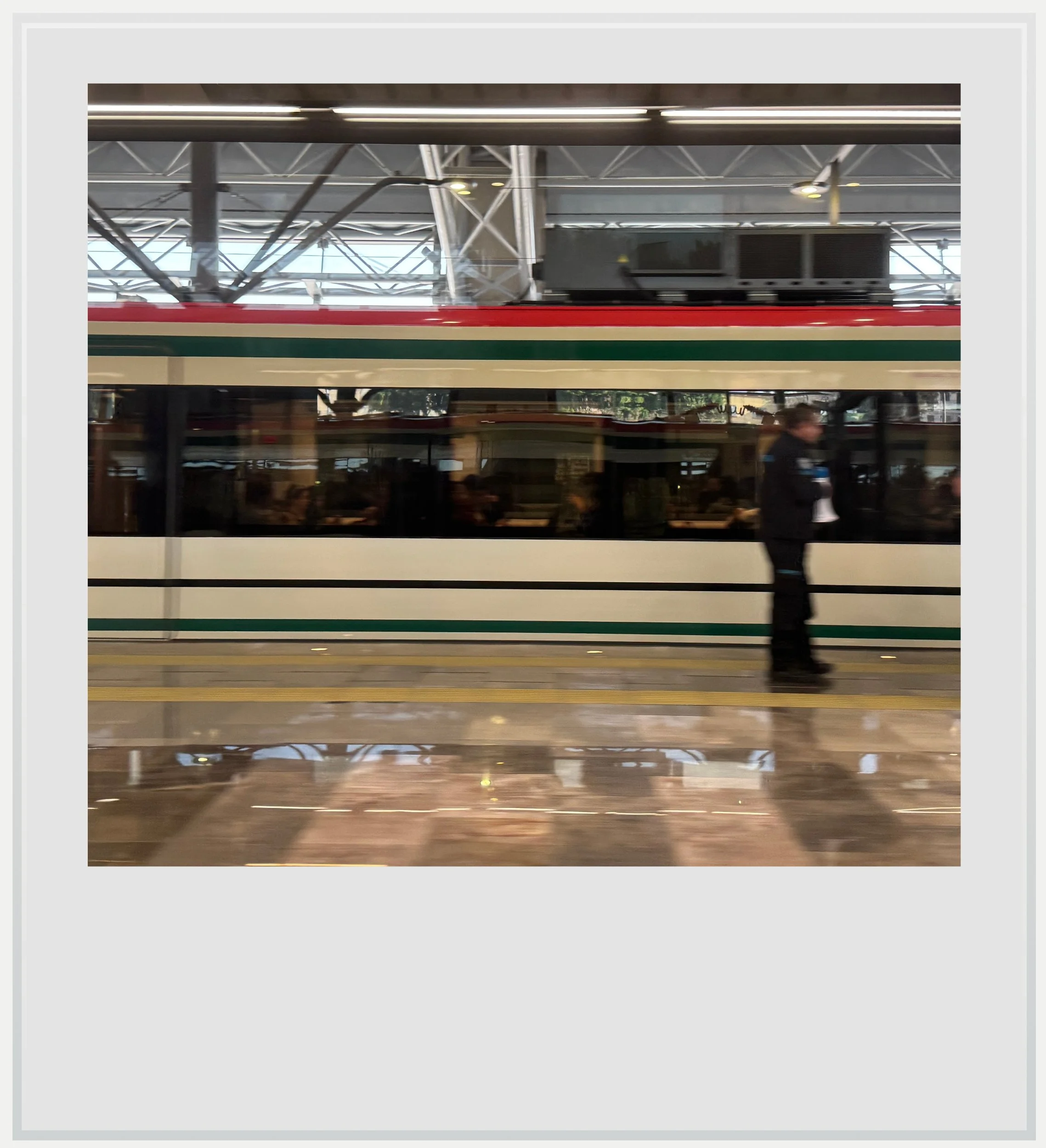
Arriving in Observatorio, the terminus on the Mexico City side.
When I boarded the train, I admit I wasn’t expecting the scenery to wow me as much as it did. In my mind, this was the realm of long-haul intercity trains, where the length of the trip would allow for significant topography changes. This was a commuter line, after all.
A few minutes after leaving the Observatorio station, I realized how wrong I was. The line followed then cut through some pretty deep canyons, through parts of Mexico City I had never seen like this. It swept through Santa Fe so high above the ground that the surrounding high-rises seemed small, and so close I could practically touch them.
The line continued to ascend, twist and turn until it went deep under the Sierra de las Cruces, to exit on the other side in a verdant, Swiss-like valley that felt like it was put there to confuse tourists (“wait, are we still in Mexico?”). Very quickly after, the line started to descend towards Toluca, which could be seen from the right side of the train, far away.
On the day of my visit, the pollution level was pretty high, and the city was shrouded in a thick layer of smog, which prevented the Nevado de Toluca volcano to be visible up until we were much closer.
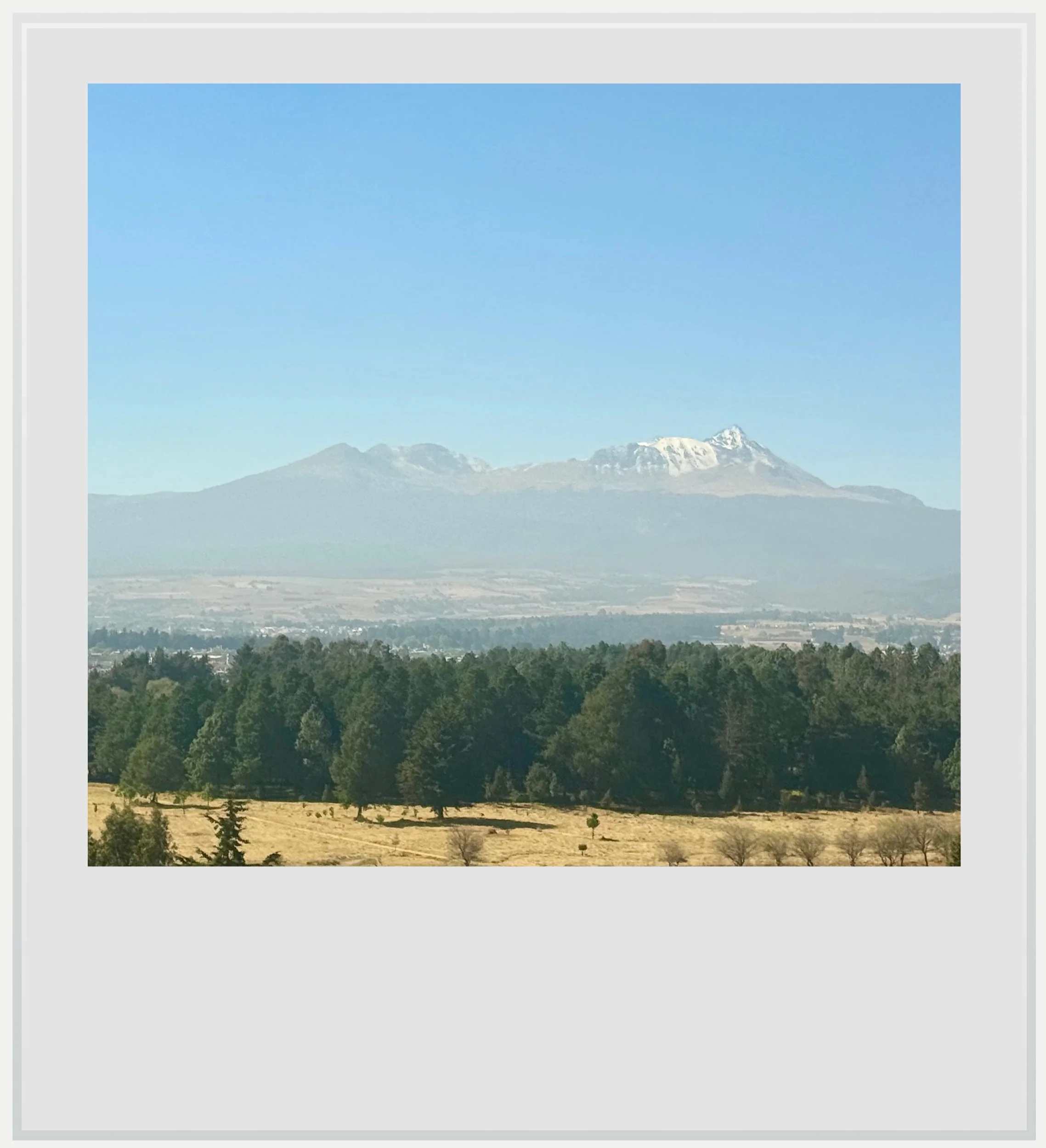
The Nevado de Toluca volcano, seen from the train.
At 15,354 feet (4,680m), its peak covered in snow, the ancient volcano towered over the valley in a way that felt much more present than the highest peak around Mexico City, the Popocatepetl.
In front of it, Toluca and its suburbs looked like a typical industrial city with traffic and haphazard architecture dominated by grey cinder block structures, that reminded me a bit of Tula de Allende, further north. Here, the train line used the right of way of a busy thoroughfare outside the city’s core - I would find out a few hours later that the city’s historic center, understated but beautifully renovated, would tell a very different story.
It swept through Santa Fe so high above the ground that the surrounding high-rises seemed small.
Most people got off the train when we stopped at the Toluca Centro station, and I was almost alone in the front car of the CAF-made train set for the last leg of the journey. I wanted to check out Toluca but I had to go to the end of the line first. About seven minutes later, our train stopped in Zinacantepec, and because I spent a little time taking photos, missed the next train going back towards Observatorio.
A few minutes later, another train came, and, after a smooth six-minute ride, I got off at Toluca, ready to explore the city.
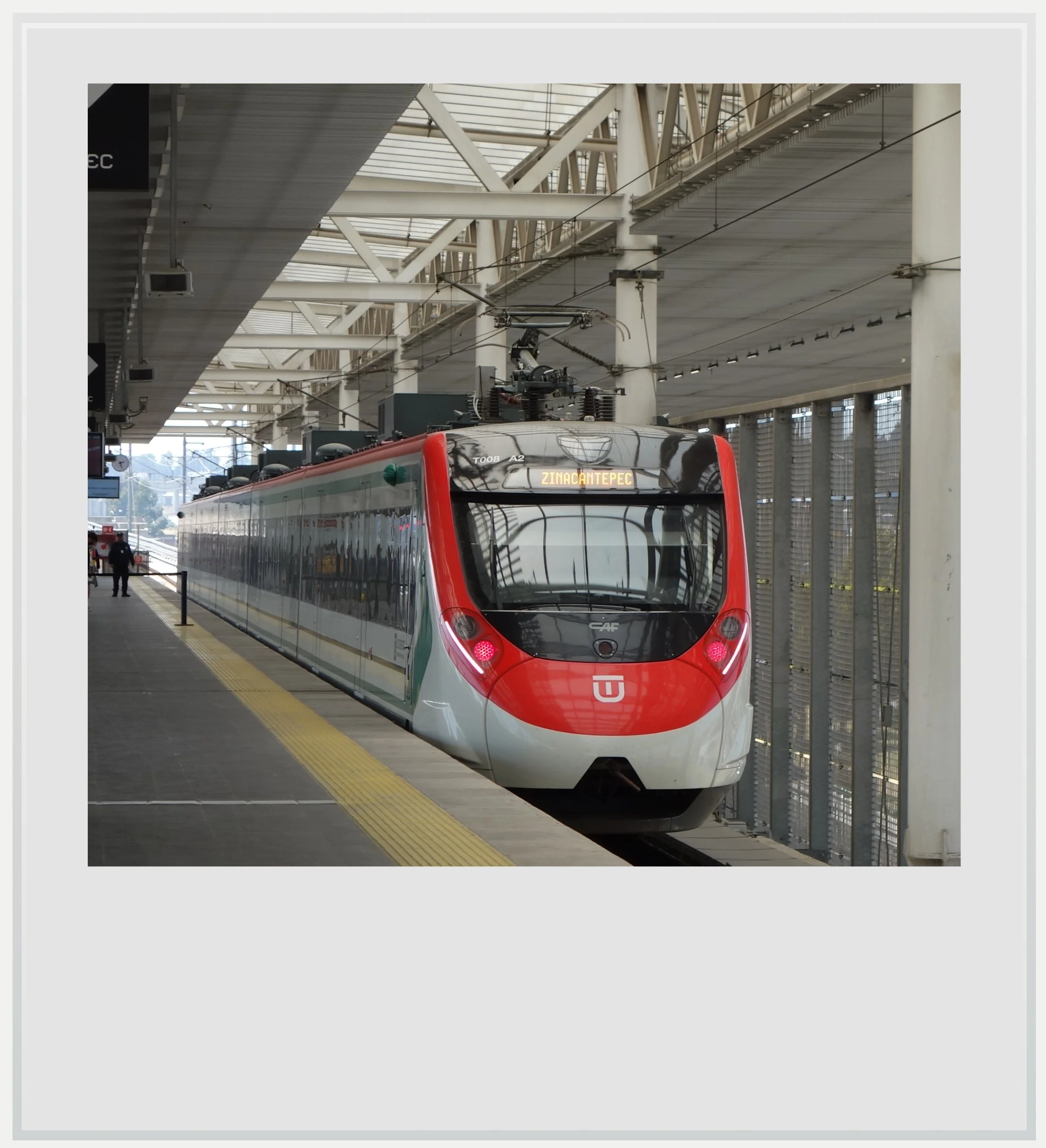
An Insurgente train set about to stop at the Toluca Centro station on its way to Zinacantepec.
On the return trip, I decided to spice it up a little bit - and by that I don’t mean just changing sides inside the train (I had picked the right side going out, and was well rewarded by beautiful scenery most of the way). I thought it could be fun to get off at Santa Fe to see the line in its urban context, where it is the most stunning architecturally.
It turned out the right side of the train wasn’t such a great choice on the way back. Given the direction of the tracks, left-side seats are more in the shade and therefore less hot. Adding to this, most of the line within the Toluca valley ran alongside a high-voltage power line to the right of the tracks going back to Mexico City, which got in the way of enjoying the landscape.
I was still able to witness the impressive ascent into the tunnel under the Sierra de las Cruces - the track grade can reach 6%, which is about three times higher than a regular line. Throughout the journey, just like in the other direction, it felt like the Insurgente was going a bit slow, and that, if given the command, it could be much faster. Even on the steepest part of the line leading to the tunnel, I never felt the train was struggling.
In fact, the Insurgente maximum speed is 56 mph in commercial service (90 km/h) when trains are technically capable of going as fast as 100 mph (160 km/h). Some parts of the line may see higher speeds at some point, as signage along the track seems to indicate a future 75 mph limit (120 km/h). I wasn’t upset by the relatively low speed - I could enjoy the stunning views for longer, but I can see daily commuters starting to wonder why the train couldn’t save them a few more minutes each way.
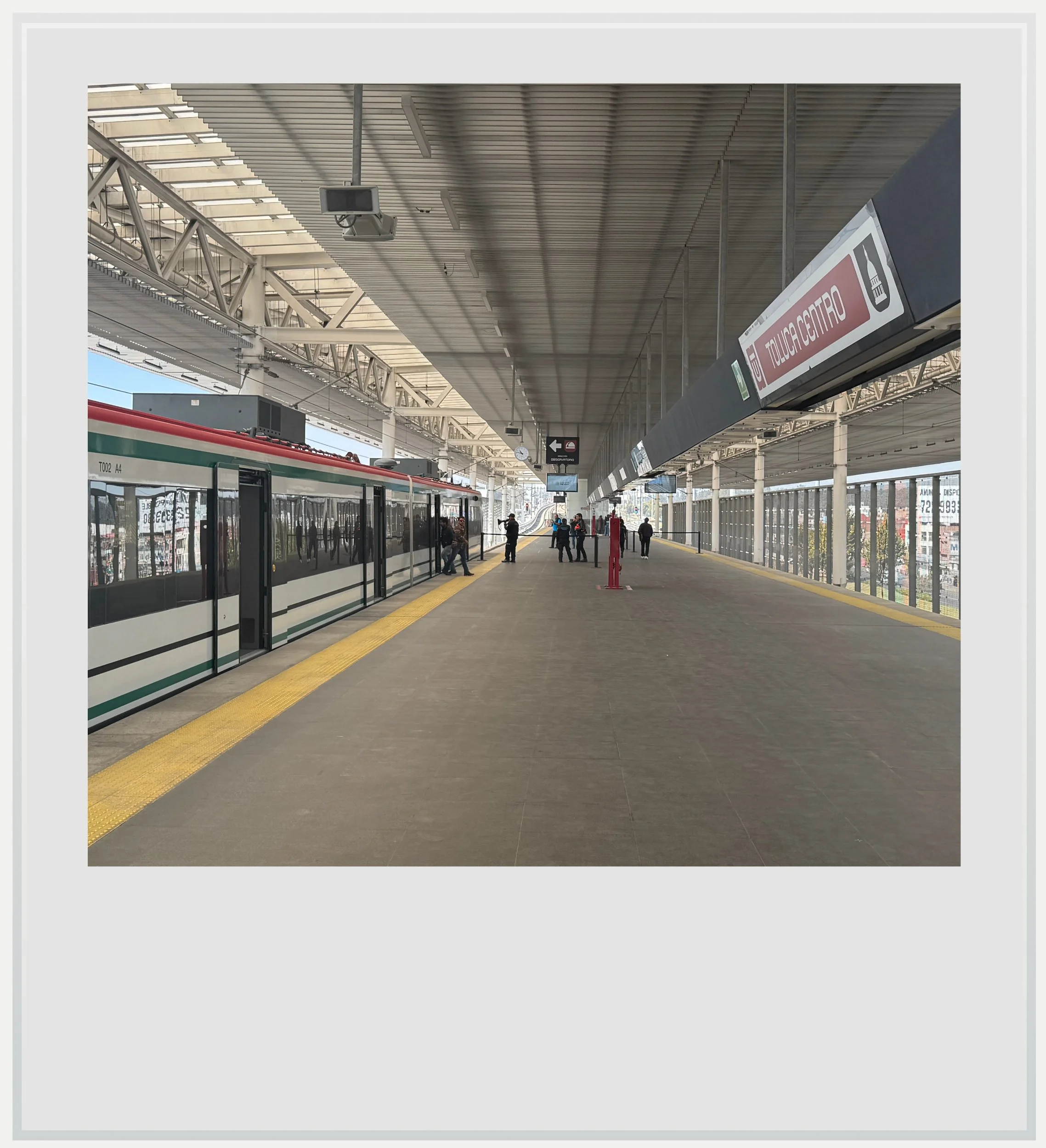
An Insurgente train towards Mexico City at Toluca Centro.
I got off at Santa Fe, where the station was built within the line’s most stunning work of engineering: a tall, sinuous double track viaduct perched high in the air that seems to defy gravity (and certainly, earthquakes, which are very frequent in the region). The modern station, all concrete, glass and metal, felt right at home among the slender glass buildings on the right side of the track, if a bit isolated.
If there is one thing I regret in how the line was planned, it’s the relative lack of connection of most stations to the urban fabric around it. Clearly, building a rail track out of nowhere in fully developed cities is expensive, but it seems like some of the stations are located far from where people want to go (Toluca Centro, Metepec) while others, smack in the middle of the urban jungle, lack convenient access to the area.
The Santa Fe station was a great example of the latter - understanding of course, that the unforgiving topography played a critical role in shaping the line. It appeared tantalizingly close to some of the nearby skyscrapers, but there was only one access point, on one side of the valley, where only infrequent buses and taxis were allowed to drop off and pick up. The only place that was relatively easy to walk to was the Santa Fe mall, six minutes away - and while this was good for the mall itself, I wondered if the station’s reach wasn’t limited by its lack of access or parking. Initial renderings of the station, courtesy of TEN Arquitectos, show a station much more integrated with its surroundings, so here’s hoping this may happen down the line.
Another example is the Vasco de Quiroga station, where the CDMX government touts an easy connection with the recently open Cablebus line #3 - yet that connection requires a 10-minute, half-mile walk to happen. This feels like another planning miss in an area of the city where dense public transit isn’t really a thing.
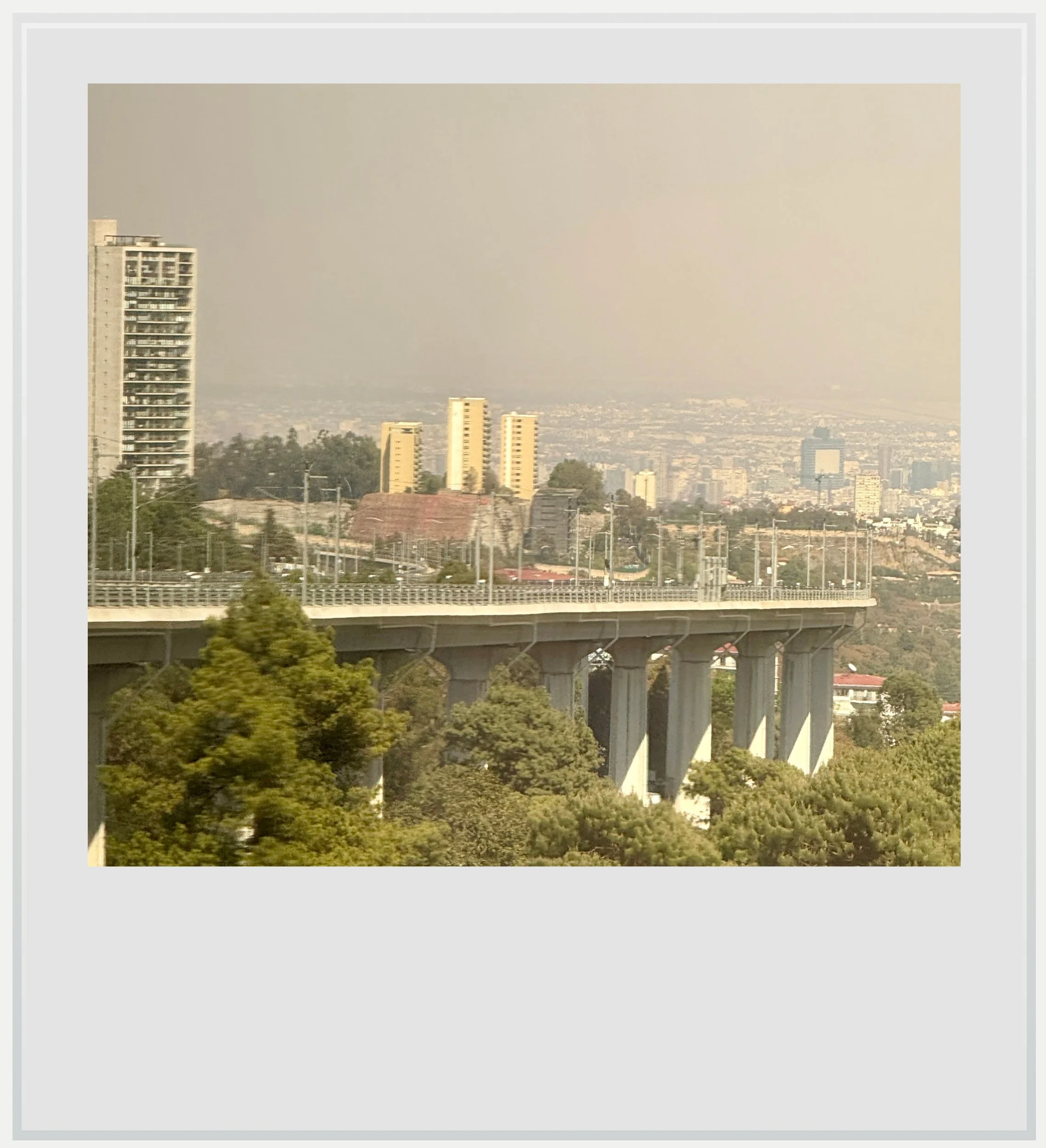
Going down towards Mexico City’s center, in the fog of a sunny February day.
Walking back to the station from the mall, I was reminded this was still very much a work in progress. The line may be fully operational, but work was still happening on the edges. Nowhere was this more obvious than in Observatorio, where the station itself wasn’t completely finished, and work was being done to connect with the line 12 of the Mexico City subway.
Despite its operational and urban-integration gaps, the Insurgente materially shortens the distance - practical and psychological - between Toluca and Mexico City. After crossing the Sierra de las Cruces, the two valleys no longer felt like separate worlds.
Practical information
(Everything you could possibly want to know about the Insurgente train - updated February 2026)
In a nutshell
A new suburban train line linking Mexico City’s Observatorio terminal to the Toluca region, the Insurgente train is both a great shortcut to the capital for Toluca commuters and a symbol of a new Mexico with developped-nation infrastructure. A feat of engineering marvel and a feast for the eyes as the train crosses mountainous terrain, it also affords visitors to Mexico City a convenient excuse to check out Toluca, the Mexican state capital, and nearby Metepec, one of Mexico’s Magical Towns.
Taking the Insurgent train from Mexico City
The head station of the Insurgente train in Mexico City is the brand new Observatorio transit hub, which is shared with subway line 1 (and, in the next few years, with line 12) and right next to the Observatorio bus terminal. From central districts of Mexico City, subway line 1 acts as the most convenient way to reach it, with easy access from the line 1 platforms to the Insurgente departure area.
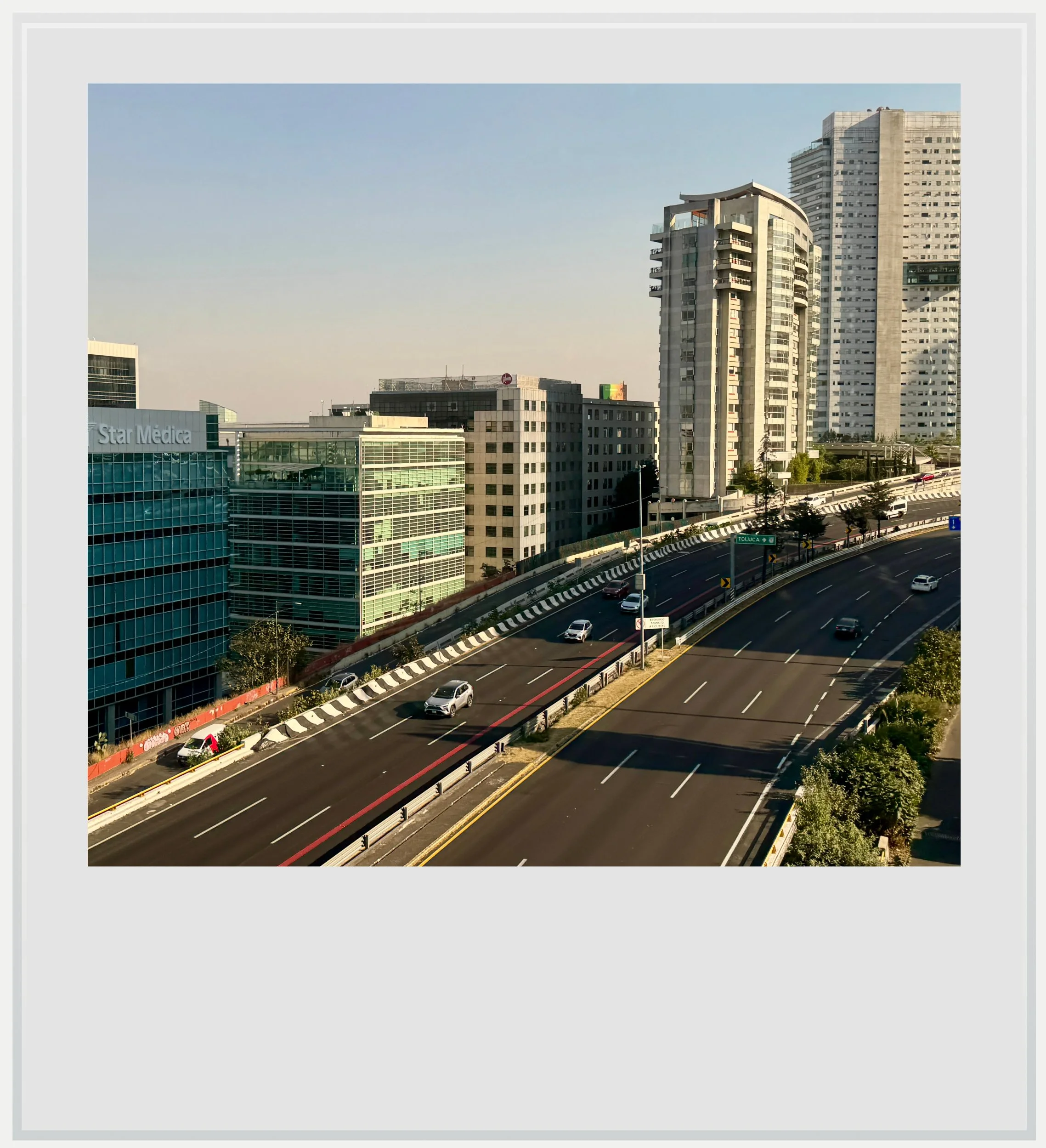
The modern urban landscape of Santa Fe from the train.
Cost and timing
The full trip from Observatorio to Zinacántepec lasts 60 minutes (take off 6 to 8 minutes if calling at Toluca Centro). The one-way ticket to Toluca Centro costs MXN 90 at time of writing (MXN 100 to Zinacántepec). Check the latest prices here.
You can pay your train fare two ways:
with the ubiquitous CDMX Mobility card, the same one used to ride the subway or Metrobus. Make sure your card balance is high enough before you get to the station as the number of ticket vending machines is fairly low compared to the flow of passengers.
with cash or credit card. The ticket machine will issue a ticket with a QR code that you need to flash at the turnstile to get in.
Note that because the fare depends on the length of your trip, you have to tap in and out of the station. When you get in using your CDMX Mobility card, the machine will only debit the minimum fare (i.e. the cost to the next station) and the balance will be taken out of your card when you tap on exit at the end of your trip (if your balance isn’t high enough, there are ticket vending machines to top up before the turnstiles). For the same reason, it is important to keep your QR-coded ticket as you’ll need it to exit the station at the end of your journey.
How frequent is the Insurgente train
Trains run every 10 minutes or so during most of the day.
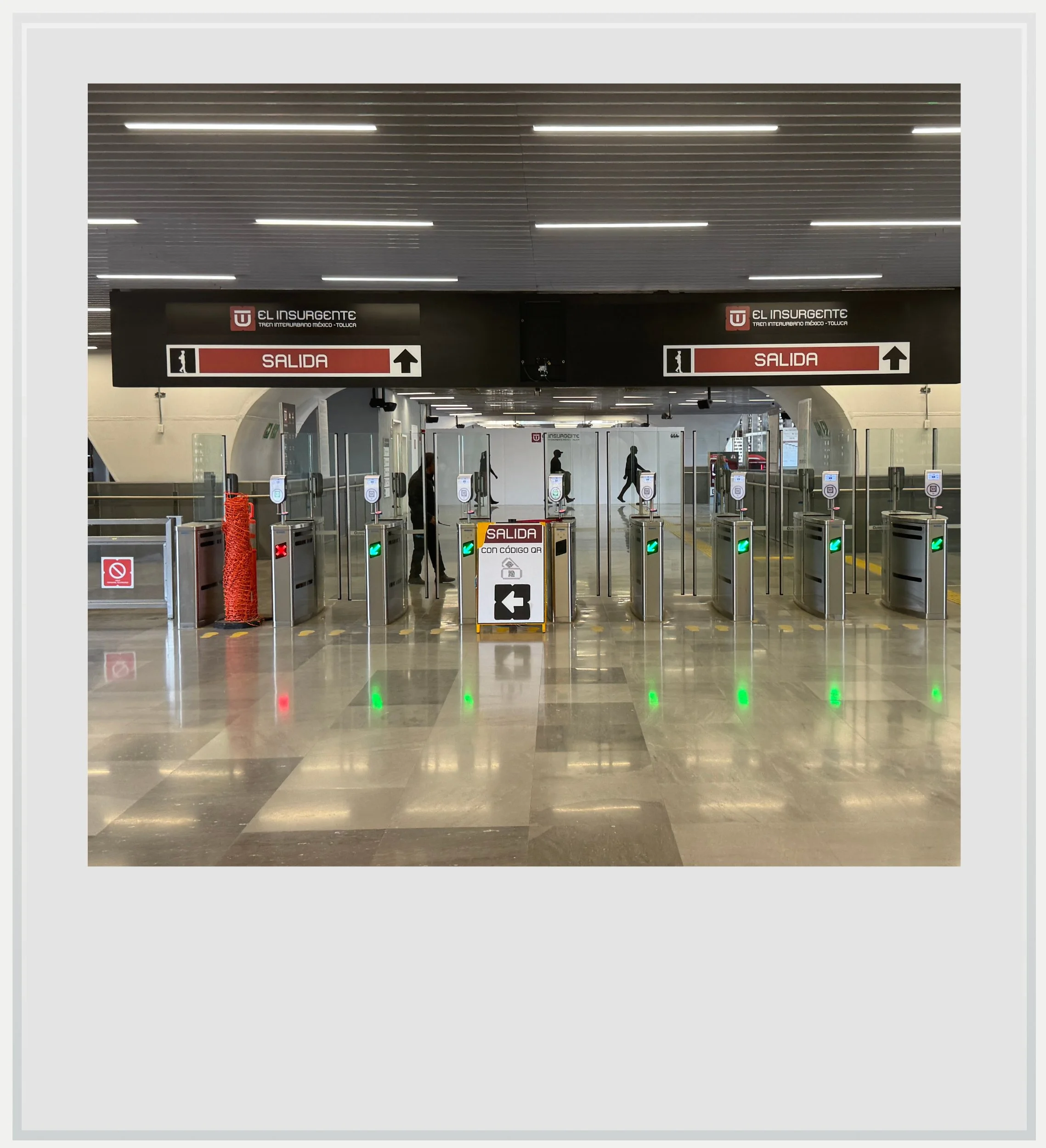
The exit turnstiles in the Observatorio terminal.
Safety on the Insurgente train
Mexico is taking safety very seriously on the train. Private safety is present into every train and walks frequently along the whole length of the train set to ensure a safe journey for everyone - as well as to remind new train commuters that bags go under your seat, not next to you, and that smoking, eating or drinking is prohibited.
Because the tight security throughout the journey, you will not see vendors on the train or on the platforms either.
What to do once in the Toluca Valley.
If you want to make more of your Insurgente train trip, Toluca and its historic center are worth a look, especially around the Cosmovitral and its Cathedral. Metepec, a pueblo mágico now swallowed by Toluca’s sprawl, can be another option as well as the massive Nevado de Toluca, which can be hiked.
Every photo’s caption will appear if you hover over it (on a computer) or click on it (on a smartphone).
All photos are mine and copyrighted.