Uxmal, Mexico.
The high point of Puuc architecture.
Looking for concrete details and tips? Go straight to the Practical Information section.
It was early morning when we reached the entrance of the Maya site of Uxmal. We had woken early to be among the first to get in, worried that, on a busy day between Christmas and New Year, the site would be crowded.
As our guide stopped us on top of a small hill, a few steps after leaving the souvenir shops area, the first building finally came into view. Basking in a soft morning light, the Pyramid of the Magician stood in front of us, majestic and imposing. I did expect a pyramid - I had seen photos, after all - but I was shocked at how different it looked from every other Maya temple I had seen before.
What made the Pyramid of the Magician feel so visually interesting was its sense of smoothness and continuity. The terraces, a key feature in Maya temples from Calakmul to Chichen Itza were there, but only became clearly visible towards the top of the building, and, with perspective, appeared compressed and softened. A staircase was there, though it barely read at first, and didn’t structure the building the way it did in major sites to the south.
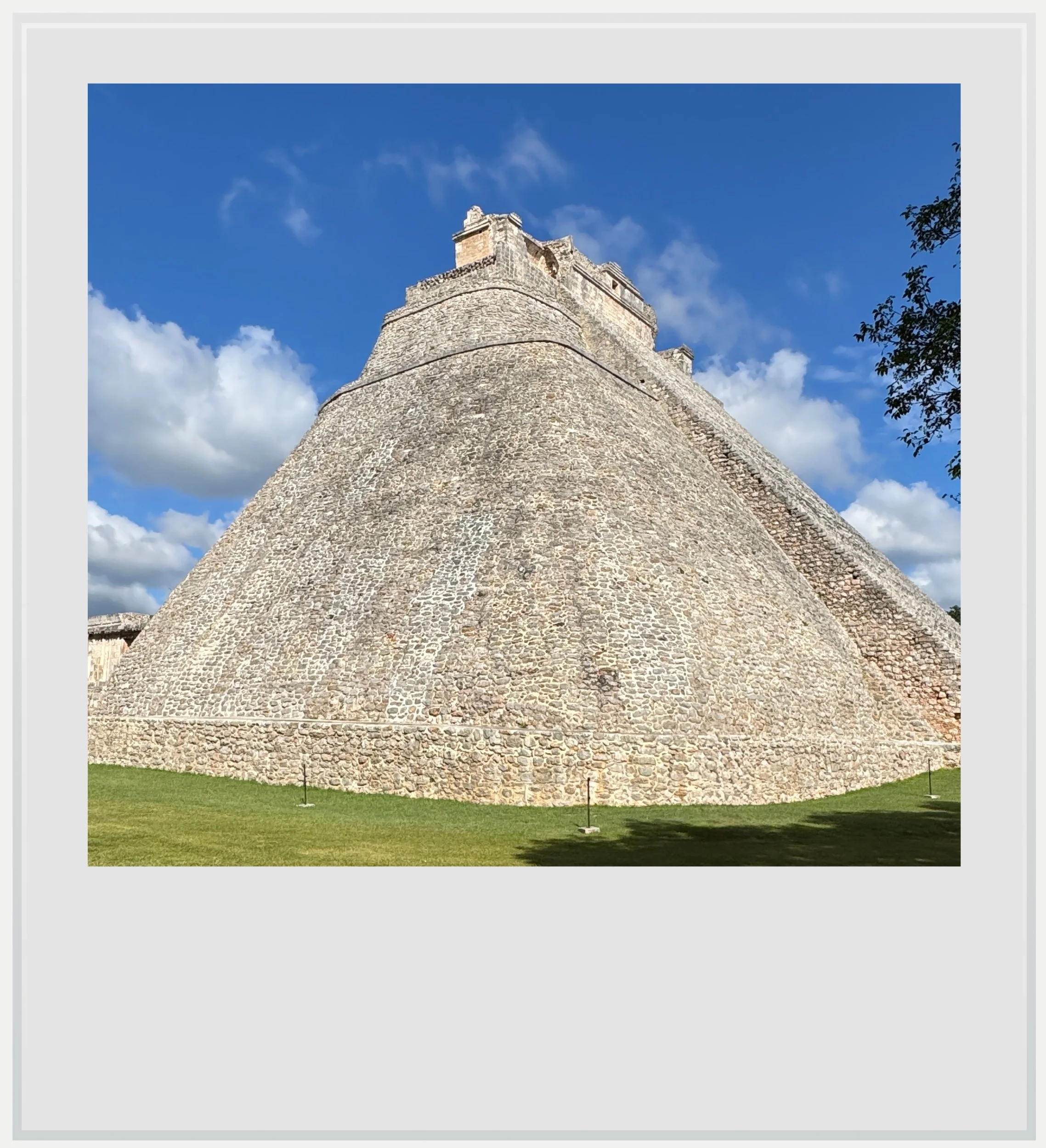
Instead of a clearly visible temple on top, we were faced with a largely closed mass, interrupted only by a relatively small doorway set high into the façade. The effect was striking: the pyramid didn’t read as a sum of layers, but as one cohesive volume, an immense and surprisingly elegant building reaching up towards the sky.
As I walked around it and discovered its back, the part where most religious ceremony likely happened, in front of the House of the Birds, I saw a more obvious execution of a grand Maya temple. The layers were more obvious, the stairs more present. It would be tempting to assume this was an earlier version of the pyramid, which we knew had been remodeled several times during its existence, but there was no definite historical proof that this was indeed the case.
In my mind, we had reached a part of the site I organically recognized. It felt more familiar, slightly reassuring, until I noticed the geometric sculptures of the rain god Chaac, adorning the sides of the main staircase all the way up to the top. While Chaac, a key deity for the Maya, was represented in other major sites, this was the first time I noticed its mask used as a geometric, repetitive pattern.
The Pyramid of the Magician which, from afar and from the back, looked more similar to other pyramids in the Maya world revealed, upon closer inspection, an interesting variation.
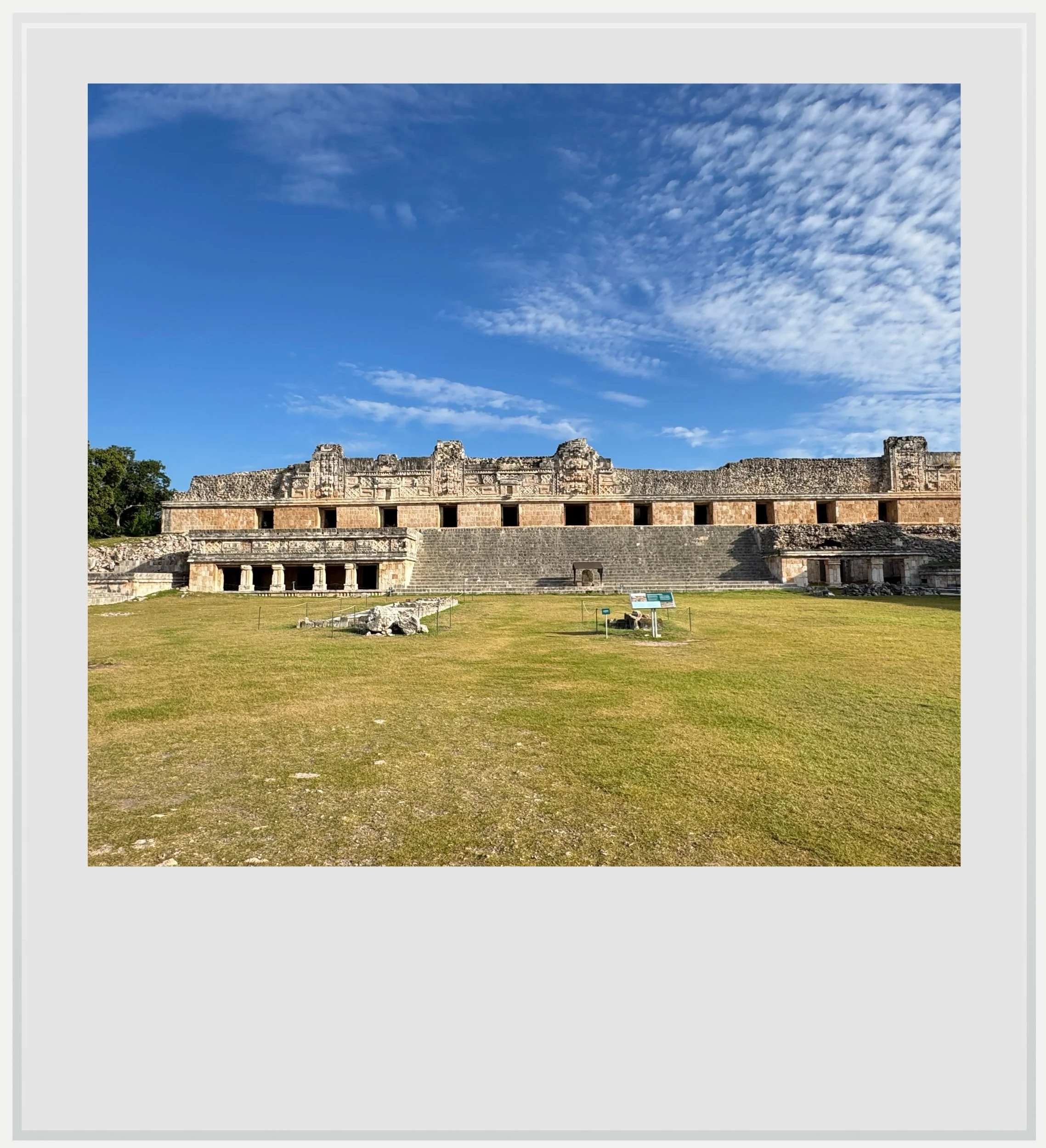
An overview of the Quadrangle of the Nuns.
This would be a revelation throughout the site of Uxmal, and why this archeological zone, a UNESCO World Heritage site, became the place where I begin to understand Maya architecture as the complex language it was. It would become obvious in the Quadrangle of the Nuns.
The Quandrangle was a misleading name for what is now thought to have been a place of governance or ceremony in the Late Classic Period (600-900 CE): it was named by the early European explorers for its resemblance to a convent. It abutted the House of the Birds and we walked to it through a narrow porch that seemed to have been designed to mirror the narrow door near the top of the Pyramid of the Magician.
Uxmal suggested a way the Maya may have seen the world.
It’s hard to overstate the effect of getting into the vast inner court within the Quadrangle. It was the first time I really felt immersed, almost enveloped in the Maya universe. It was a surreal feeling. The Quadrangle of the Nuns is where it all clicked for me.
The complex, in itself, was the perfect illustration of the idiosyncrasy of the Puuc style. The paradigm shift, there, was that visual emotion wasn’t driven by sheer stature like in Calakmul or Chichen Itza, but by perfection and repetition of design, in a way that felt quasi overwhelming.
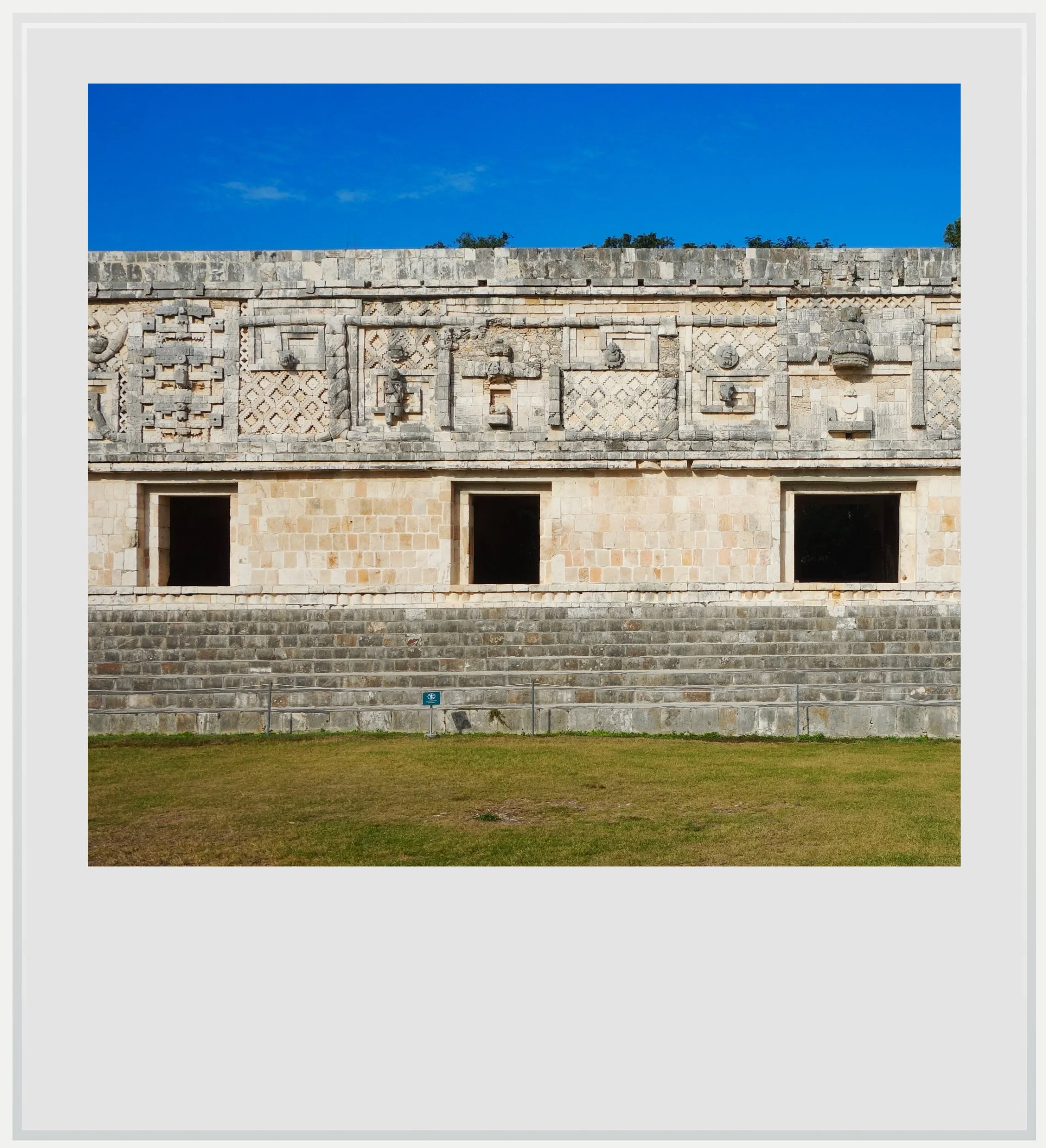
A detail of a sculpted façade in the Quadrangle of the Nuns
The buildings around the inner plaza were fairly low, at one or two stories, but they were all following the same design pattern. The lower side of each façade was smooth and quiet, while the top half was richly decorated with geometric designs. The repetition across the four sides of the square seemed to be telling a story, centered around Chaac and its many variations.
It was an extraordinary illustration of Puuc architecture, perfectly distilled in a single complex. The mastery lay in the way the buildings expressed meaning: not through mass but through surface. The amazement I felt inside the Quadrangle of the Nuns wasn’t the same as what I experienced in front of the gigantic Calakmul pyramids, where their sheer size made me feel very small. In Uxmal, in front of this sharp visual story carved on otherwise simple walls, I was left speechless.
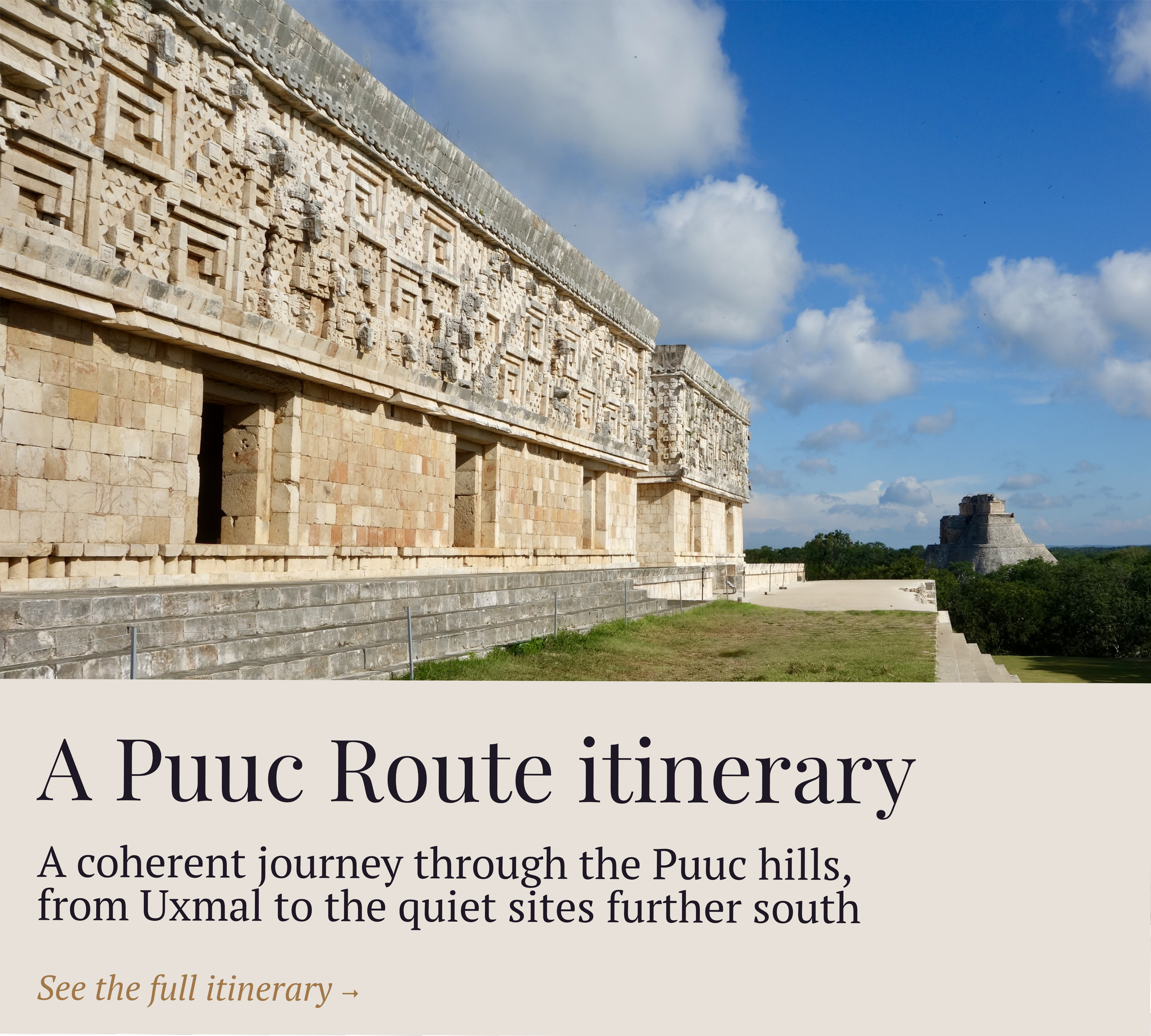
There is no single explanation for this shift from size to surface, but several factors likely contributed. The Puuc region is drier, with no permanent water sources, which made the presence of Chaac critical. The political landscape also appeared different from the southern lowlands, with fewer large-scale rivalries that would have required displays of power through massive temples. And the available stone allowed for precise cutting, enabling a different architectural language to emerge.
Uxmal suggested a way the Maya may have seen the world, the lower walls a metaphor for earth, simple and plain, and the higher façades symbolizing the sky, where gods lived and rain came from.
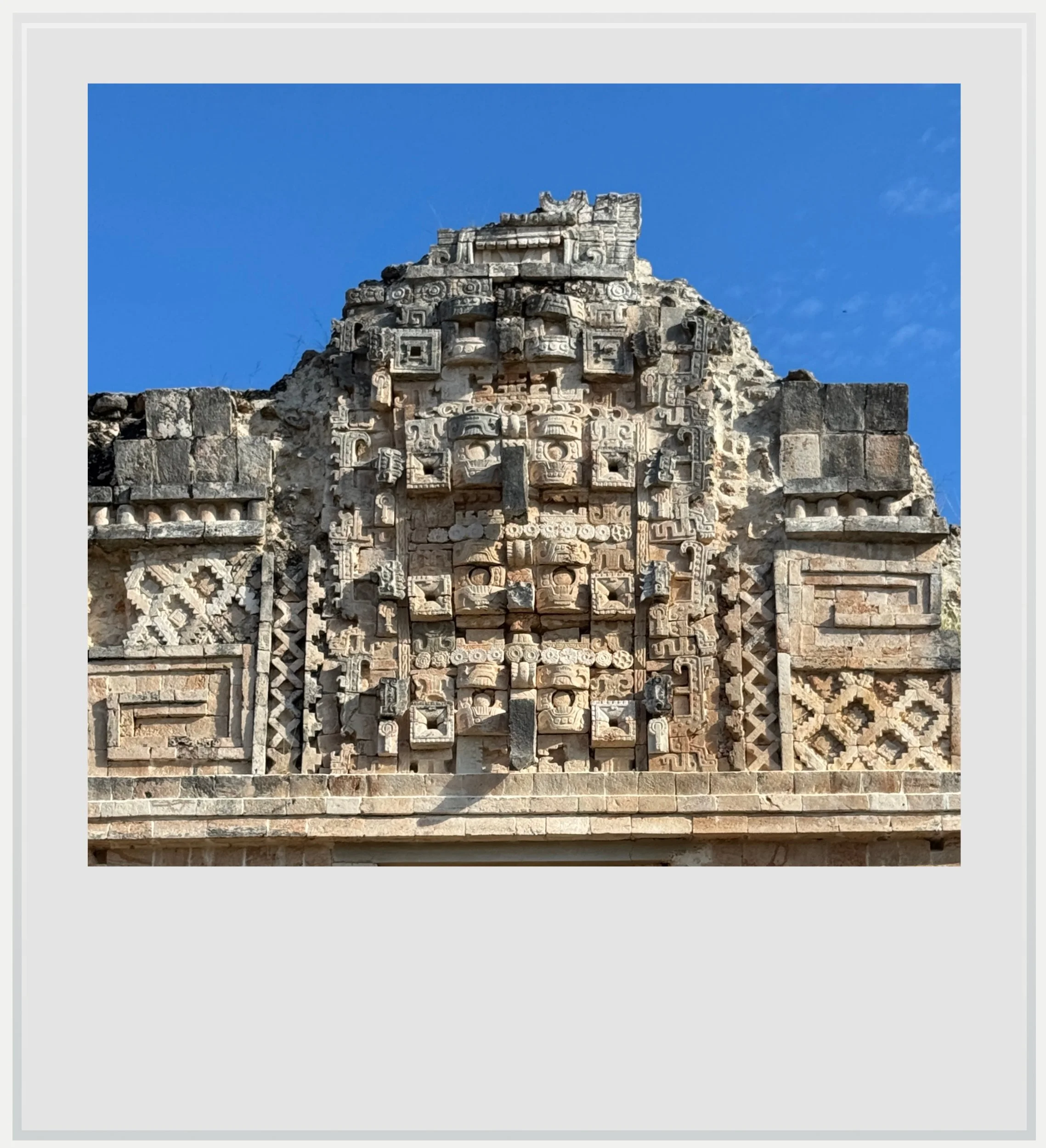
A geometric repetition of Chaac in the Quadrangle of the Nuns.
It was no wonder, then, why Chaac, the rain god, was so present in the geometric patterns adorning the upper walls of the Quadrangle of the Nuns. He played such an important role in Maya cosmology and was so relevant in the very dry Puuc region that its multiplied presence was understood as an invocation. Representing dozens of Chaac figures was a way to both pay homage and ask for rain. Repeating his likeness in perfect geometric patterns throughout the Quadrangle seemed to show that the world didn’t have to be chaotic, that it could be structured, even tamed.
There was a point where I realized our guide was still talking, but my mind had drifted off, caught by the incredible display of Maya craftsmanship in front of us. It was hard to leave this area, as if something had shifted in me, too.
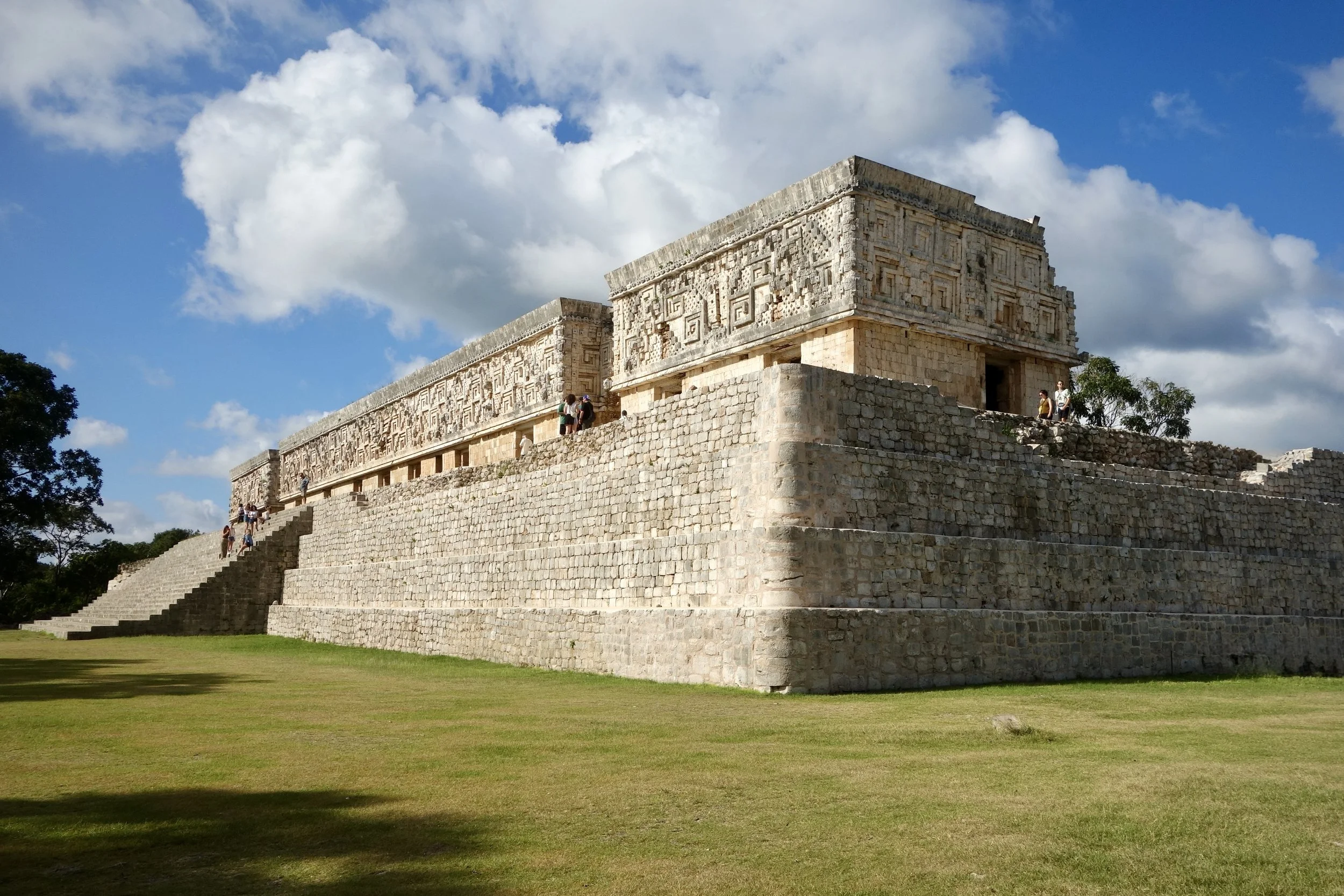
The Palace of the Governor was another highlight of our visit. Sitting on top of an artificial platform, the building seemed to dominate the whole site - the view over the the Quadrangle and the Pyramid of the Magician was, in fact, fantastic.
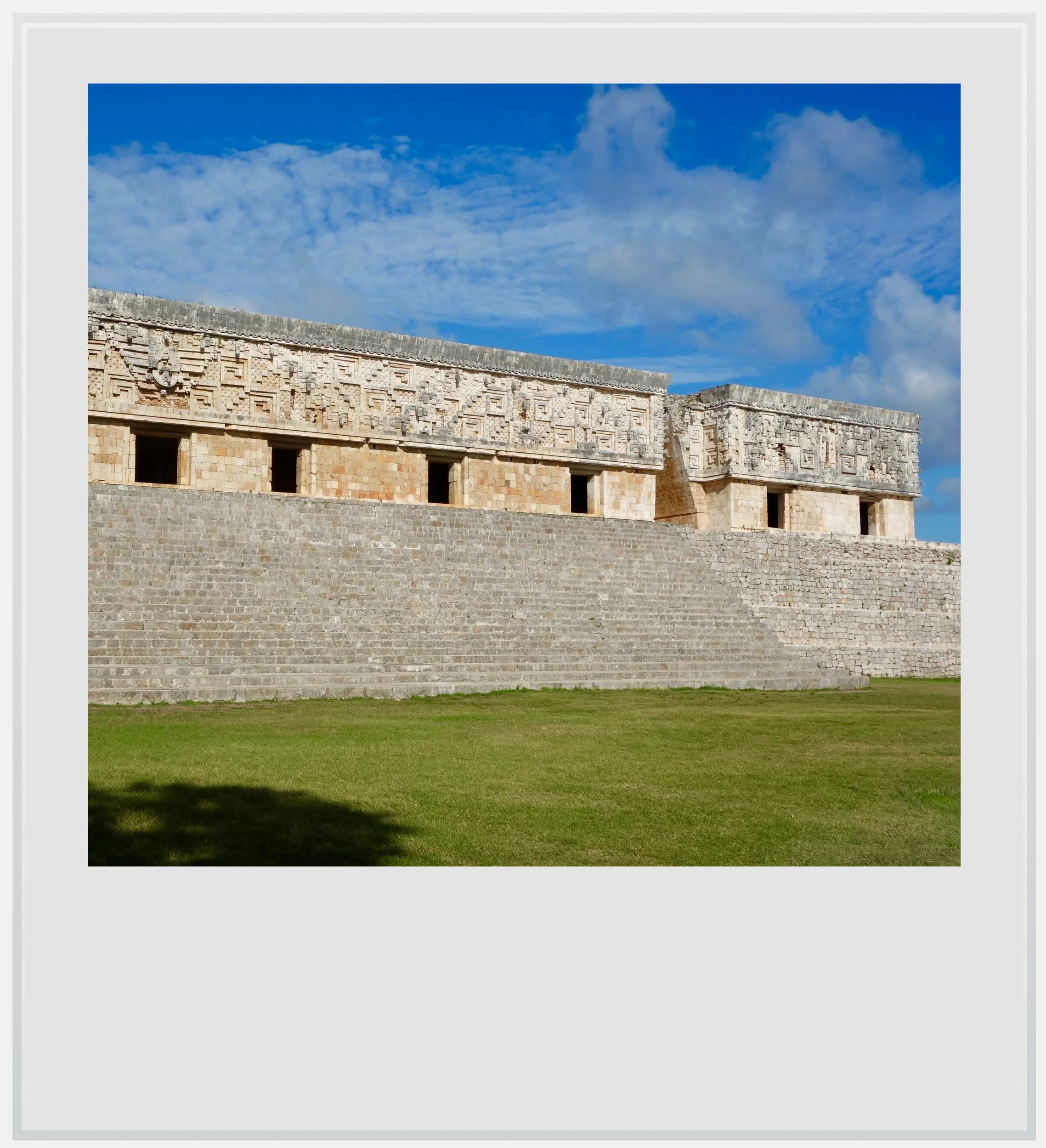
A side view of the Governor Palace.
The design logic we had seen in the Quadrangle of the Nuns carried over: the plain lower wall, the elaborately constructed upper façade, but it was handled differently. In the Quadrangle, the pattern surrounded us, immersive. Here, it stretched out. The building was set up horizontally across a vast platform, and the decoration opened outward, with a different visual rhythm. Where the Quadrangle might have sounded like a short, masterful aria on repeat, the Palace was a full movement of a symphony, expressing a more complex story.
The same elements were there, the masks of Chaac, the geometric patterns, the repetition, but they were handled differently. The façade felt more paced. Chaac was still present, but no longer everywhere all at once. He became part of a larger system, one that brought together rain, order, and authority across the length of the building.
The mastery lay in how the buildings expressed meaning through surface.
Beyond this display of design excellence, that sense of control was not limited to the façades. It extended to the site itself. From the ground, I felt that the buildings were not placed at random, that something held them together, but it was difficult to articulate. It only became clearer when our guide explained it: the Governor’s Palace, like most other buildings, wasn’t aligned arbitrarily, but oriented toward Venus, one of the most important celestial bodies in Maya cosmology. It was a different kind of order, one that is less immediately visible, but no less deliberate.
It would be tempting to read the evolution of Maya architecture styles as a progression moving north, from the massive, austere pyramids of the Peten in modern Guatemala to the elegant sculpted façades of the Puuc region, but the reality doesn’t fully align with this. Chenes architecture, seen in areas directly south of the Puuc hills, in sites like Santa Rosa Xtampak or Hochob, overlap in time with the Puuc style, and therefore didn’t precede it. In the Chenes region, the façade became an image, often a single symbolic god figure shaped as a door, a pathway to the underworld.
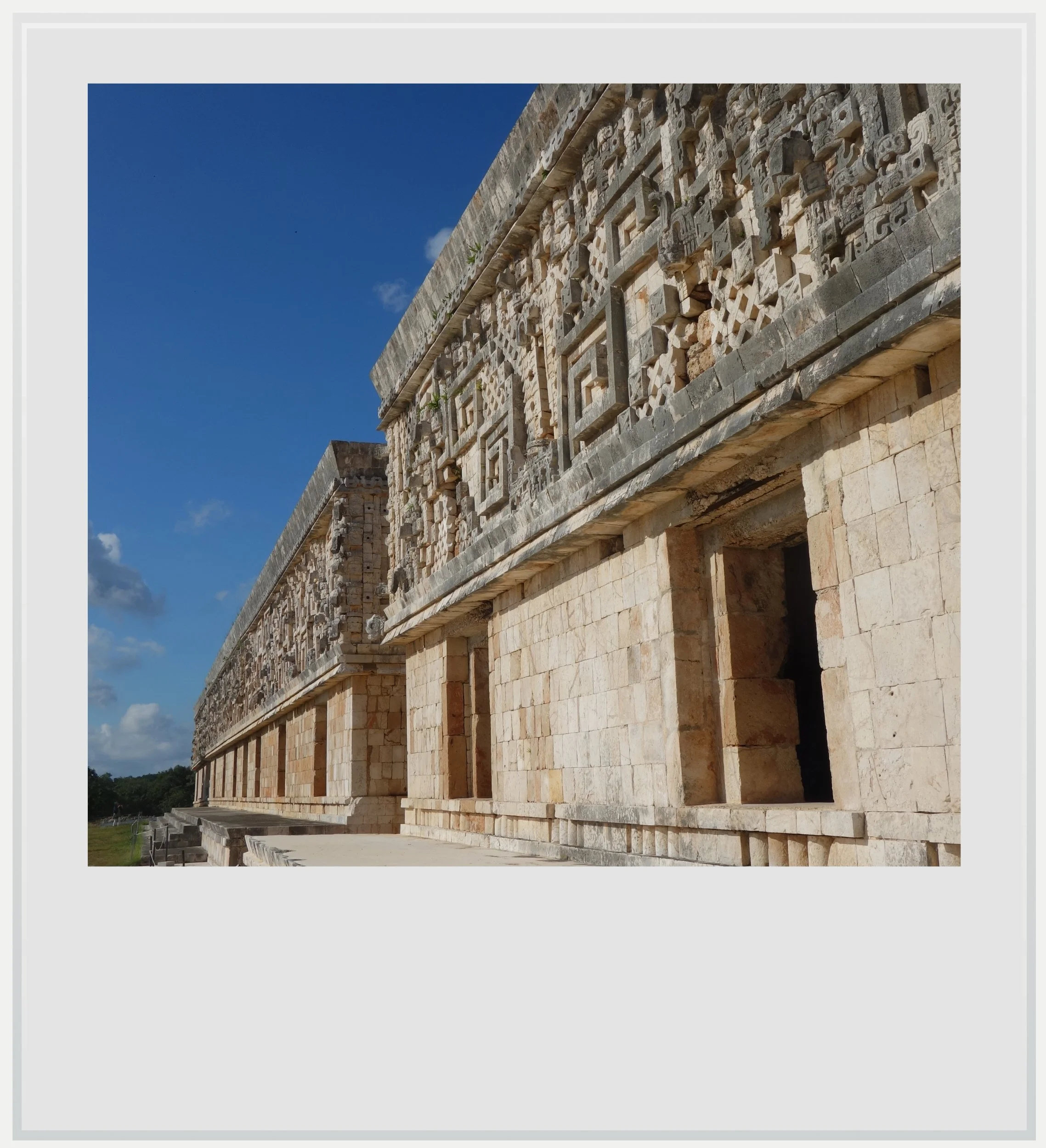
Façade detail on the Governor Palace.
In Uxmal, that logic was more abstract. The zoomorphic figure of Chenes gave way to pattern and geometric repetition. It wasn’t so much a later stage of architectural history as a different path, one that pushed the architectural surface further toward precision and control.
We left Uxmal just after 10 AM, when the site was beginning to welcome more and more tour buses, but I wished I could have stayed longer. I was drawn to this site in a way I hadn’t been by any other, and I promised myself I would go back. Looking back at that day, I know that’s when I realized the Maya world was much more complex than the (beautiful, incredible) site of Chichen Itza, and visiting it a few years before had only scratched the surface of the universe that could only be guessed from the ancient stones left behind. My Rio Bec, Chenes and Puuc visits started to all align in making sense of these complex, incredibly sophisticated societies that, millennia later, were still trying to teach us stories.
Practical information
(Everything you could possibly want to know about Uxmal - updated April 2026)
In a nutshell
Uxmal is one of the finest examples of Puuc architecture, where meaning is expressed through surface rather than sheer scale. The contrast between plain lower walls and richly decorated upper façades gives the site a distinctive visual coherence. It offers a different way of understanding how Maya architecture could express power and order. Visit time: 2 hours. Travel time from Merida: 1 hour.
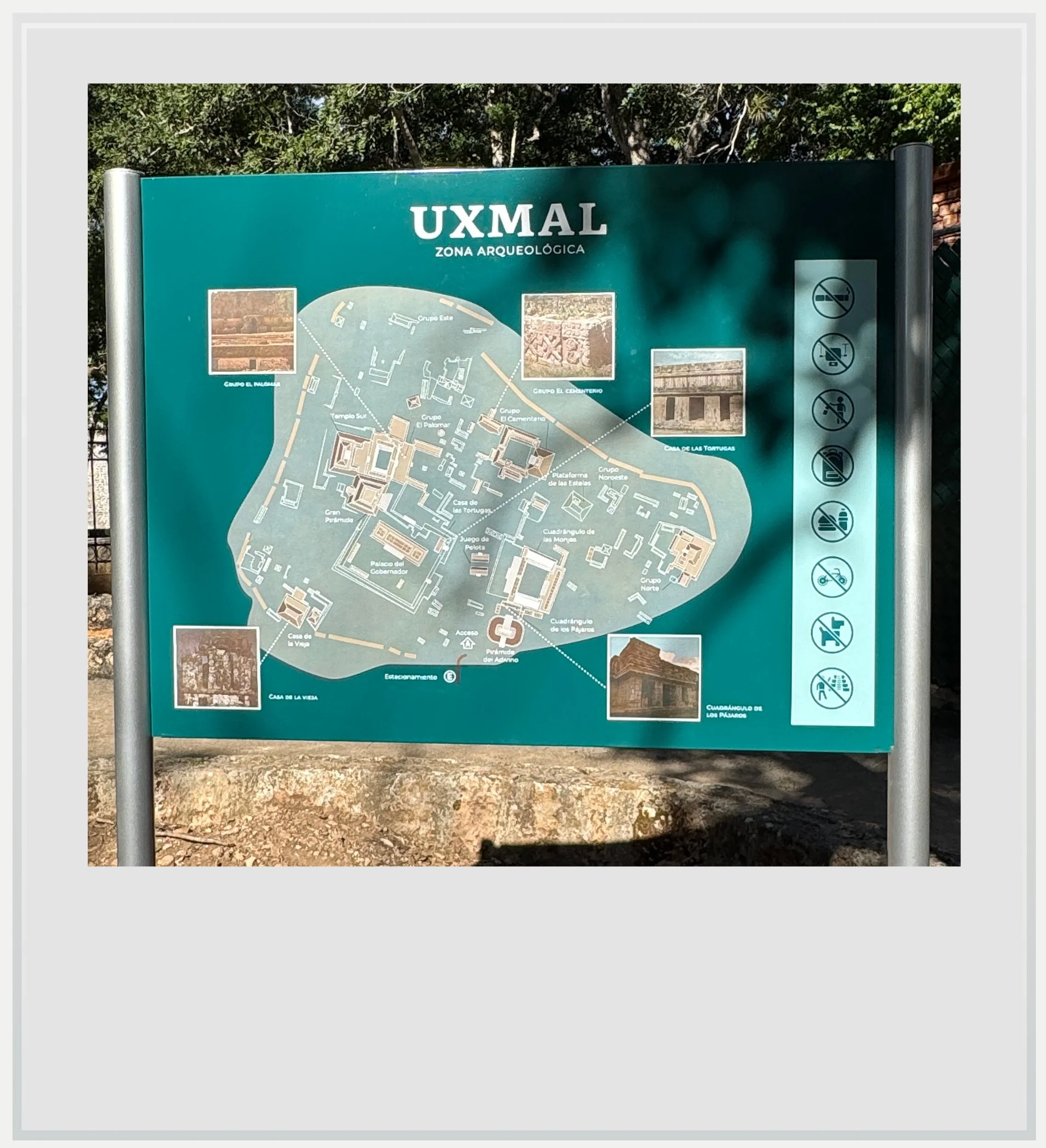
The site map for Uxmal.
How to get to Uxmal
How to get to Uxmal from the US: the easiest way to reach Uxmal from the US is via Merida. There are about 15 flights a day from Mexico City to Merida airport (MID), making a connection from the US through the capital convenient. Alternatively, several airlines provide non-stop service between Merida and the US: United Airlines from Houston (IAH), American Airlines from Dallas (DFW) and Miami (MIA), VivaAerobus from Miami and Orlando (MCO). See below for instructions once in Merida.
How to get to Uxmal from Mexico City: the capital sees around 15 flights a day to Merida’s airport (MID), either with flag carrier Aeromexico, or with low cost airlines VivaAerobus and Volaris. Flying is more convenient than taking a bus. ADO links Mexico’s TAPO station with Merida’s TAME station up to 8 times a day, but the travel time is 17 hours and prices not that much cheaper than flying.
How to get to Uxmal from Merida: there are three solid options to get to the Maya site.
rental car - this is the most convenient way to visit the area, and pretty much the only option if you’re aiming to visit other sites further on the Puuc route. Car rentals are widely available at the Merida airport and in town, from a variety of national and global brands. Price should hover around USD25 to 50 per day for an economy car. Driving to Uxmal from Merida is fairly easy. The key is to reach highway 180 towards Campeche, then take highway 261 towards Uxmal and follow it all the way to the Uxmal access road, where an overhead sign will direct you to the car park. It should take approximately one hour, and the roads are in good condition.
bus from central Merida. Sur, a regional company affiliated with ADO, offers limited service to and from Merida. I wasn’t able to confirm the exact bus schedule, though. Many reports online state that there are only a couple of buses per day (line is SUR #519). Check at the TAME bus station the day before to confirm (SUR timetables aren’t available online). However, it should be possible to fit an Uxmal visit within the departing buses on the line. Price should be around MXN 100 one way (it’s best to buy a round trip ticket at the TAME station in Merida)
find a tour. Many options are available on global platforms like Viator or Get Your Guide, and some include other Puuc sites along the way. Prices vary between USD 75 and 150 depending on options and group size.
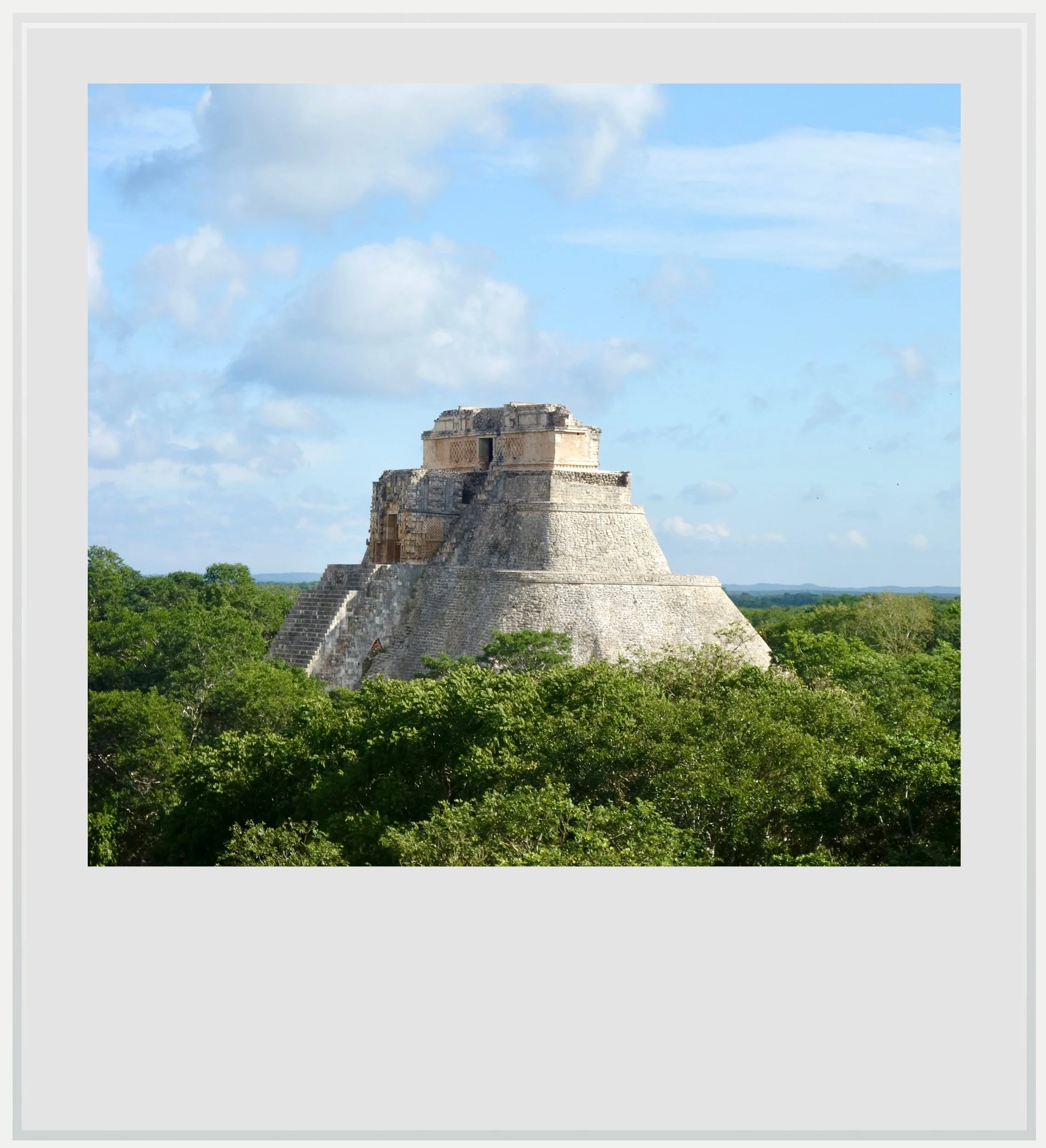
The Pyramid of the Magician emerging from the forest.
When to go to Uxmal
The best months weather-wise to visit Uxmal are during the dry season, between November and April, with January and February the (relatively) coolest months. This is also peak season, and unlike more remote sites, Uxmal does receive a steady flow of visitors.
Aim to arrive early, ideally at opening (8 AM), when the site is still quiet and the light is softer. The central areas, especially around the Pyramid of the Magician and the Quadrangle of the Nuns, become noticeably busier with tour groups from late morning onward.
Alternatively, an afternoon visit (from around 2:30 PM) offers cooler temperatures and fewer people, though you need to manage your time before closing.
I visited Uxmal in late December, during the peak season. Arriving at opening time made a significant difference, as the site was still uncrowded until about 10 AM.
How much does it cost to visit Uxmal
At the time of writing, the site entrance cost MXN 556 for foreigners and MXN 262 for Mexicans and foreign residents of Mexico with credentials. What’s confusing: the fee is paid in two parts, one to the federal government, and one to the State of Yucatan, at two different ticket booths, next to each other. The federal government fee (MXN 105) could only be paid in cash, while the state fee (MXN 461 for foreigners and MXN 157 for Mexicans) could also be paid with a VISA or Mastercard. There was an ATM on site, which was working when we visited, but online reviews mention this isn’t always the case, so bring enough cash, just in case.
Guides were available. We paid MXN 900 for ours, who stayed with us for a good hour, walking us through the site’s highlights.
The site is free for Mexicans and foreign residents on Sundays, which usually means bigger crowds. Avoid Sundays if possible.

How much time should a visit to Uxmal take
Our visit took about two hours, but given the site’s size and the abundance of well-restored buildings, it could easily take three full hours to cover it all.
Guides were available, ours (who spoke French) charged MXN 900 for the visit.
What are the opening times of the Uxmal archeological zone
Uxmal is open Monday to Sunday from 8 AM to 4 PM.
How busy is Uxmal
Uxmal, a UNESCO World Heritage site and one of Mexico’s finest archeological sites, is the fourth most visited Maya site in the country (based on full-year 2025 figures, the latest available at time of writing). 277,000 visitors went through its gates in 2025, or an average of 760 per day. This seems like a lot until you realize there were about 6,000 visitors a day in Chichen Itza and 2,800 in Tulum. Uxmal is a big site, and its crowds, although noticeable, are fairly spread out. To enjoy a more solitary visit, it is recommended to come at opening time or later in the day to avoid the bulk of the tour-bus groups.
Food & lodging in Uxmal
Hotels
For most people, accommodation in Merida will make the most sense, if a visit to Uxmal is part of a bigger Yucatan trip. There are plenty of hotel and Airbnb options in the Yucatan capital.
If you would rather stay close to the archeological zone, say, to save on drive time in the morning, I recommend the following two hotels:
The Picked Onion in nearby Santa Elena. I stayed there during my second Puuc route visit, and enjoyed the quiet surroundings. Rooms are single casitas, built in the regional style, that blend very well in a lovely garden. Comfort is basic but decent. Breakfast is included. The hotel sits less than fifteen minutes from the Uxmal entrance.
Hotel Mundo Maya “Nuevo Uxmal”. While I haven’t stayed in this hotel, I sampled its sister properties in Calakmul and Edzna, and the experience was similar enough to see a positive pattern. Built by the federal government alongside the Tren Maya, Mundo Maya hotels are meant to bring premium hospitality to more remote areas of the Maya world, to spur a tourism expansion. The hotels are beautifully designed, the rooms luxurious, and the prices very competitive. This hotel is located about thirty minutes away from the archeological zone.
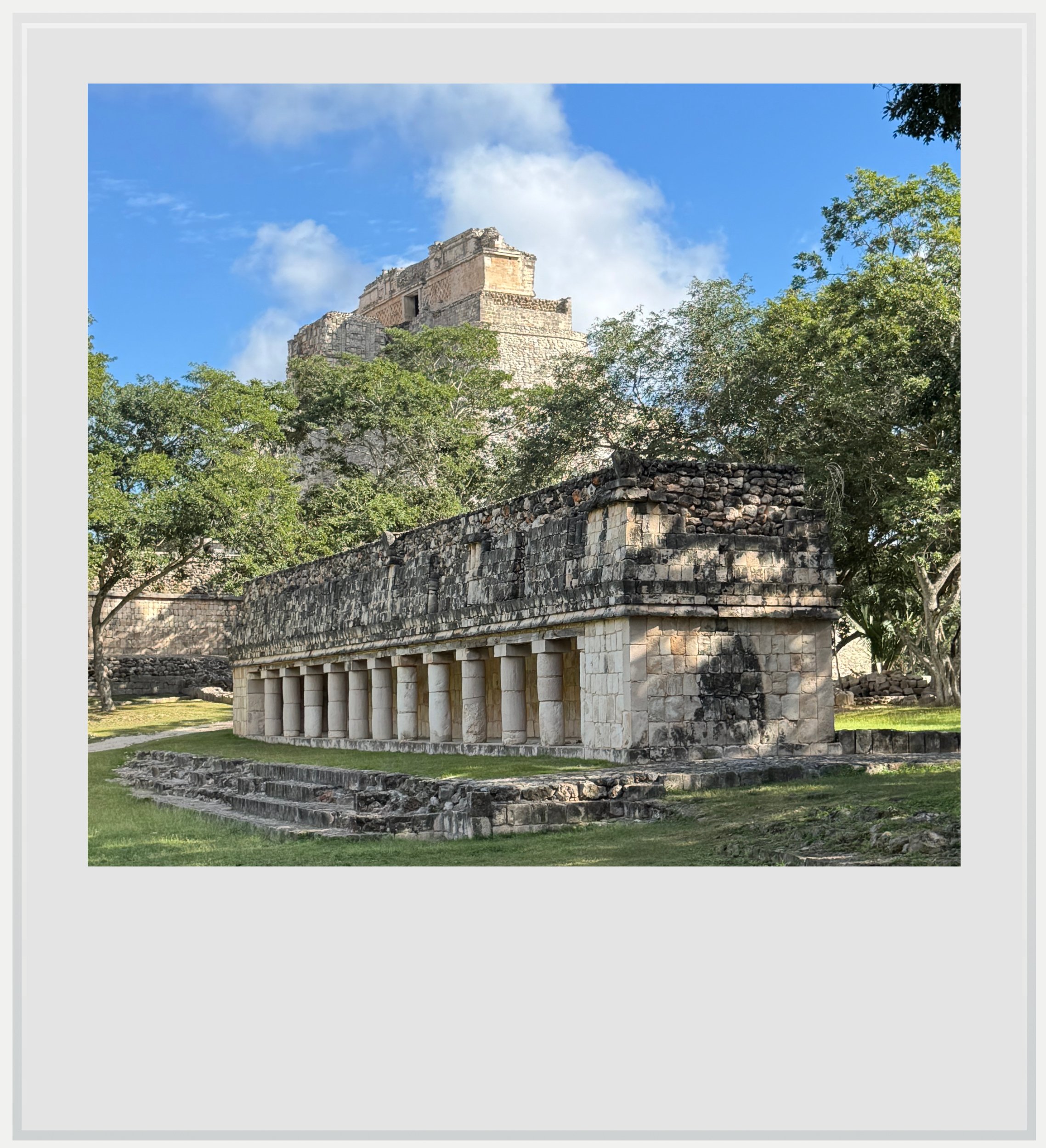
A building by the ballgame court, in front of the Pyramid of the Magician.
Restaurants
If you’re coming to Uxmal for a half-day and heading back to Merida, it may make sense to delay having lunch until you’re back in the beautiful colonial city. If, however, Uxmal is only the first stop on the Puuc route, you will need to find lunch along the way. Most of the restaurants on the route seemed well regarded locally, but didn’t always feel like places we could stop at without hesitation. We had trouble finding a place for lunch in Santa Elena, and drove to nearby Ticul to enjoy a really good meal at the El Principe Tutul Xiu hotel, where the restaurant opened at 11 AM for lunch.
Snacks were available just beyond the site’s entrance in Uxmal, in an area with a few souvenir shops and a coffee station, but past Santa Elena towards the Puuc route, there was absolutely no store or food stand so make sure you break for lunch before leaving Santa Elena.
Safety in Uxmal
The State of Yucatan is considered one of the safest regions in Mexico by the U.S. Department of State and is not subject to a specific travel advisory as of publication. While Mexico as a whole is listed at Level 2 (“Exercise increased caution”) and some states, such as Zacatecas or Guerrero, are classified as Level 4 (“Do not travel”), Yucatan remains one of the safest states in the country, and no precautions beyond basic common sense are generally necessary for visitors.
The ancient city of Uxmal is considered safe. It is a well-known tourist site that benefits from an increased security presence. The main danger in this part of the peninsula is remoteness. It is recommended to avoid driving (or being driven) at night, when risk increases: the area is fairly isolated, with spotty cell service outside of cities, so any issues happening on the road at night could possibly spiral.
Keep in mind these travel tips
Heat isn’t a joke in Yucatan, and even in the dry season, temperatures can reach very high levels around midday. Make sure you hydrate regularly and keep a water bottle with you.
The UV index may be low in the morning and evening, but during the day, it gets pretty high. Wear SPF.
Bring cash. While many shops accept foreign credit cards, bus companies, taxi drivers, and many smaller boutiques do not. Some restaurants were cash-only as well.
Cell service can be spotty outside of cities, and although Telcel signal was strong overall near Merida, it disappeared approaching Uxmal. No other provider covered the old Maya settlement either. Telcel is usually the safest bet for coverage throughout remote areas of Mexico. If you’re roaming, check that you can roam on Telcel, or investigate a Mexican eSIM that uses this network. Telcel coverage is independently mapped here. Change the network in the drop down menu at the top to see other companies.
Every photo caption appears if you hover over it (on a computer) or click on it (on a smartphone).
All photos are mine and copyrighted.