Papantla, Mexico.
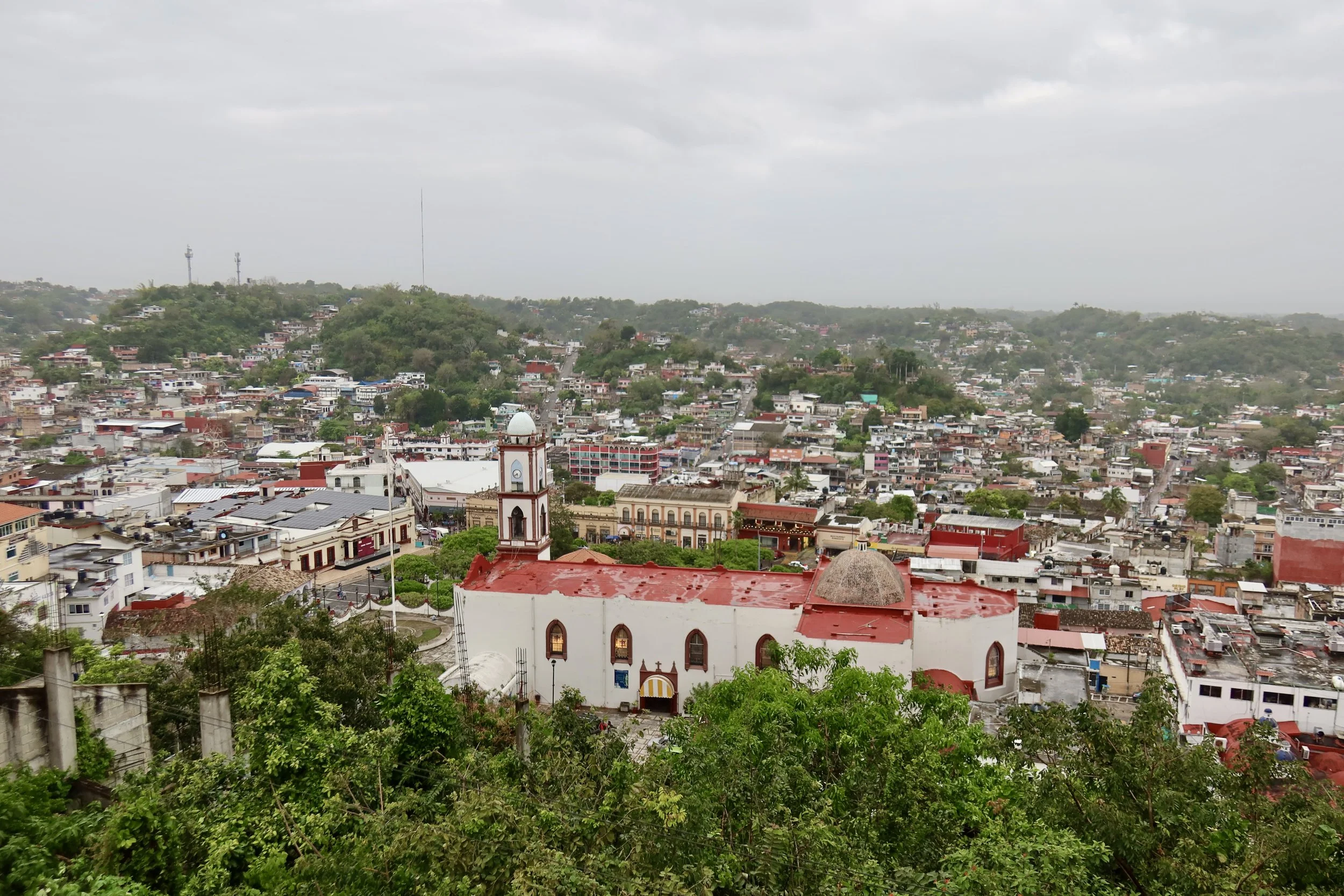
At the Heart of the Totonac World, a Town That Comes Into Focus Gradually.
Looking for concrete details and tips? Go straight to the Practical Information section.
First impressions aren’t supposed to matter, but they do. It was initially hard for me to like Papantla. I had arrived on an ADO bus just a few minutes earlier, and had had to walk uphill to get to my hotel under pouring rain.
The city, not used to this weather in March, was deserted, and it felt like I had walked into a place people had just fled en masse. The sidewalks were slick. The temperature was a mere 60° F (16° C) and I was dressed for the usual hot weather of the Caribbean coast.
Papantla, through no fault of its own, was in the middle of a cold front so serious that the Mexican weather service had issued an advisory and I, unwilling to change my plans at the last minute but probably misunderstanding what it truly meant, had powered through.
The front had hit us earlier, while on a bus between Mexico City and Poza Rica, and it showed no sign of abating. I just hoped I would get a few hours of respite to discover the town and visit the nearby UNESCO World Heritage site of El Tajin.
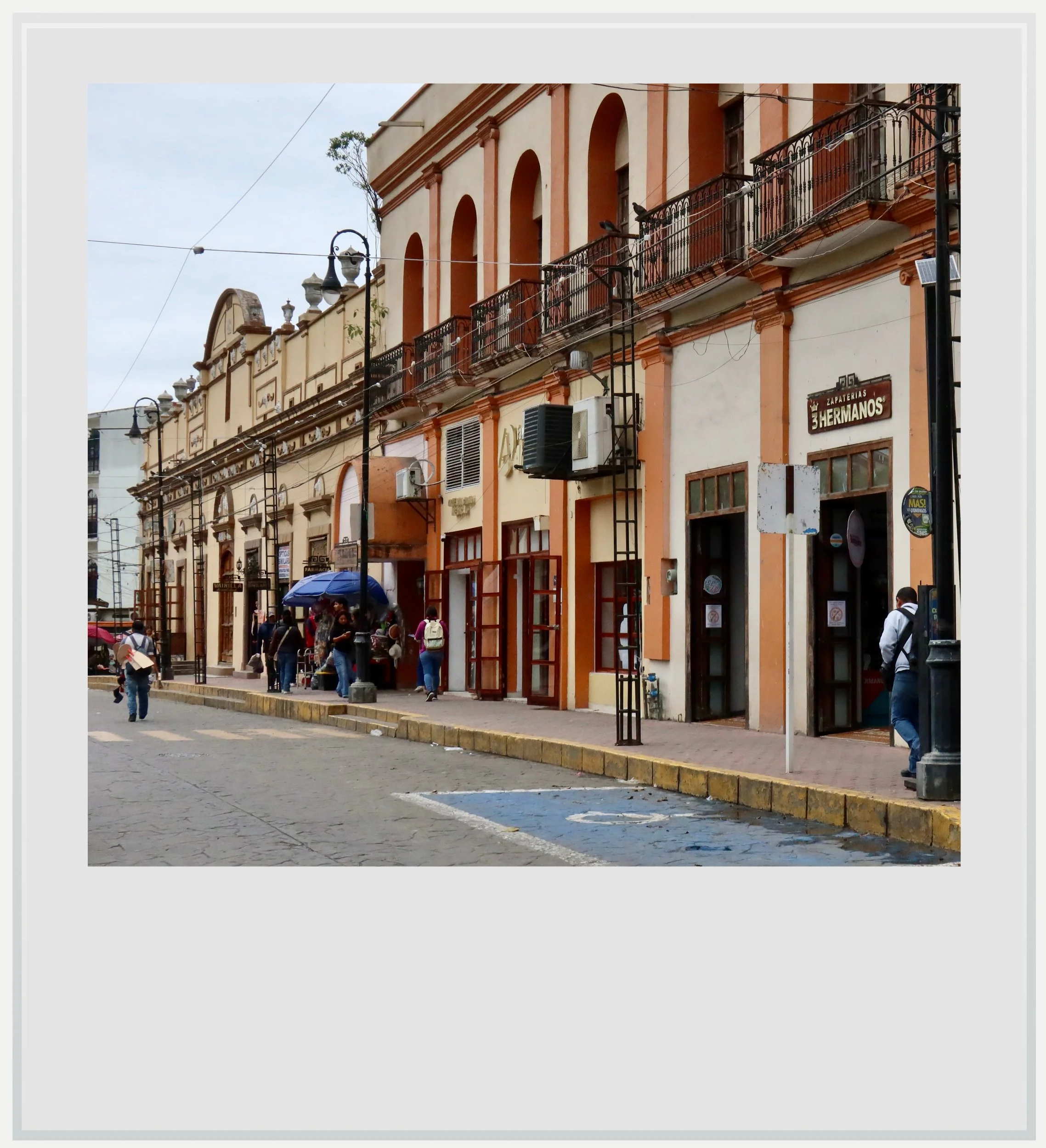
Street by the zocalo in Papantla
There was a silver lining in all of this. I had rarely felt this disconnected from the rest of Mexico before. The transition from sunny, dry, chaotic Mexico City to this cold, crowd-free city surrounded by jungle had felt so brutal, that I could have believed anyone telling me I had been transported in the middle of nowhere.
When the rain stopped, before nightfall, I was able to walk around in Papantla for a bit, and I really think that’s when the town’s charm began to come through.
I walked up to the most obvious panoramic point I could find, a few hundred feet above the main square, where a massive statue, the Monumento al Volador, paid homage to the Totonac ritual in which performers spin through the air on long ropes. From there, the whole town of Papantla appeared in front of me. The feeling I was looking at a mismatched city and landscape returned. All the colonial cities I had previously visited in Mexico were located in the drier highlands, or in the flat Yucatan.
I had never been to a colonial town in the middle of a lush jungle, and the juxtaposition of this dense vegetation with the colorful rooftops of Papantla’s main church were almost disturbing. I kept on thinking they weren’t meant to be together.
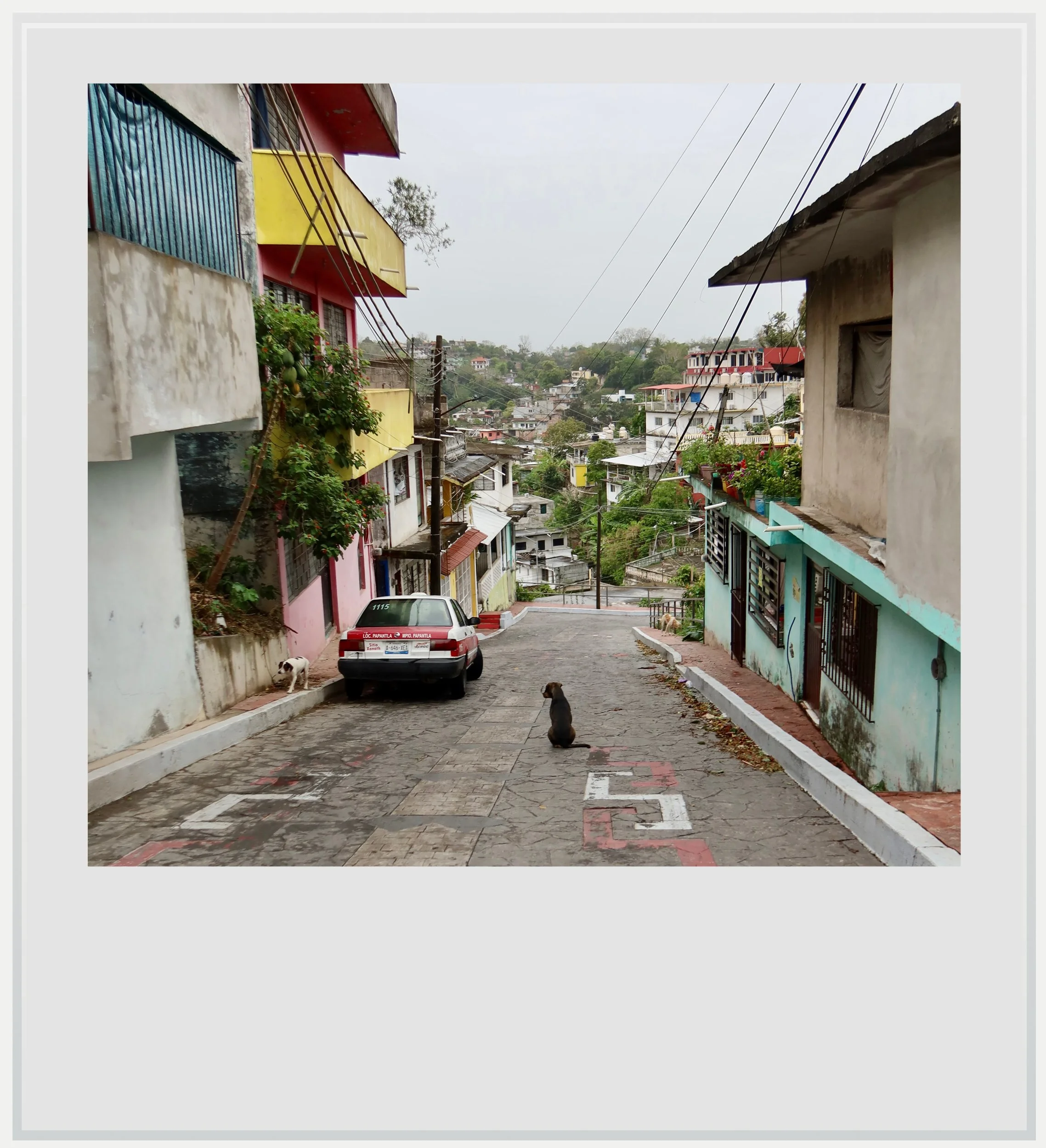
A steep street with dogs.
And yet they were, and that’s what how I started to sense the city vibrating below me.
It would be fair to say I hadn’t chosen to come to Papantla. Rather, I had wanted to visit the ancient Totonac city of El Tajin, a few miles away, and Papantla came to be the gateway to the ruins. It was a pueblo magico, after all, and it would be a nice complement to my archeological explorations.
The feeling I was looking at a mismatched city and landscape returned.
In fact, Papantla was much more than the pueblo-magico-next-to-El-Tajin. It was the beating heart of the Totonac region, its true cultural center, and a source of pride for its inhabitants. I understood quickly that, if Papantla didn’t have the immediate polished charm of many other magical towns, that was because its place in this government program was likely won on cultural significance, and not over beautiful colonial facades.
It only began to make sense when I stepped back in time. Before Christopher Colombus, the Totonac occupied an area comprised of the current state of Veracruz and parts of Puebla and Hidalgo, and developed for centuries, mastering stone constructions and the cultivation of vanilla, among many other feats.
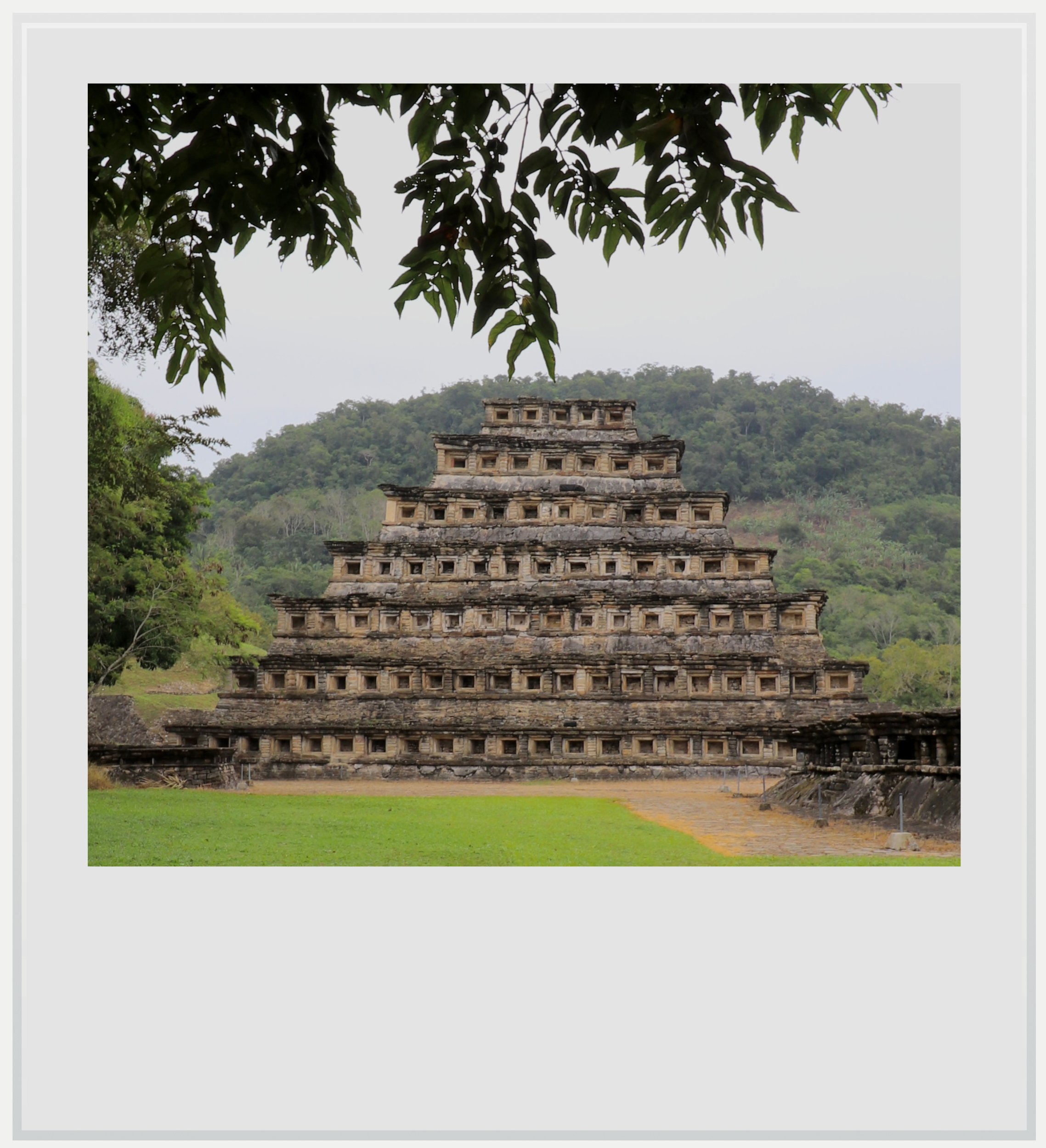
The Pyramid of the Niches in El Tajin.
Conquered by the Aztecs in the late 15th century and then by the Spaniards in the 16th, the Totonac culture has nonetheless remained vibrant throughout the years, and is a big part of everyday life in the state of Veracruz, as well as a source of pride for its inhabitants.
One of its symbols are the Voladores. Rooted in Totonac culture, these performers execute ritual ceremony to the gods, climbing a very tall pole from which they descend flying down, spinning around to the sound of a flute. This is such a profound part of the culture that it was recognized by the UNESCO as an “intangible cultural heritage” and is still performed regularly in Papantla.
The Totonac culture is much more than this, though. Its ancient roots are illustrated in the wonderful archeological site of El Tajin, nearby. Its current relevance is reflected both in a language, an official language of Mexico and in its cuisine, very different from highland or Yucatan fare.
As I walked down Papantla’s streets, another layer emerged. There was a strong indigenous presence in the population, making the crowd feel unusually homogeneous - a marked difference in a country known for its métissage. Although the State of Veracruz was strategic for the Spanish crown, the area around Papantla, deep in the tropical forests and away from major sources of minerals, was left alone, which helped the Totonac culture preserve its cohesiveness - and its genetic makeup.
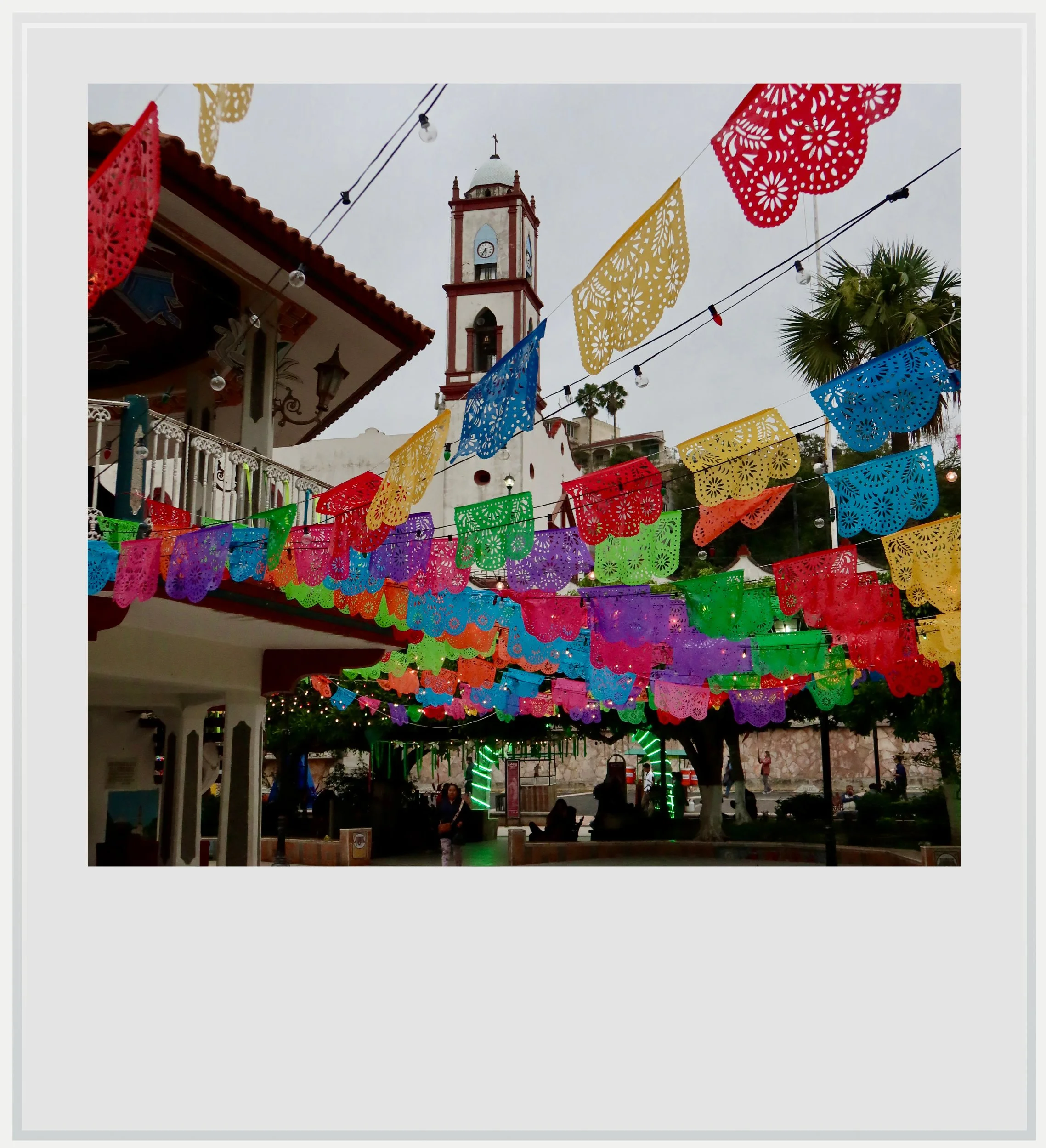
Papantla's main church and zocalo.
This is why it felt I had stepped into a very different part of Mexico. It wasn’t just the climate or the landscape. It was also the people.
The city of Papantla has grown to accommodate 55,000 inhabitants, but in many ways, it still feels like a big village, with daily life centered on the zocalo, its main square, framed by a church, the municipal palace, and the town market.
The Teodoro Cano museum highlighted several large pieces that captured the way the region saw itself.
Where it felt different than a classic zocalo, however, was how the plaza responded to the sloping terrain. While the square itself was fairly flat, the church, built on its southern side, was set on higher ground, overlooking the main square and giving it a slightly daunting presence.
As I sat down on a bench to watch daily life unfold in front of me, I saw people hurrying past the shops, teenagers meeting after school, older couples resting under the shade. It was a scene of urban life repeated in countless other main squares in Mexico. That zocalo was functioning as expected, no matter the terrain quirks.

Part of an artwork by Teodoro Cano shown in the eponymous museum.
What set it apart was how it served as a cultural anchor, not just a spatial one. Built on the church’s exposed foundation wall was a 275-foot (84-meter) relief mural honoring the Totonac world. It acted as a focal point of the square’s fourth side and traced the history of the region’s indigenous people.
The mural also revealed the layers that have shaped the region’s identity. The Catholic church of Our Lady of the Assumption stood above the square, while the mural below grounded it in Totonac history. The contrast between the two felt like a quiet metaphor for that identity.
Inspired by the mural, I decided to learn more about his creator, Teodoro Cano. Born in Papantla, Cano has come to embody the Totonac culture and traditions through his art, and quite a few of some of its most iconic paintings are gathered in his eponymous museum in town. The space, organized like a modern art gallery, was located off the historic core, next to a few colonial-era buildings being renovated. It seemed as if I had stumbled into Papantla’s up-and-coming neighborhood.
Trained by Diego Rivera, Mexico’s most famous muralist, Cano worked on many murals across the State of Veracruz, and indeed his work was most impressive when done on large canvases. The museum highlighted several large pieces that captured the way the region saw itself.
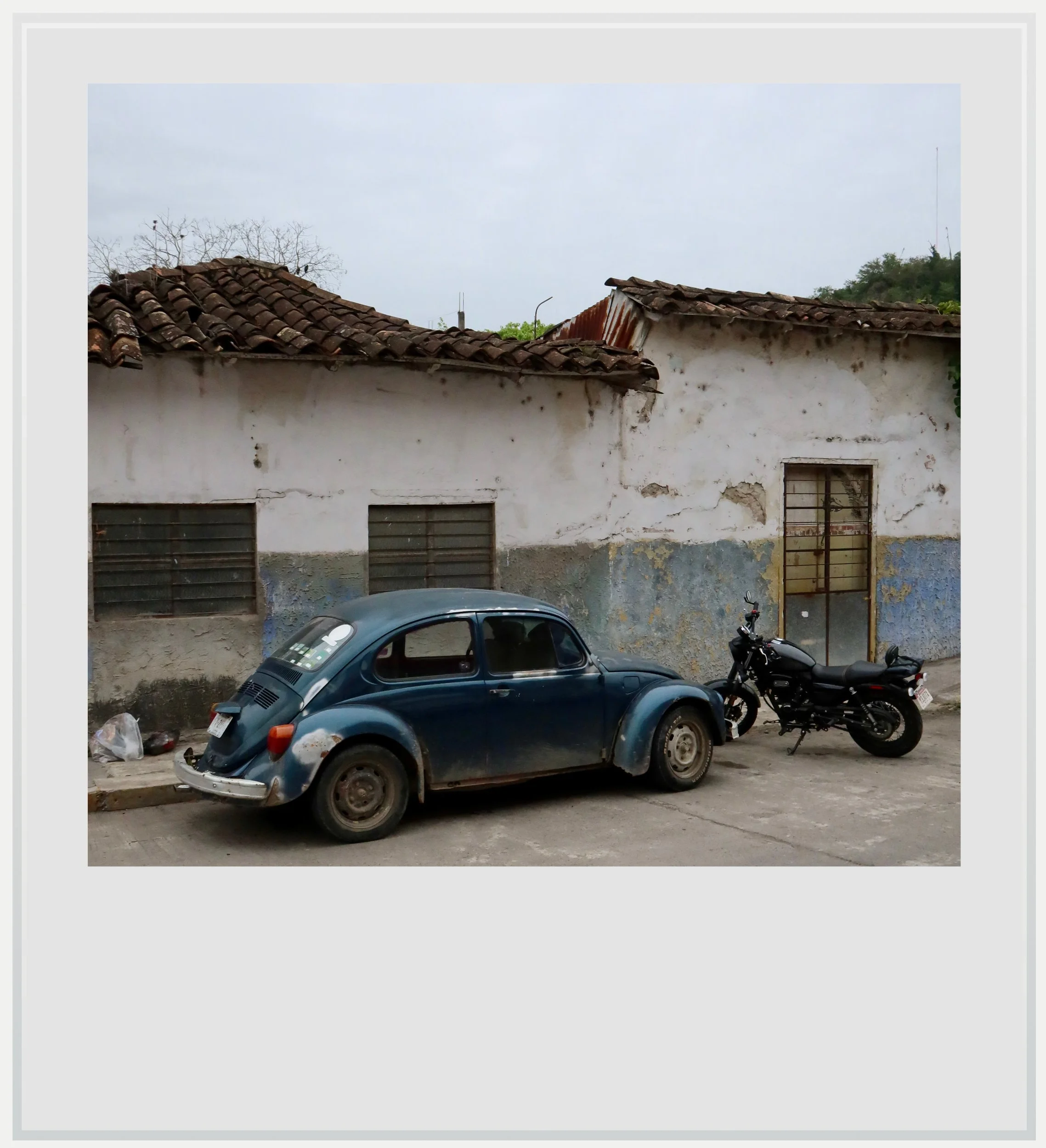
A street just outside historic core in Papantla.
While walking in Papantla’s historic core, I realized another layer had been there all along. Papantla isn’t defined by picturesque façades. Getting to know it requires a different kind of attention, one that focuses less on what the town shows and more on how it lives.
Like some of the Mexican places I enjoy the most, Papantla hadn’t sold its soul to tourism. The city didn’t feel marketed. There were very few shops obviously geared towards the transient, or fancy restaurants to feed them.
This was a town that didn’t need to change who it was, because what defined it was never on the surface to begin with.
Practical information
(Everything you could possibly want to know about Papantla - updated March 2026)
In a nutshell
Papantla is best visited as a base for El Tajín, but it rewards a short stay of its own. Expect a low-key town with strong Totonac identity, limited tourist infrastructure, and easy access from Mexico City by bus in about 5 hours. Two nights is ideal.
How to get to Papantla
How to get to Papantla from the US: the easiest way to reach Papantla from the US is via Mexico City. Fly into MEX (the main airport, close to the city center) or NLU (AIFA), further north. MEX is more convenient, as it is closer to the bus stations where services to Papantla depart.
How to get to Papantla from Mexico City: taking an intercity bus is the easiest way to reach the small Veracruz town from the capital. Only ADO offers direct service (with a stop in Poza Rica but no change of bus), 5 to 7 times a day, for MXN 522 at time of writing, but less if booked in advance. Most services leave from Mexico City’s Northern bus station (by subway station Autobuses del Norte, on line 5), but one of the night services actually departs from the TAPO station, close to subway station San Lazaro, on line 1. Travel time is between 4 and 5 hours depending on traffic.
It is also possible to take a bus to Poza Rica, a bigger industrial town 40 minutes to the North. There are dozens of departures a day between ETN (luxury), Futura and ADO GL (executive), ADO (first-class) and Conexión (second class, sold through Futura). Most buses leave from the Northern Bus Station, except one ADO night bus which leaves from the TAPO station. If you’re not clear about the service differences, check out this article that explains it all.
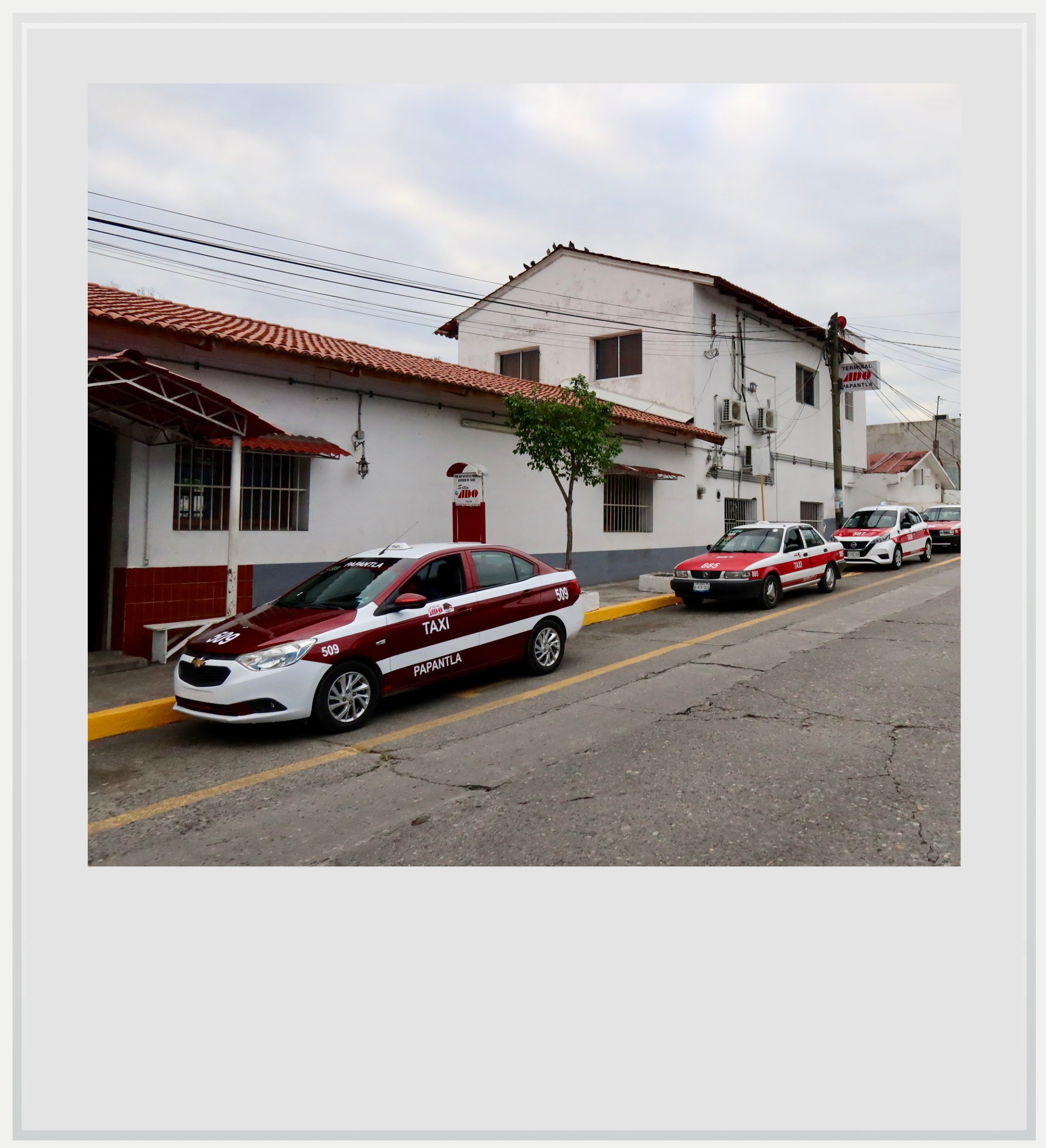
Papantla's ADO bus station.
There are two main bus stations in Poza Rica, one for ADO and one for basically all the other companies, but they are right next to each other, so changing stations is fairly easy, if needed. From Poza Rica, it’s easy to take an EJE local bus to Papantla (from the same station where ETN and Futura arrive), for MXN 21, about one hour, every 30 minutes or so, or an ADO first-class service from the ADO station, MXN 95, about one hour, every hour or so. Travel time via Poza Rica and a connection is about 5 to 6 hours depending on traffic.
Why bother with a connection in Poza Rica when direct buses exist? Two reasons: one, there are more buses so more options are spread out during the day. Two, taking a luxury or an executive bus for the roughly 4-h trip to Poza Rica can be a much nicer experience than the ADO first-class experience (however nice it is when compared to classic US or European buses).
I wrote a full report on my bus trip between Mexico City and Papantla via Poza Rica, which you can read here.
When to go to Papantla
Papantla sits at low elevation so it gets really hot during the summer. The best time to go is the dry season, from mid-November to early April, with the coldest months December and January. Tourist flows are lower during the week, when weekends can get noticeably busier. If you’re not into crowds, avoid the Christmas season and Holy Week.
A good time to go to Papantla to enjoy a vibrant display of Totonac culture are the days around the spring equinox, when cultural celebrations abound.
How long to stay in Papantla
Papantla is usually seen as a gateway to the incredible UNESCO-listed ruins of El Tajin, a few miles outside the city. It’s possible to visit both the ruins and the town in a day, so that’s a perfect two-night destination (travel on day one, visit on day two, return on day three).
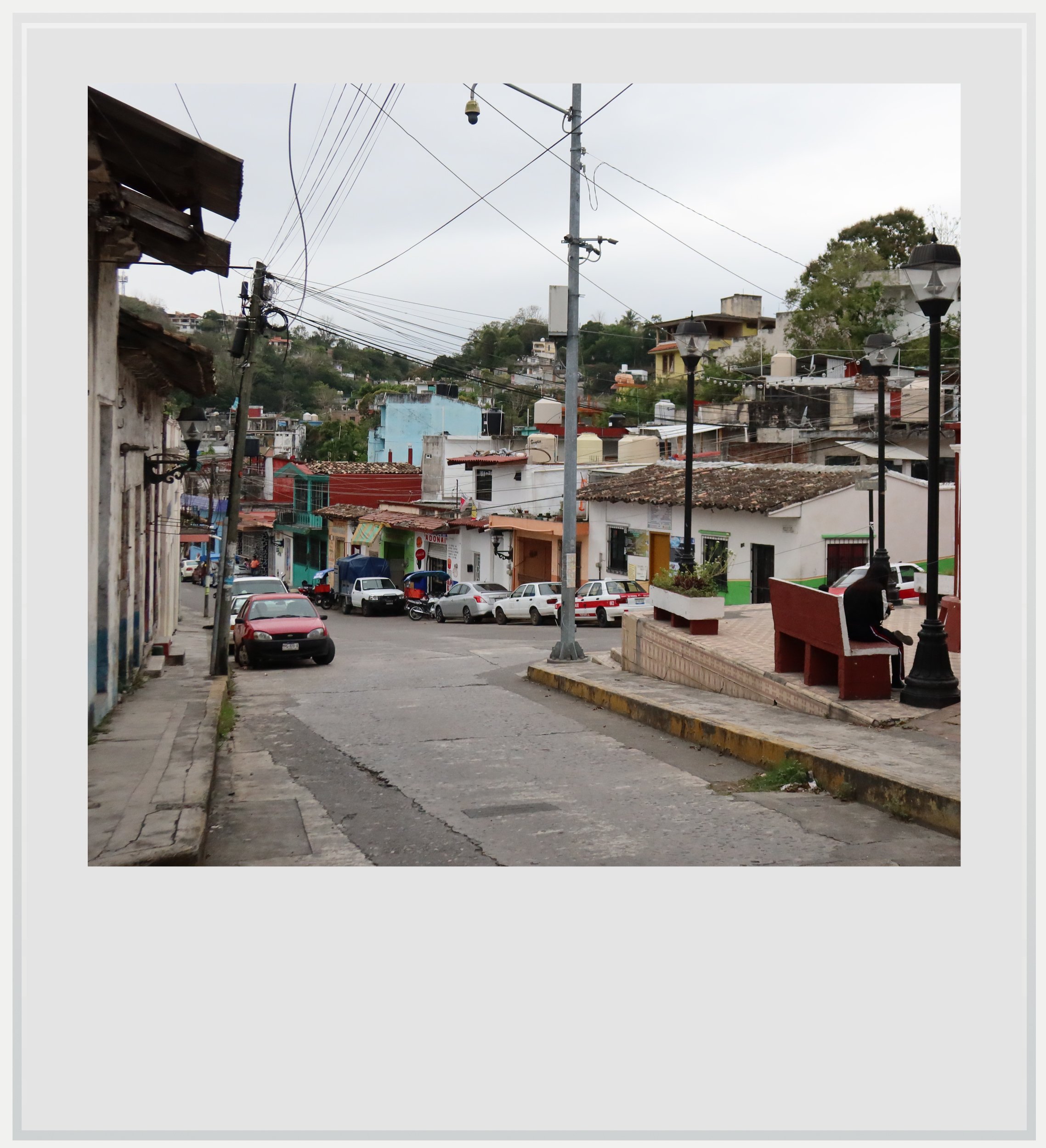
Rodolfo Curti street near the Cano museum.
Food & lodging in Papantla
Hotels
There aren’t a lot of hotels in Papantla and, as the town is mostly frequented by Mexican tourists, some of them aren’t listed on global platforms. I picked the best-rated hotel on Google, Hotel Tajin, currently with a rating of 4.0 stars. I loved its very central location, two blocks from Papantla’s main square, two blocks from a big supermarket open late, and a block away from a taxi station. Like most of Papantla, it seemed to not have been refreshed in a few decades, but although very basic, it was clean and convenient.
It is possible to stay in Poza Rica, where the hotel choice is bigger, but the city itself doesn’t have much going for it, and the trek to El Tajin takes more time, so if you want to be there at opening time, you’ll have to get up earlier. That combination made me opt for a Papantla hotel, and the Hotel Tajin did the job.
Restaurants
Papantla has a few restaurants that offer good local cuisine, and they are a great way to get to know the Totonac culinary culture. I had a really good lunch at Naku restaurant, a little far from the town center but worth the 5-minute taxi-ride (about MXN 50). The food in the region is notably different from other parts of Mexico, with a strong focus on meat and seafood. I recommend trying it.
I was also recommended Restaurante Humo but didn’t have time to try it.
I took my breakfast at the restaurant within Hotel Tajin, Totonaco, which won’t win a design prize, but has good reviews on Google and where the breakfast was really good (they offer many formulas for MXN 155, that you can customize).
Safety in Papantla
The State of Veracruz is considered a relatively safe state by the US Department of State, which lists the State under a Level 2 travel advisory meaning “Exercise increased caution” when you travel.
The city of Papantla and El Tajin are considered safe. Both are tourist sites that benefit from an increased police presence. The main security issue in the state is the illegal tapping of fuel pipelines, known locally as huachicol, which doesn't happen in touristy areas.
It is recommended, however, to avoid driving (or being driven) at night, when risk increases: the area is fairly isolated, with spotty cell service outside of cities, so any issues happening on the road at night could possibly spiral.
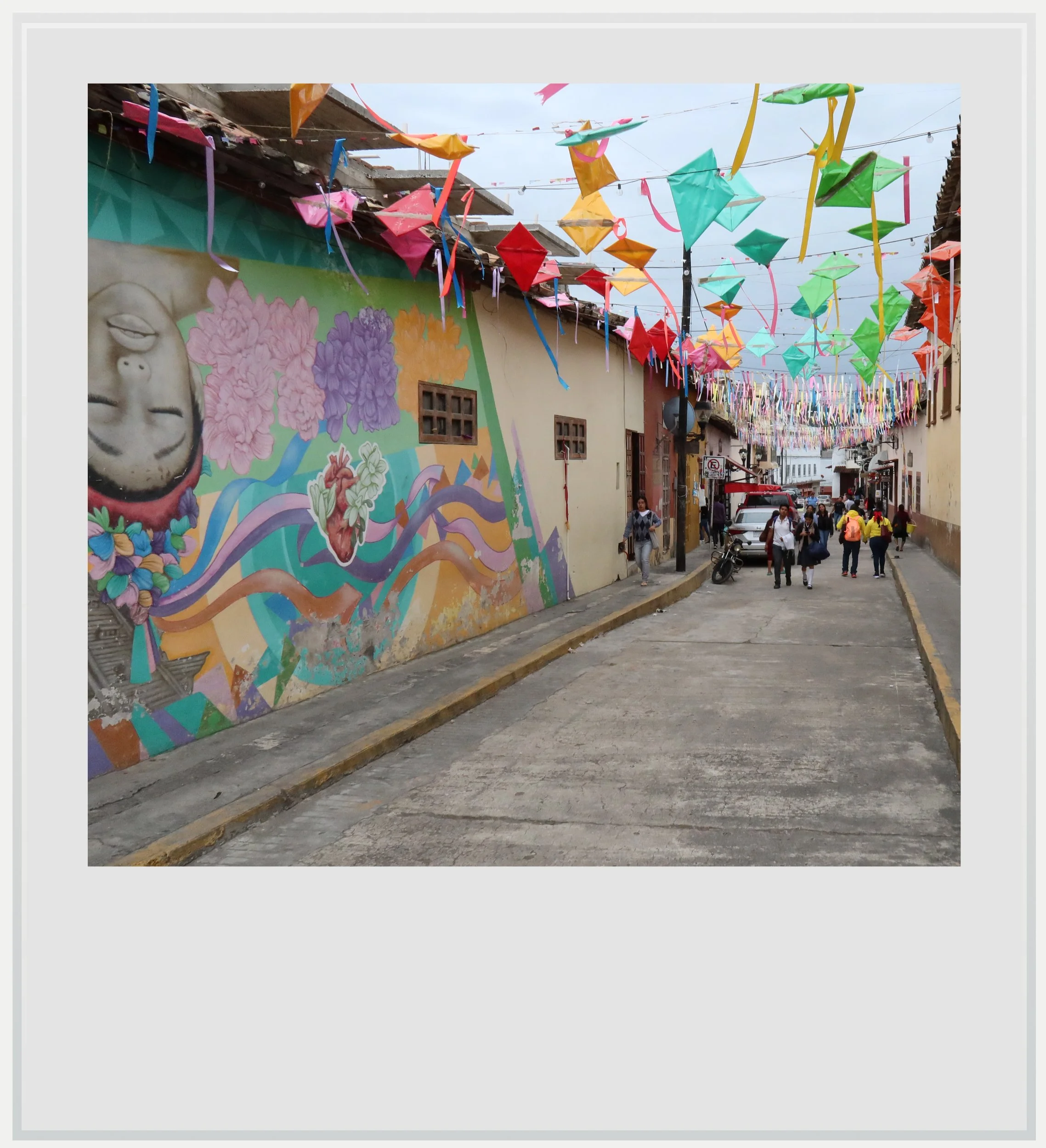
Lazaro Muñoz street, just off the zocalo.
Keep in mind these travel tips
Heat isn’t a joke in Veracruz, and even in the dry season, temperatures can reach very high around midday. Make sure you hydrate regularly and keep a water bottle with you.
The UV index may be low in the morning and evening, but during the day, it gets pretty high. Wear SPF.
Bring cash. While many shops accept foreign credit cards, bus companies, taxi drivers, and many smaller boutiques do not. Some restaurants were cash-only as well.
Cell service can be spotty outside of cities, and although Telcel signal was strong overall, other providers may not have the same extended coverage. Away from main cities and roads, Telcel is always the safest bet. If you’re roaming, check that you can roam on Telcel, or investigate a Mexican eSIM that uses this network. Telcel coverage is independently mapped here. Change the network in the drop down menu at the top to see other companies. It looks like AT&T and Altan Redes offer good coverage in Papantla, but Movistar definitely doesn’t. Only Telcel has meaningful coverage in and around the El Tajin archeological zone.
Every photo caption appears if you hover over it (on a computer) or click on it (on a smartphone).
All photos are mine and copyrighted.