Kabah, Mexico.
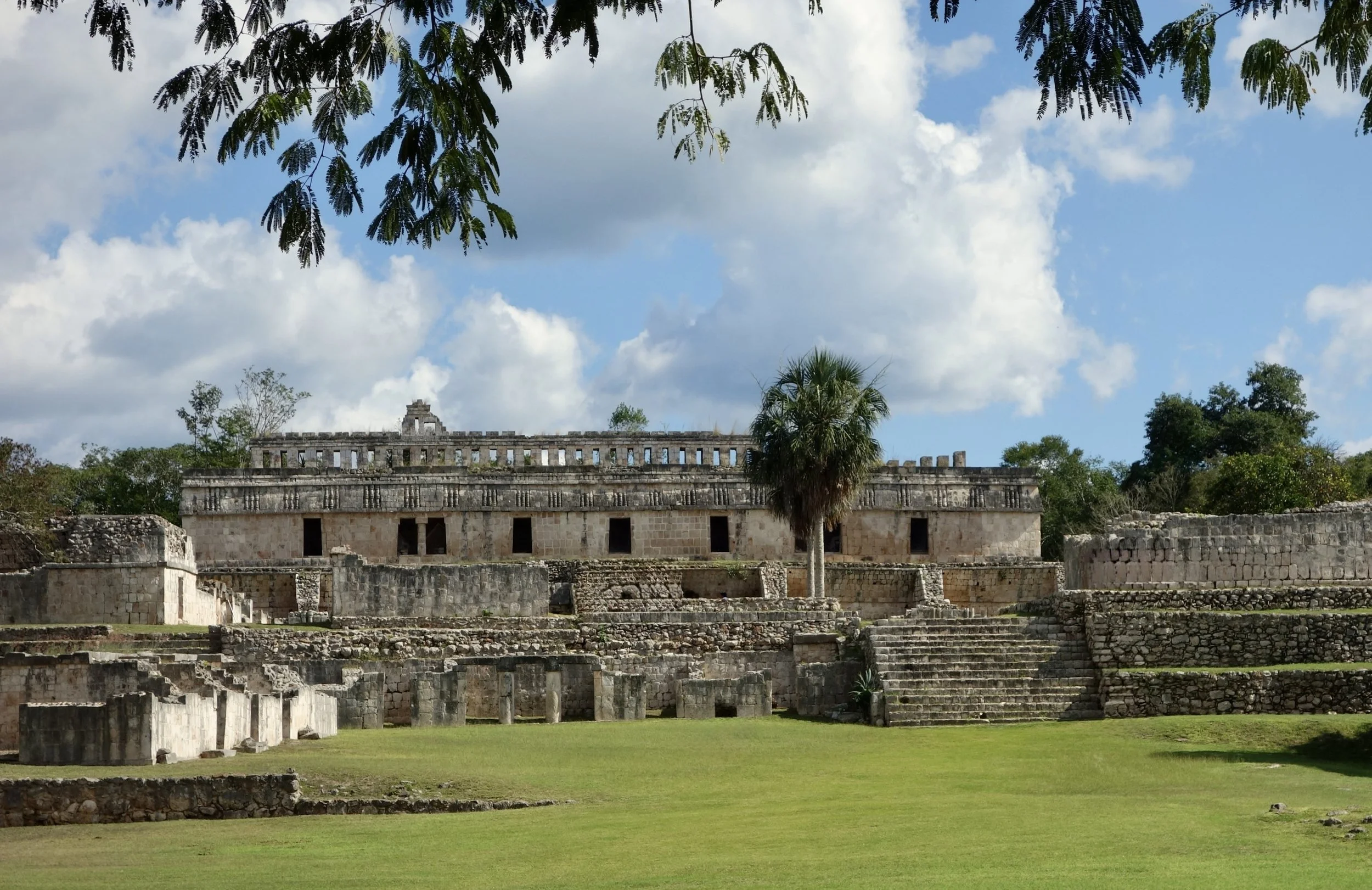
South of Uxmal, where Puuc architecture almost breaks its own syntax.
Looking for firsthand logistics, costs, and practical tips, including where to eat and stay? Go straight to the Practical Information section.
Entering the Maya settlement of Kabah, in southern Yucatan, is a staged experience that should come with a warning. The first building we saw, as we parked our rental car along highway 261, was the main palace, framed by trees marking the site’s boundary.
We had just left Uxmal and this was our next site on the Puuc route, the hilly and dry region south of Merida home to the eponymous Maya architectural style. The Kabah palace looked, from afar, like a beautiful expression of classic Puuc style of the kind we had seen at Uxmal earlier. I assumed we were going to walk through a variation of that, perhaps on a less grand scale, since Uxmal had been the major political center during the Late Classic Era (600-900 CE) when these buildings had been erected.
Nothing prepared us, however, from the revelation of entering the site, stepping up towards the palace… and noticing, right away, one of the most intricately sculpted buildings of the whole Maya world, to its right. Previously hidden from view by the tree line, it now appeared, atop of a small raised platform, as if dominating the landscape.
The Codz Pop, or Palace of the Masks, was the highlight of our visit to Kabah. It represented a fascinating look at how the codes of Puuc architecture, which I had witnessed firsthand in Uxmal, were pushed into a patterned repetition so exuberant it almost broke everything I thought I had understood about the Puuc design language.
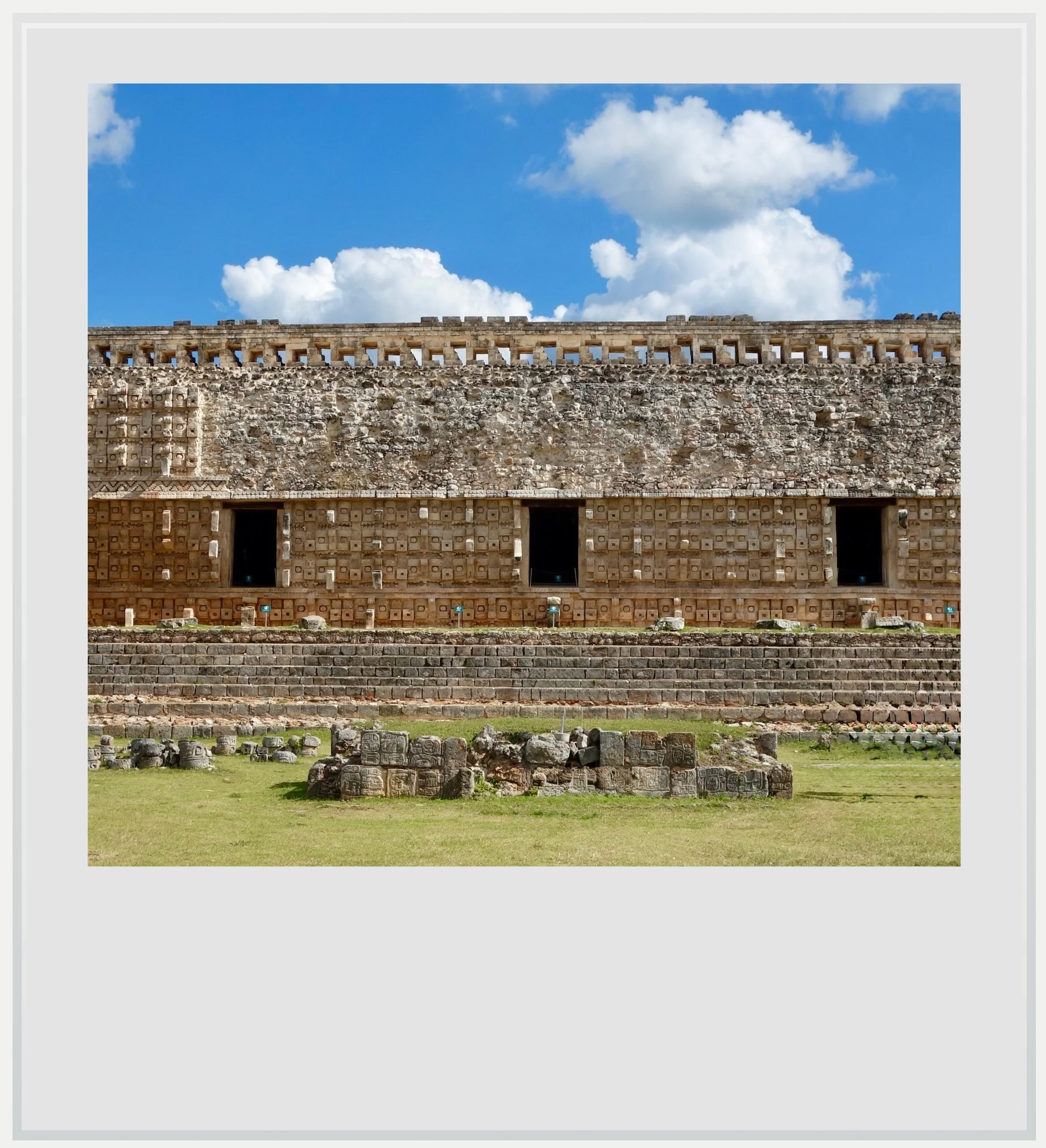
A partial view of the Palace of the Masks
The Codz Pop had seen several phases of careful work, and the most recent phase had given it a polish similar to some of the buildings at Uxmal, restored with such precision that they looked like they might have come up from the earth untouched by centuries underground.
This was even more striking in Kabah, as the Palace of the Masks featured hundreds of sculpted Chaac masks, perfectly repeated across several rows on its western side. There were so many of them, repeated so relentlessly, that it became hard to know where to look, the pattern almost dizzying. I kept looking at the building and asking myself how this could fit within the codes of the Puuc style.
We arrived thinking we were about to visit a mini Uxmal.
Maybe it couldn’t. To make sense of this, I had to compare it to the design rules we had seen established at Uxmal. There we had seen a consistent pattern throughout the key palaces, with building façades richly decorated on their top half with repeated geometric patterns, while their bottom half was left unadorned, smooth and clean. Here, there was no such restraint: the full façade of the Codz Pop was sculpted, top to bottom, by a proliferation of masks representing the rain god so densely organized that it was hard, at first, to really understand what we were looking at.
Only when we got closer to the building itself did each individual mask start to take shape, one among many others, much like trying to discern a single animal in a dense pack until you get really close.
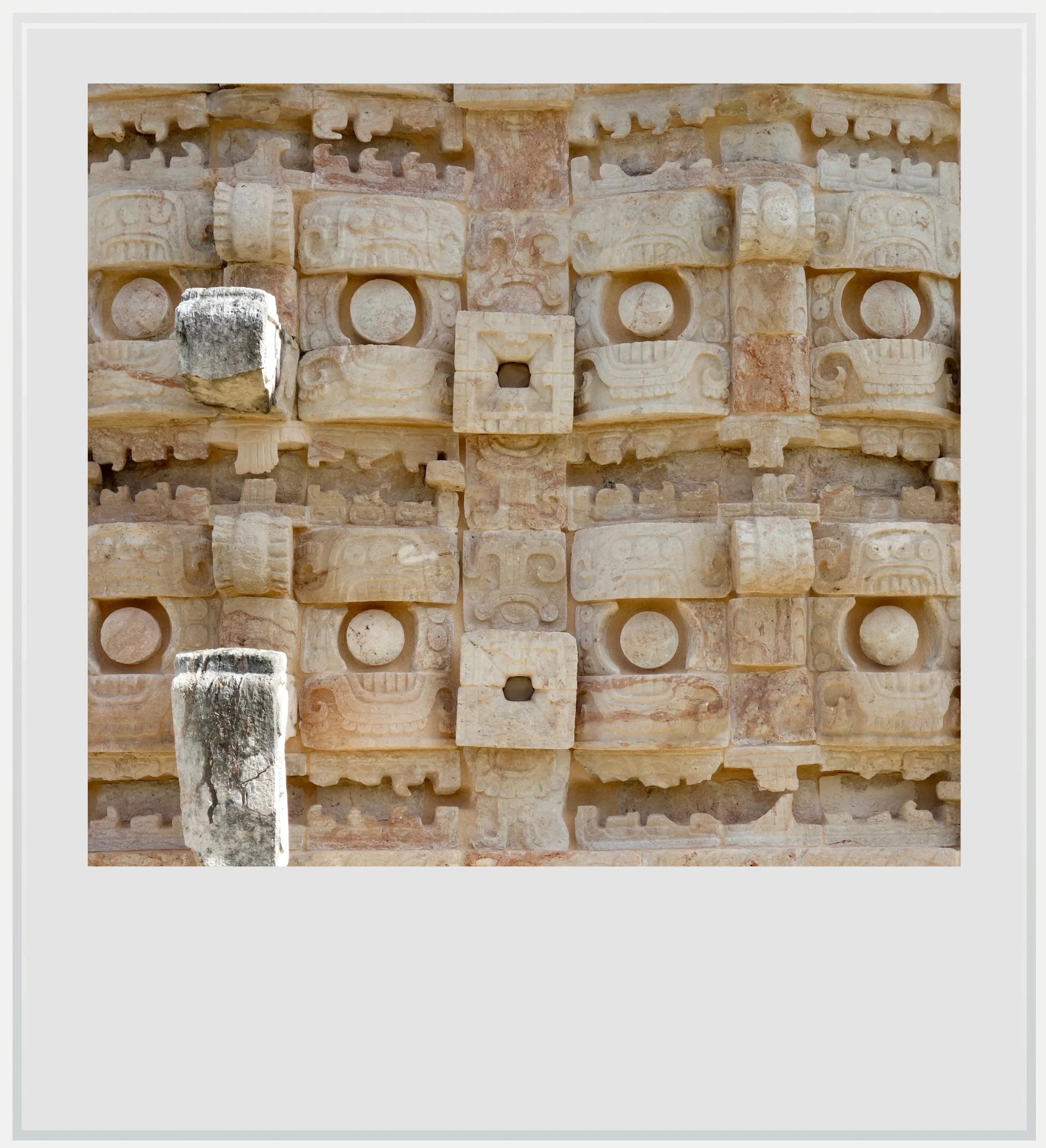
A detailed view of the Chaac masks on the western façade of the Palace of the Masks.
I assumed this was the visual effect builders were looking for. It was both humbling and a bit terrifying to stand in front of this dense cluster of stone faces, stunned by the seemingly obtuse meaning of the wall until we allowed ourselves to get closer.
From the façade emanated a sense of power, as if forces far beyond us had suddenly taken form.
It would be fair to say I approached the building cautiously. I am not a very superstitious person, but I could feel, somehow, that we were close to a building whose meaning was powerful for ancient Mayas.
We do not know the specific reasons for the existence of the Palace of the Masks, nor do we know why this extreme version of a frieze came into existence. In a region as dry as the Puuc hills, where water was never guaranteed, the presence of Chaac was hard to read as anything other than an appeal for rain. Archaeologists generally interpret the building in that way, and the sheer number of masks suggests an attempt to intensify that appeal.
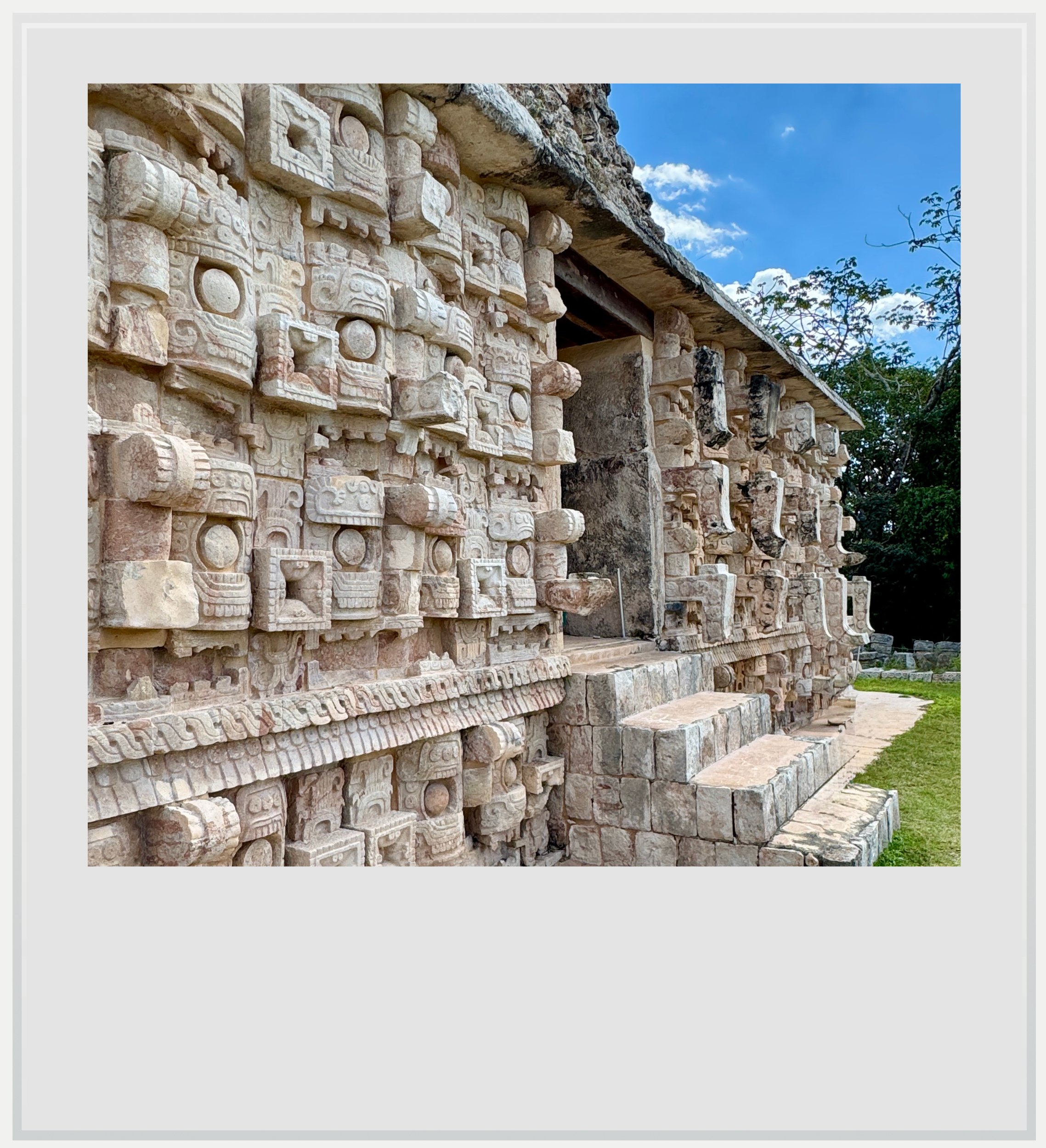
A side view of the western façade of the Codz Pop.
It is also possible that this overwhelming repetition of Chaac masks was a way to project power: whoever ordered the palace to be built could have wanted to show they were the ones who could best harness their strength to reach Chaac and bring rain.
Seeing the Codz Pop in person was an experience in itself that no photography or rendering could ever match. It was a terrific way to visually show how the Puuc style of carving building façades could be pushed to the extreme, almost broken, with an incredible, quasi-overwhelming effect.
The Palace of the Masks was a glorious anomaly.
The site of Kabah was full of other treasures, among them the main palace. It was accessible via a pathway from the Codz Pop, which made us go around the building and notice that, on its eastern side, the carvings were closer to a classic Puuc style, with repeated geometric patterns, sometimes resembling textile motifs. We also noted the presence of human figures, probably members of the elite, on the upper frieze. That part of the building felt more subdued, more human, a notable contrast with the opposite side.
The main palace was a faithful example of classic Puuc architecture, as we had seen at Uxmal earlier: a long, horizontal structure organized through repetition, with a restrained lower wall supporting a more expressive upper frieze. Here, even if the Puuc character was unmistakable, it looked subdued. The geometric repetitions on the upper frieze were there, but in pared-down patterns of three colonnettes, repeated many times along the surface of the building.
Kabah’s palace felt a little bit more austere than Uxmal, but perhaps it didn’t have to work as hard as the House of the Governor to establish its bona fides: in Kabah, the main palace was centrally located among the eastern part of the settlement, and its size naturally made it the focal point of the whole ensemble.
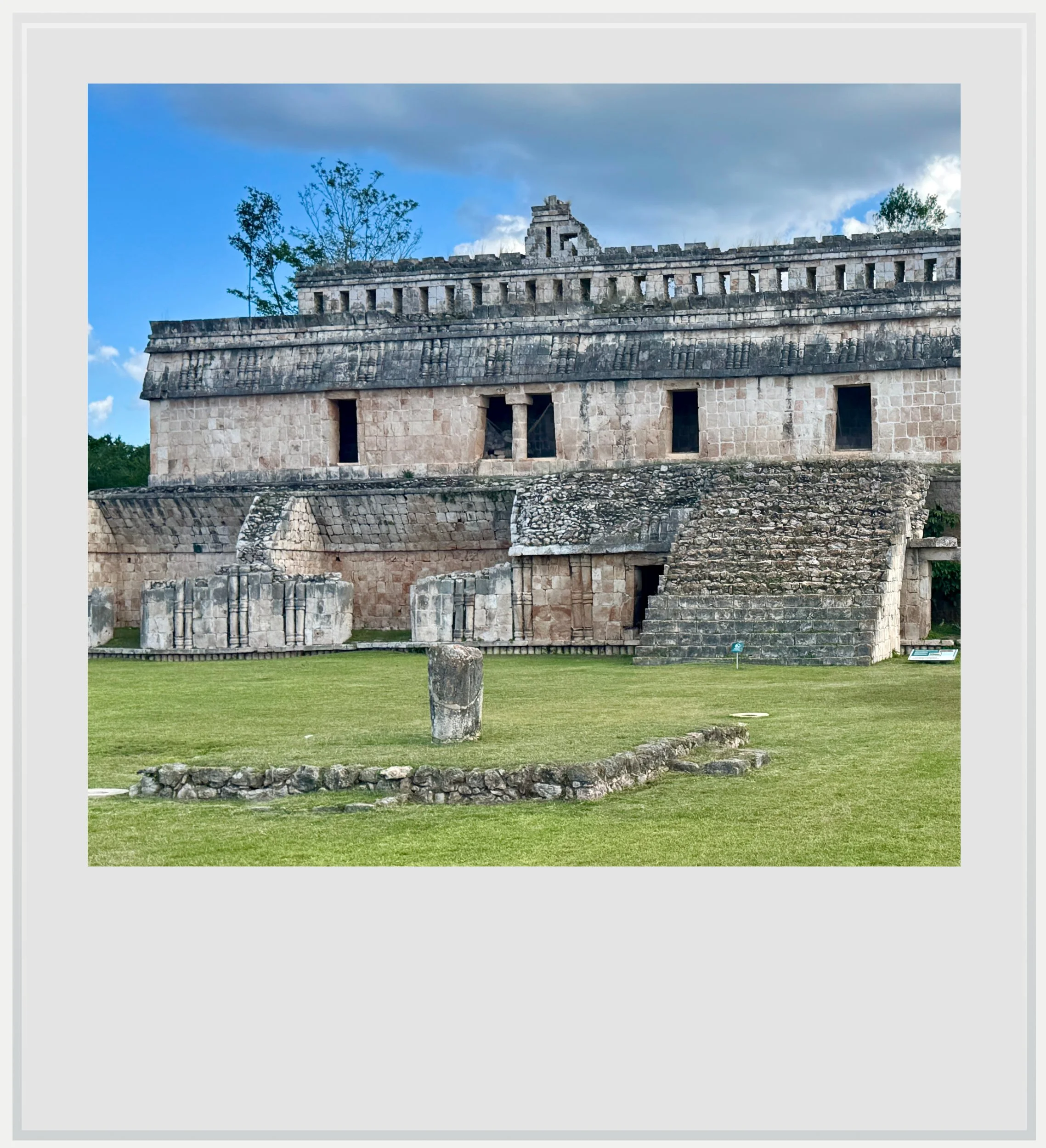
The contrast between these two palaces and the order in which we saw them mattered immensely. We had arrived thinking we were about to visit a mini Uxmal, and left knowing the site had, in fact, played with our senses. We now understood the main palace as a sort of architectural baseline, which helped make the Palace of the Mask a lavish architectural exception.
Perhaps that’s how Maya rulers saw this: a classic palace to represent power and continuity, making the exaggerated Palace of the Masks a glorious anomaly meant to reinforce the strength of the message to Chaac.
Although Kabah wasn’t as big a site as Uxmal, it extended beyond the immediate area surrounding its two palaces, across highway 261. Few people visit the other side, but it helped explain the power dynamics within the Puuc hills, although nothing could really top what we had just experienced in front of the Palace of the Masks.
More buildings had been partially excavated in that area, but none were as easily accessible as the Arch. Most likely the gate marking the entrance to Kabah, the arch formed the beginning of a direct road, or sacbe, linking Kabah to Uxmal over an 11-mile (18 km) causeway. It highlighted the importance of the relationship between the two cities.
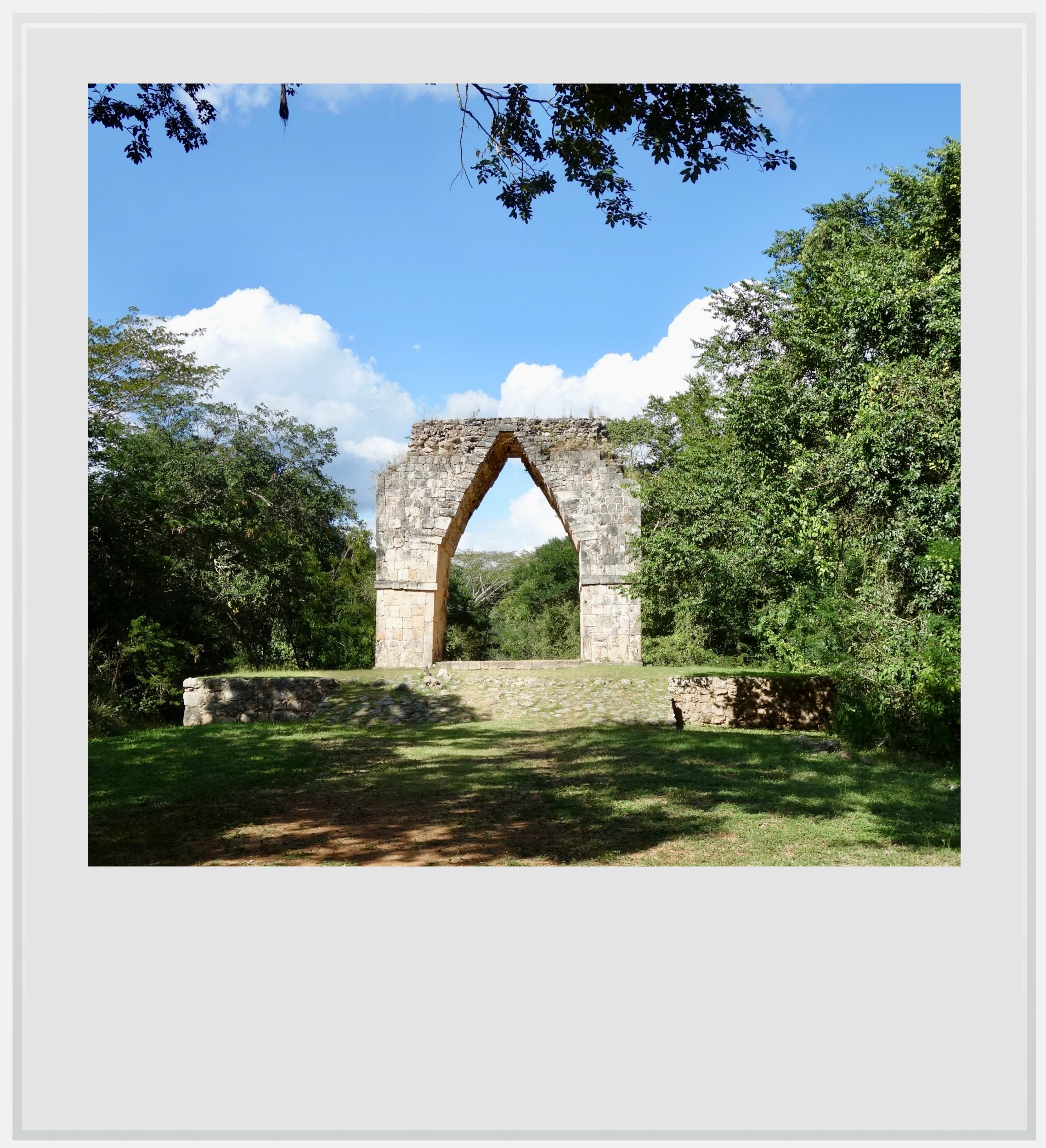
The Arch, or the entrance gate to the old city of Kabah.
We headed back to our car after a while, but the incredible visual impact of the Codz Pop stayed imprinted in my memory, not only for the unexpected display of architectural genius, but also as a contrast to the classic Puuc style, which, hours before, had seemed to us the pinnacle of Maya design.
Practical information
(Everything you could possibly want to know about Kabah - updated April 2026)
In a nutshell
Kabah, a Maya site in the Puuc hills of Yucatan, looks, at first, like a quieter extension of Uxmal. Then the Palace of the Masks appears, and those rules begin to unravel, turning repetition into something so dense and disorienting it almost breaks the language of the style itself. The site is a great complement to a visit to Uxmal, a few miles to the north.
How to get to Kabah
How to get to Kabah from the US: the easiest way to reach Kabah from the US is via Merida. There are about 15 flights a day from Mexico City, making an air connection from the US through the capital convenient. Alternatively, several airlines provide non-stop service between Merida and the US: United Airlines from Houston (IAH), American Airlines from Dallas (DFW) and Miami (MIA), VivaAerobus from Miami and Orlando (MCO). See below for instructions once in Merida.
How to get to Kabah from Mexico City: the capital sees around 15 flights a day depart towards Merida’s airport, either with Mexican flag carrier Aeromexico, or with low cost airlines VivaAerobus and Volaris. Flying is more convenient than taking a bus. ADO links Mexico’s TAPO station with Merida’s TAME terminal up to 8 times a day, but the travel time is 17 hours and prices not that much cheaper than flying.
How to get to Kabah from Merida: there are two solid options to get to the Maya site.
rental car - this is the most convenient way to visit the area, and pretty much the only option if you’re aiming to visit other sites further on the Puuc route. Car rentals are widely available at the Merida airport and in town, from a variety of national and global brands. Price should hover around USD25 to 50 per day for an economy car. Driving to Kabah from Merida is fairly easy. The key is to reach highway 180 towards Campeche, then take highway 261 towards Kabah and follow it all the way to the Kabah site, past Uxmal and Santa Elena. The site is visible from the road, and therefore hard to miss. The drive should take approximately 1h20, and the roads are in good condition.
find a tour. Many options to visit Uxmal, the main Puuc site, are available on global platforms like Viator or Get Your Guide, and some include Kabah, the next stop on the route. Prices vary between USD 75 and 150 depending on options and group size.
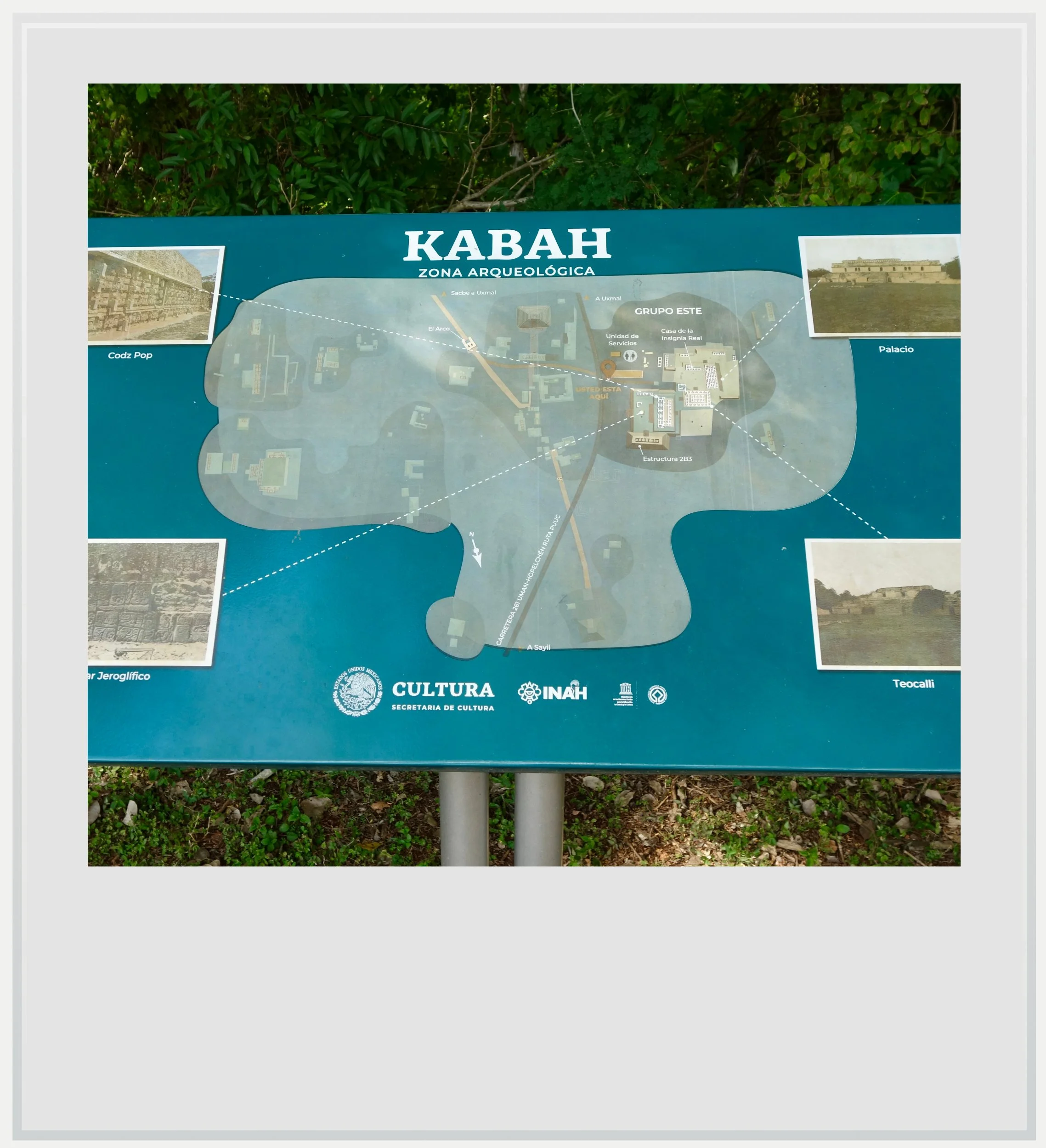
The orientation map at the site’s entrance.
When to go to Kabah
The best months weather-wise to visit Kabah are during the dry season, between November and April, with January and February the (relatively) coolest months. This is also peak season, but Kabah is hardly ever crowded, although a touch more visited than Puuc sites further south.
Most people visit the Puuc sites in order, starting with Uxmal, so it is likely you’ll hit Kabah just before or after lunch, at a time where the sun is strong and the light a little flat. There isn’t a lot of shade around, but the site visit is relatively fast and should be OK even during the hottest hours of the day.
Alternatively, a mid-afternoon visit (from around 3pm), on the way back from Puuc sites to the south, will offer cooler temperatures, better light and fewer people, though you would need to manage your time before closing.
I visited Kabah in late December, during the peak season, after an early lunch, and the heat was tolerable (but it will be different in the humidity of a summer day).
How much does it cost to visit Kabah
At time of writing, the price was MXN 155 for foreigners, and MXN 85 for Mexican citizens and legal residents with credentials.

How long should a visit to Kabah last
The site isn’t a big as Uxmal, and a visit can be done in 40 minutes to 1 hour, depending on whether the focus on only on the two palaces on the east of highway 261, or on the entire site.
What are the opening times of the Kabah site
The site is open every day from 8 AM to 5 PM, with the last entry allowed at 4 PM.
Food & lodging in Kabah
Hotels
For most people, accommodation in Merida will make the most sense, if a visit to Kabah is part of a bigger Puuc route trip. There are plenty of hotel and Airbnb options in the Yucatan capital.
If you would rather stay close to the Kabah archeological zone, say, to save on drive time in the morning, I recommend the following two hotels:
The Picked Onion in nearby Santa Elena. I stayed there during my second Puuc route visit, and enjoyed the quiet surroundings. Rooms are single casitas, built in the regional style, that blend into the vegetation of a lovely garden. Comfort is basic but decent. Breakfast is included. The hotel sits between Uxmal and Kabah, less than ten minutes from the Kabah entrance.
Hotel Mundo Maya “Nuevo Uxmal”. While I haven’t stayed at this hotel, I sampled its sister properties in Calakmul and Edzna, and the experience was similar enough to see a positive pattern. Built by the Mexican state alongside the Tren Maya investments, Mundo Maya hotels are meant to bring premium hospitality to more remote areas of the Maya world, to spur a tourism expansion. The hotels are beautifully done, the rooms luxurious, and the prices very competitive. This hotel only makes sense if Uxmal is your first stop of the day, as it is located 30 minutes from the ancient Puuc capital, and 45 minutes from Kabah.
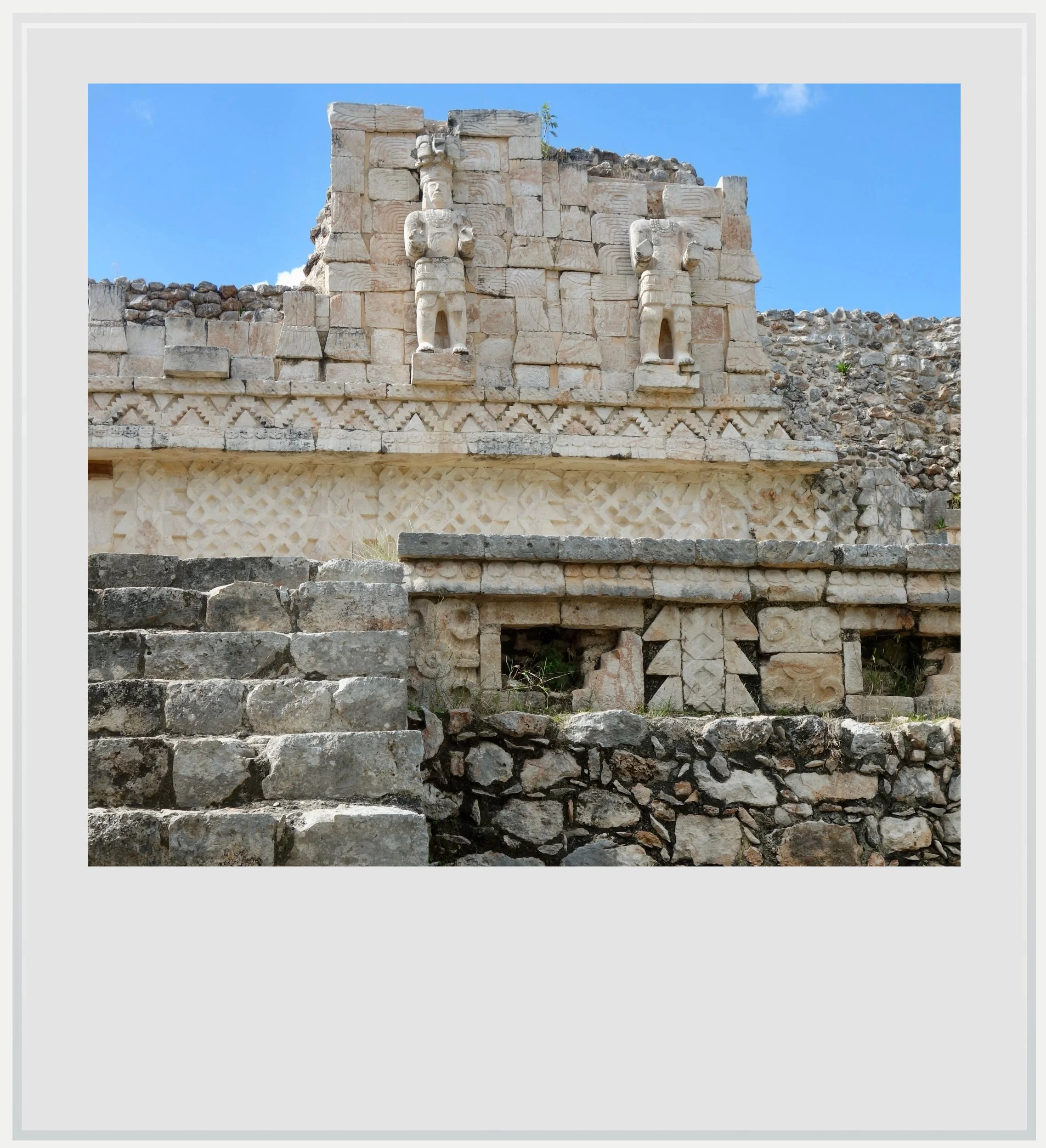
Human figures on the eastern façade of the Codz Pop.
Restaurants
If you’re coming to Kabah as part of a short day trip along the Puuc route, including perhaps only Uxmal and Kabah before heading back to Merida, it may make sense to delay having lunch until you’re back in the beautiful colonial city. If, however, Kabah is only one first stop among several others on the Puuc route, you will need to find lunch along the way. Most of the restaurants on the route seemed well regarded locally, but didn’t always feel like places we could stop at without hesitation. We had trouble finding a place for lunch in Santa Elena, and drove to nearby Ticul to enjoy a really good meal at the El Principe Tutul Xiu hotel, where the restaurant opened at 11 AM for lunch.
You’re able to buy snacks right after the entrance in Uxmal, within a nice tourist area featuring a few souvenir shops and a coffee station, but past Santa Elena towards the rest of the Puuc route, there is absolutely no store or food stand so make sure you break for lunch before leaving Santa Elena, and therefore, before getting to Kabah.
Safety in Kabah
The State of Yucatan is considered one of the safest regions in Mexico by the U.S. Department of State and is not subject to a specific travel advisory as of publication. While Mexico as a whole is listed at Level 2 (“Exercise increased caution”) and some states, such as Zacatecas or Guerrero, are classified as Level 4 (“Do not travel”), Yucatan remains one of the safest states in the country, and no precautions beyond basic common sense are generally necessary for visitors.
The ancient settlement of Kabah is considered safe. It is a well-known tourist site on a relatively well-traveled road. The main danger in this part of the peninsula is remoteness. It is recommended to avoid driving (or being driven) at night, when risk increases: the area is fairly isolated, with no cell service, so any issues happening on the road at night could possibly spiral.
Keep in mind these travel tips
Heat isn’t a joke in Yucatan, and even in the dry season, temperatures can get very high around midday. Make sure you hydrate regularly and keep a water bottle with you.
The UV index may be low in the morning and evening, but during the day, it gets pretty high. Wear SPF.
Bring cash. While many shops accept foreign credit cards, bus companies, taxi drivers, and many smaller boutiques do not. Some restaurants were cash-only as well.
There are no shops on the route past Santa Elena, so any drinks or snacks will need to be purchased there before heading further south, or in Uxmal, where a coffee station offers beverages and snacks, inside the fee area.
Cell service can be spotty outside of cities, and although Telcel signal was strong overall near Merida, it disappeared approaching Uxmal, and didn’t reappear later along the Puuc route. Kabah is therefore a no-service zone. No other provider covered the area either. Telcel is usually the safest bet in Mexico for coverage. If you’re roaming, check that you can roam on Telcel, or investigate a Mexican eSIM that uses this network. Telcel coverage is independently mapped here. Change the network in the dropdown menu at the top to see other companies.
Every photo caption appears if you hover over it (on a computer) or click on it (on a smartphone).
All photos are mine and copyrighted.