El Meco, Mexico.
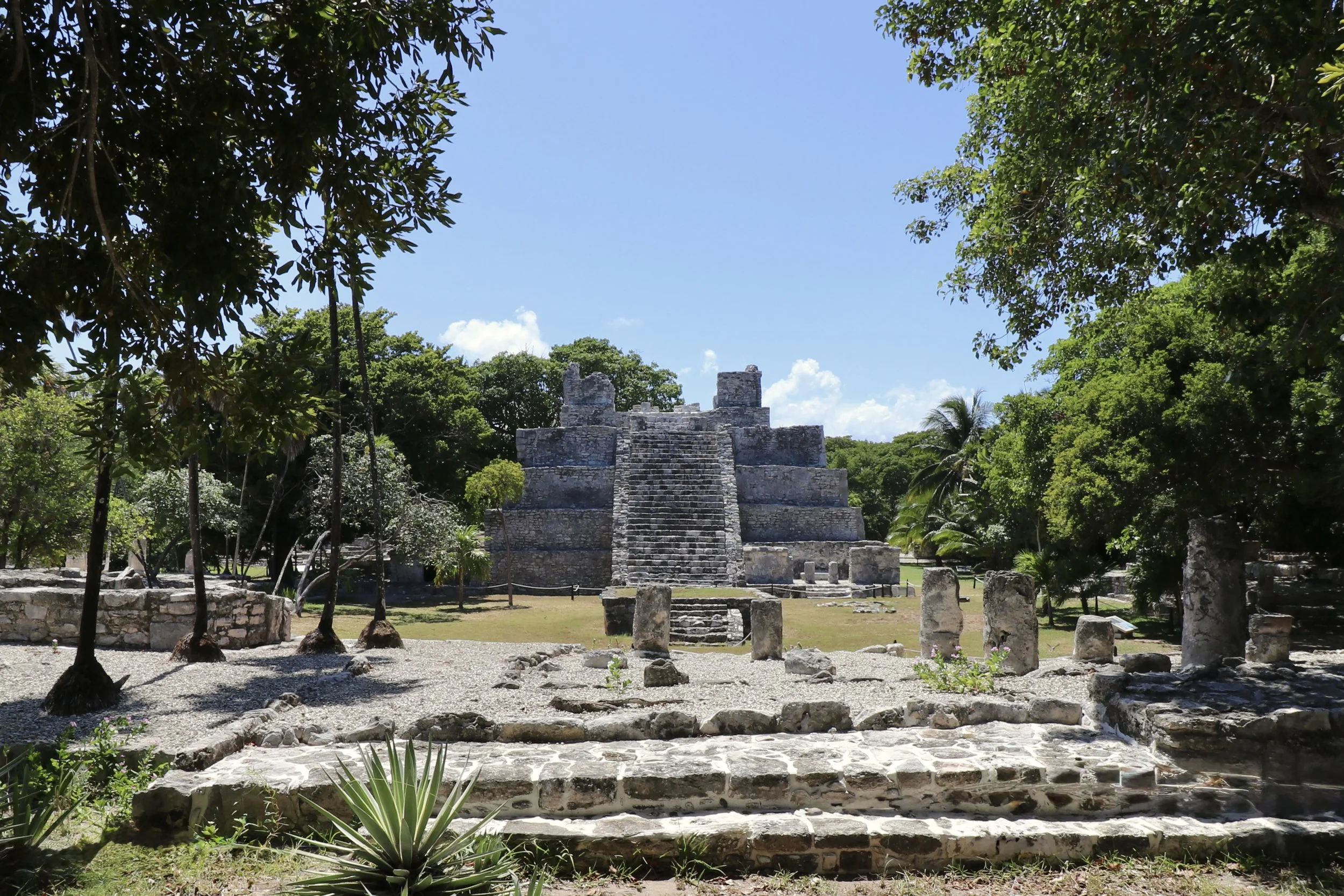
A ancient Maya port city caught between the Caribbean Sea and modern Cancun.
Looking for directions or opening hours? Head straight to the Practical Information section.
It was past 3pm in Cancun and I had just made my way to the parking lot of El Meco, one of the few archeological zones scattered around the city. I wished I could have waited a little longer to visit the site, as the summer heat was stifling, but entry was only allowed until 4pm, so here I was, braving the unrelenting sun.
Not many tourists coming to Cancun are aware that the area was heavily populated by the Maya before the Spanish conquest. In fact, most people looking for ancient Maya cities to discover will zero in on Chichen Itza or Tulum, further away, but very few ever realize that some of the best examples of Coastal Maya architecture are located right there, at the northern edge of the Cancun suburbs.
The first thing that struck me, as I parked my car in the shade-free parking lot, fearing the time I would go back to what would basically feel like a mobile sauna, was how pristine and well-maintained the area around the archeological zone was. This wasn’t something entirely unexpected: as part of its commitment to increase visitor numbers in the Yucatan peninsula, and in connection with the opening of the Maya Train, the Mexican Government has been pouring funds to upgrade the infrastructure around some of its most famous Maya archeological zones. El Meco benefited from this, with enhancements and upgrades completed in late 2024.
The most unexpected feature was the pedestrian bridge, linking the parking area, abutting the Caribbean coast, and the actual ruins on the other side of the road. A few decades prior, the ancient city was one, but the road leading to Punta Sam actually split it in two. Today, the contrast is a little disconcerting: at first glance, it makes little sense to have set up the welcoming area on the right side of the road, with the parking, ticket office and shaded benches, when the actual monuments sit on the other side.
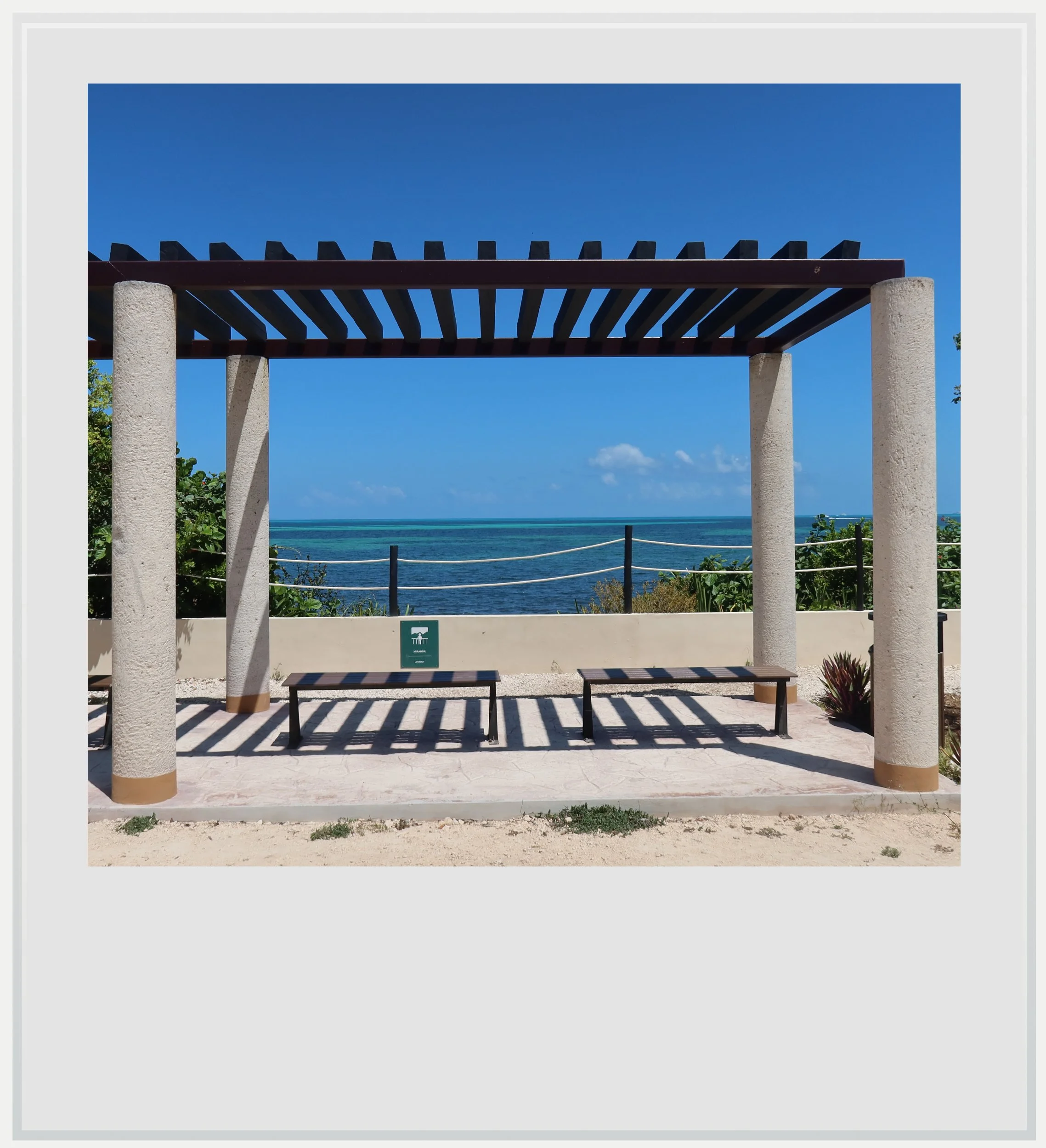
Shaded benches with a sea view.
The explanation is much more mundane than I initially assumed: although no Maya buildings are visible on the parking side, they do exist - excavation work hasn’t been completed yet. What we do know is that El Meco, given its location right by the water, in front of Isla Mujeres, had a strong relationship with the sea. I hope that the works will start soon to reveal what must have been a very active port area in ancient Maya times. In that respect, the location of the visitor center and the bridge made a lot of sense: they provided a physical link to make the old settlement one again.
For me, the bridge played another role, that of the perfect elevated viewpoint from which to take in the majestic Castillo, the main building. It felt very cinematic, the edifice gradually revealing itself as I climbed the bridge ramp, seemingly inviting me in.
The second thing that drew my attention, as I was crossing the bridge, was how discovering El Meco would be different from most of the Maya cities I had already visited. Major Maya sites like Uxmal or Edzna sit away from main population centers and feel isolated, almost disconnected from any sort of modern urban fabric.
Here, I was experiencing a curious sort of cognitive dissonance: the settlement of El Meco, although small, was relatively well preserved, yet it was sliced by the road to Punta Sam, flanked to the south by encroaching Cancun suburbs, and boxed in to the north by the cruise-ship-sized St Regis hotel, which had opened only weeks earlier. From the bridge, the sight was almost surreal, a stunning Maya temple dwarfed by a massive hotel building, the two erected hundreds of years apart. Crossing the road felt like traveling from one era into another in a time machine.
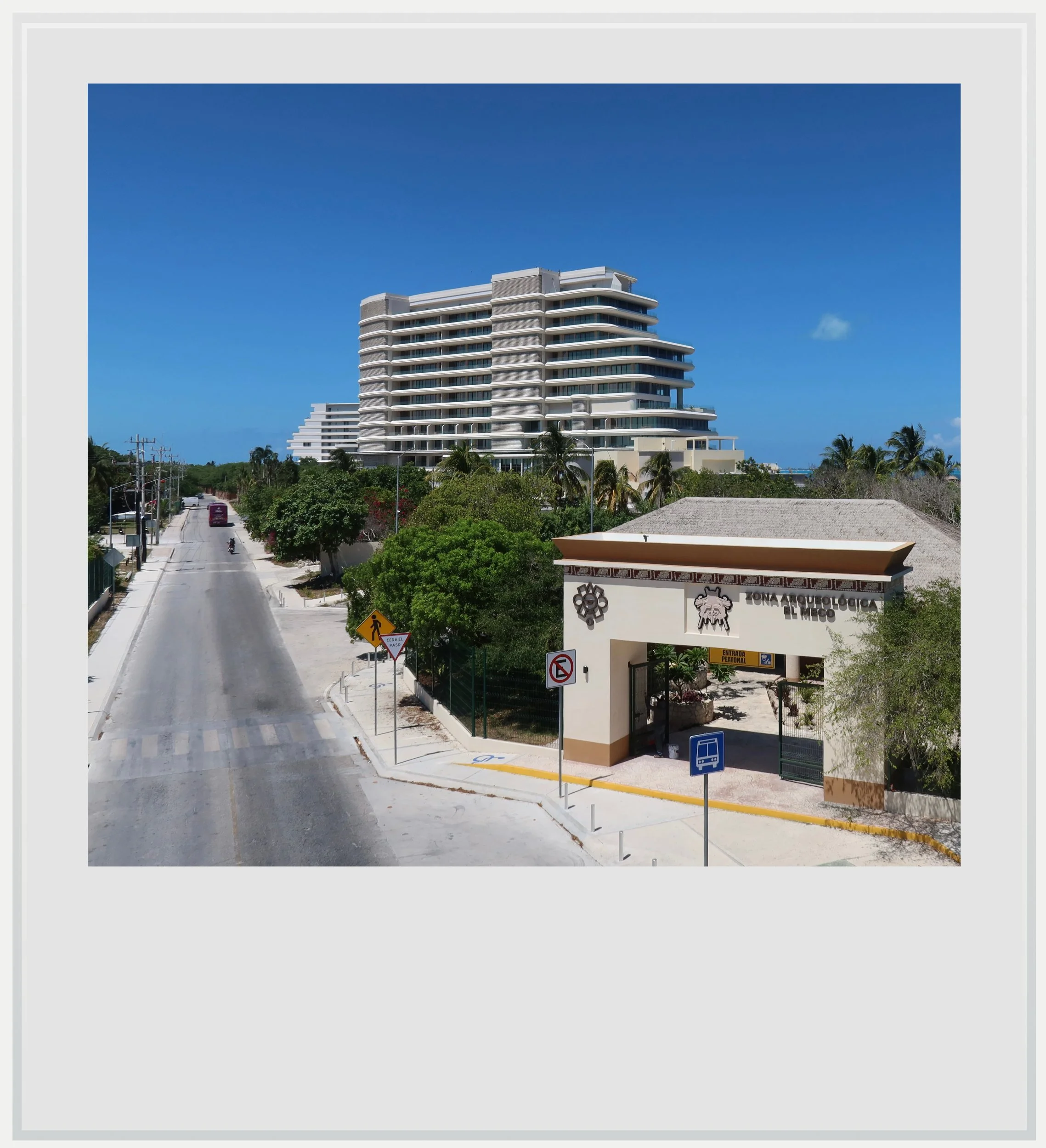
The entrance to El Meco, with the new St Regis hotel in the background.
Although El Meco had been the first stop of my Maya itinerary around Cancun, it felt instantly familiar in style and size. I had visited the Tulum ruins years ago, and its iconic main building, perched just above the Caribbean Sea, immediately came to mind. El Meco’s Castillo had a similar pyramidal form, an unusual one for the Late Postclassic cities of the eastern Yucatan coast.
The familiarity extended beyond the pyramid. Both sites are emblematic of a Maya building style called Costa Oriental, or East Coast, which I would encounter again in San Miguelito and El Rey a few days later.
The sight was almost surreal, a stunning Maya temple dwarfed by a massive hotel building
It is believed that El Meco started as a small fishing village in the Early Classic period of the Maya civilization, around 300 AD. From this period, not much is left, for the Maya tended to expand some of their buildings over time. The site was abandoned, probably during the Late Classic period, only to be occupied again at some point after 900 AD, although the exact dates are currently debated.
Over time, smaller polities had emerged in the Maya world, ruling over more fragmented territories, and I asked myself whether it could help explain why El Meco’s Castillo, 41 feet tall (12.5 meters), was the tallest Late Postclassic pyramid on Yucatan’s eastern coast - compare this to Structure 2 in the great Maya capital of Calakmul, reaching 180 feet (55 meters). The official answer isn’t settled.
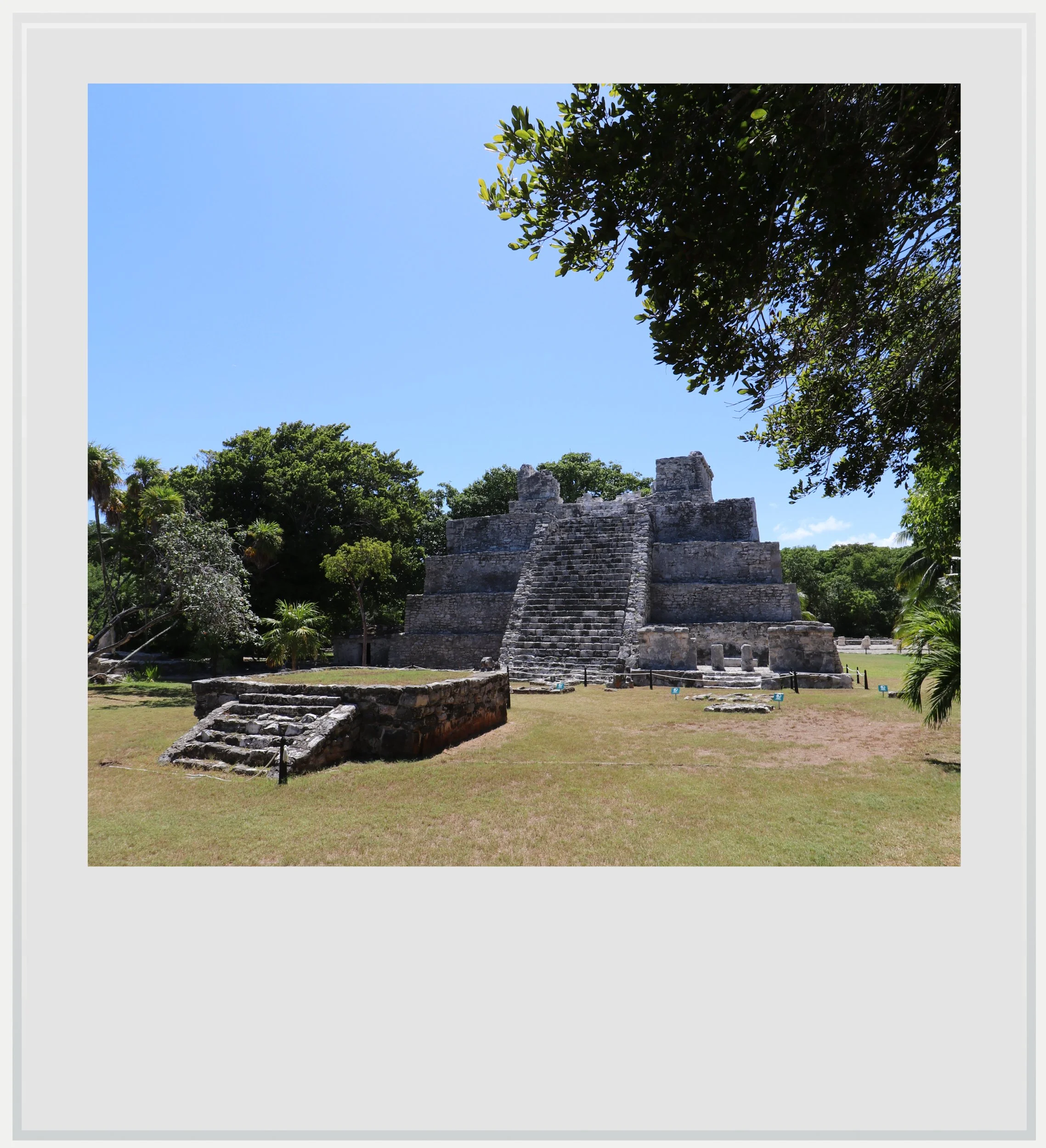
El Meco’s Castillo
El Meco’s Castillo was a pyramid built on four levels and was topped with a temple, but the access to it felt less inviting. With its tall, vertical walls, it looked to me more like a defensive fort than a place of worship.
It seemed as if some of the virtuosity and intricacy of the Late Classic stonework, seen in the Puuc cities or in the Chenes region, had given way to something seemingly more utilitarian. It doesn’t mean later Maya cities were any less sophisticated: recent archeological research tends to point to the architecture reflecting different systems and spatial priorities.
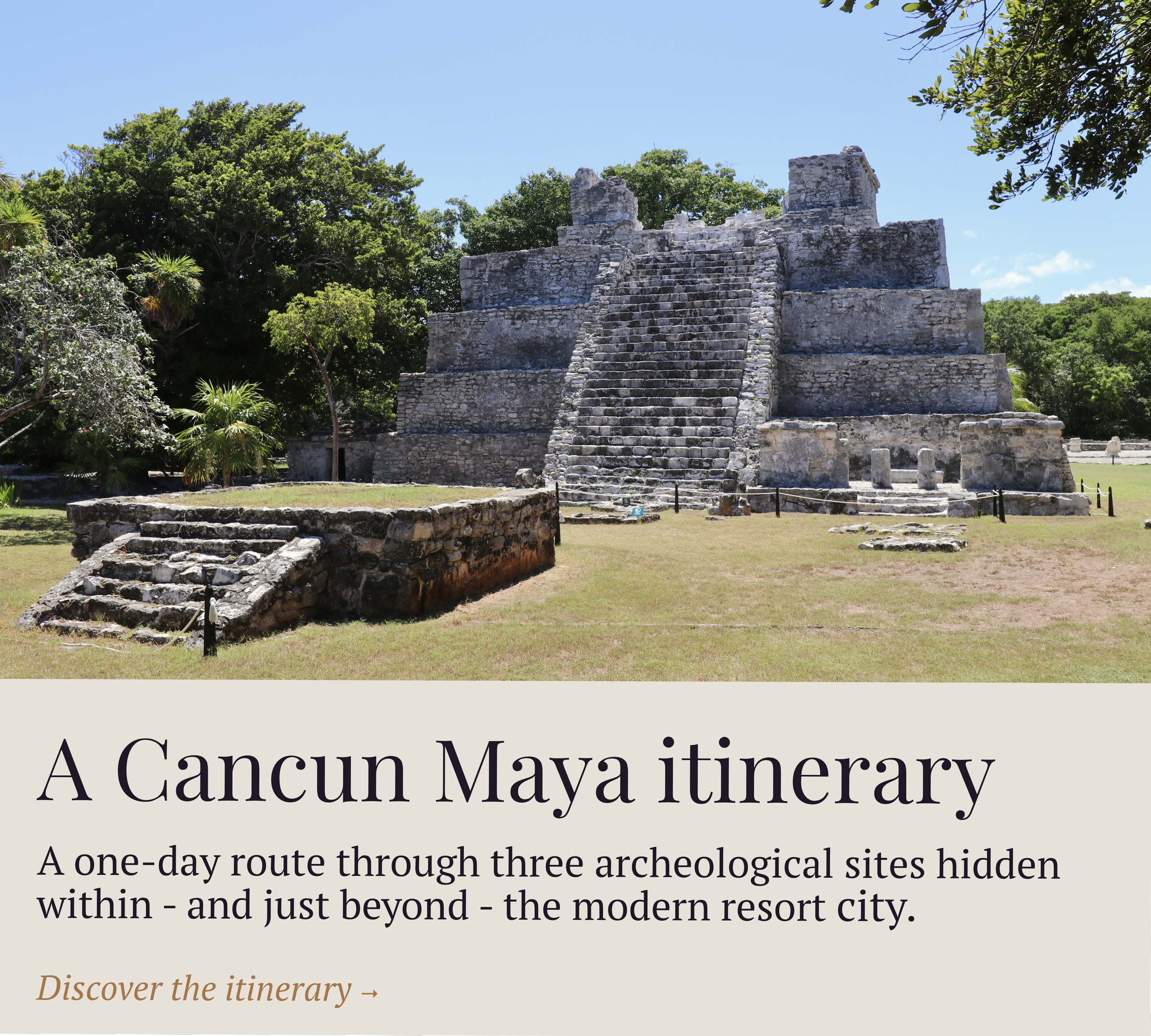
That is not to say El Castillo wasn’t a stunning building. Beautifully restored, at least on its main facade, the building’s proportions are both elegant and massive, clearly marking it as the focal point of the settlement. It faces the sea - the only Late Postclassic Costa Oriental pyramid in this configuration - and the southern tip of Isla Mujeres, looking towards another ancient Maya site on the island. It is believed that this unusual orientation had to do with the relationship between these two settlements.
While it would be tempting to deduce the temple was dedicated to Kukulcan, a deity closely associated with Chichen Itza, as the two snake heads carved at the bottom of its main staircase recall the much bigger ones featured on the Kukulcan pyramid there, we don’t know this as a fact.
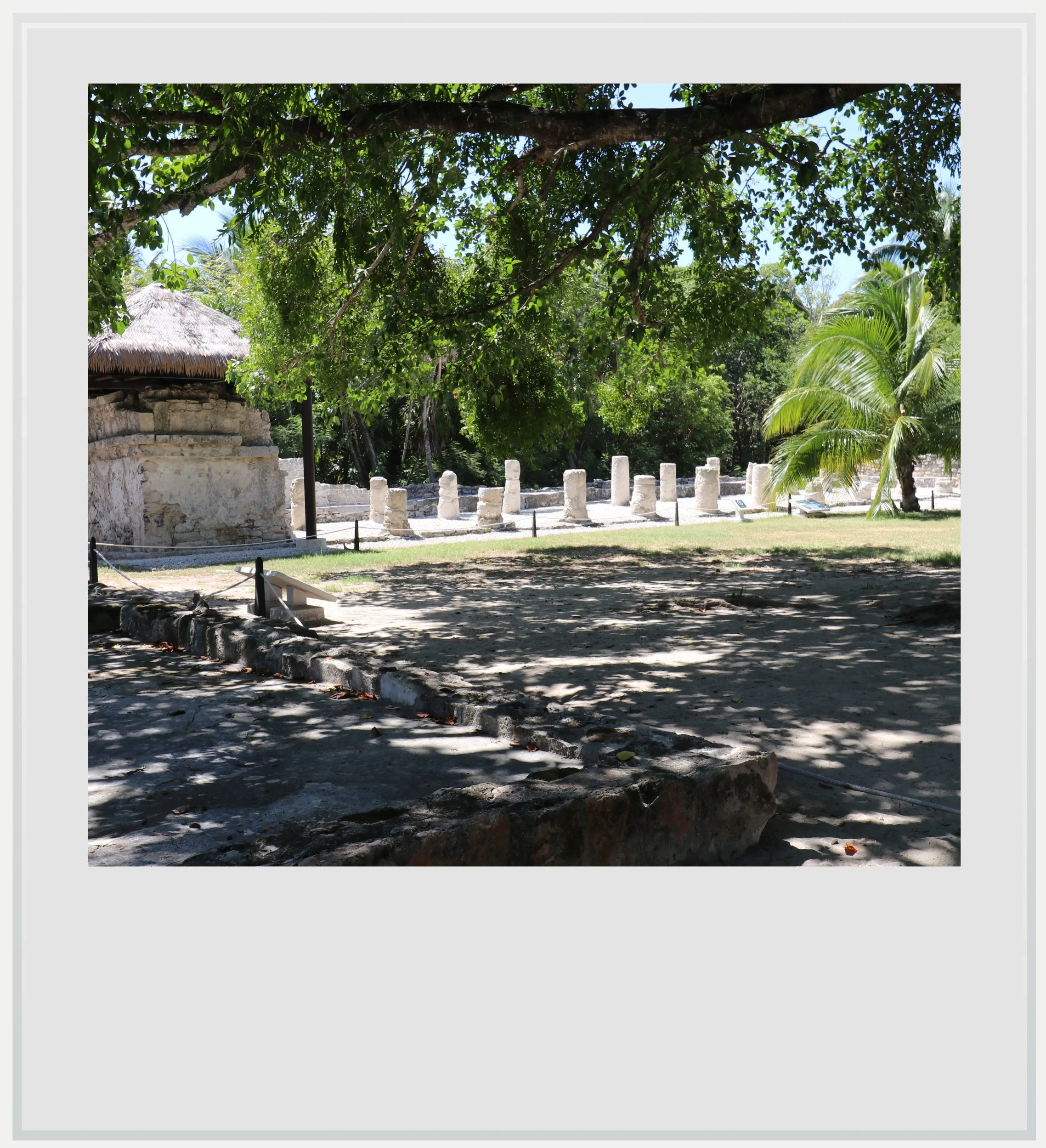
El Meco’s Structure 12.
Escaping the shade surrounding the main building, I checked out other structures, careful not to disturb the many iguanas lounging in the sun, seemingly oblivious to my presence. The second-most interesting building was Structure 12. Sadly not as well preserved as El Castillo, it is nonetheless a beautiful example of the Costa Oriental building style: flat, long and supported by columns. It isn’t currently known why builders came to rely on this newer construction style at that point in Maya history, but one consequence is that using flat roofs enabled the creation of wider rooms and larger vestibules than in some older Maya styles.
In fact, Structure 12 is believed to have served an administrative purpose. Archeologists suggest the large bench seen on the back wall may have been used as a waiting area for people to see an official. While partially speculative, I appreciated this detail as it helped me visualize how the inhabitants of El Meco might have been lined up here on an ordinary day. Suddenly, the building felt alive, part of a city that was once a prosperous port.
As I was turning around to check out the few other buildings on site, I noticed some noise: a family of tourists had arrived, breaking the solitude of my exploration, and reminding me it was time to let them enjoy this beautiful Maya settlement on their own. Walking back on the bridge towards the parking lot felt different. I had been immersed in a deserted Maya city, surrounded by vegetation, and suddenly, all I could see in front of me was the Caribbean Sea.
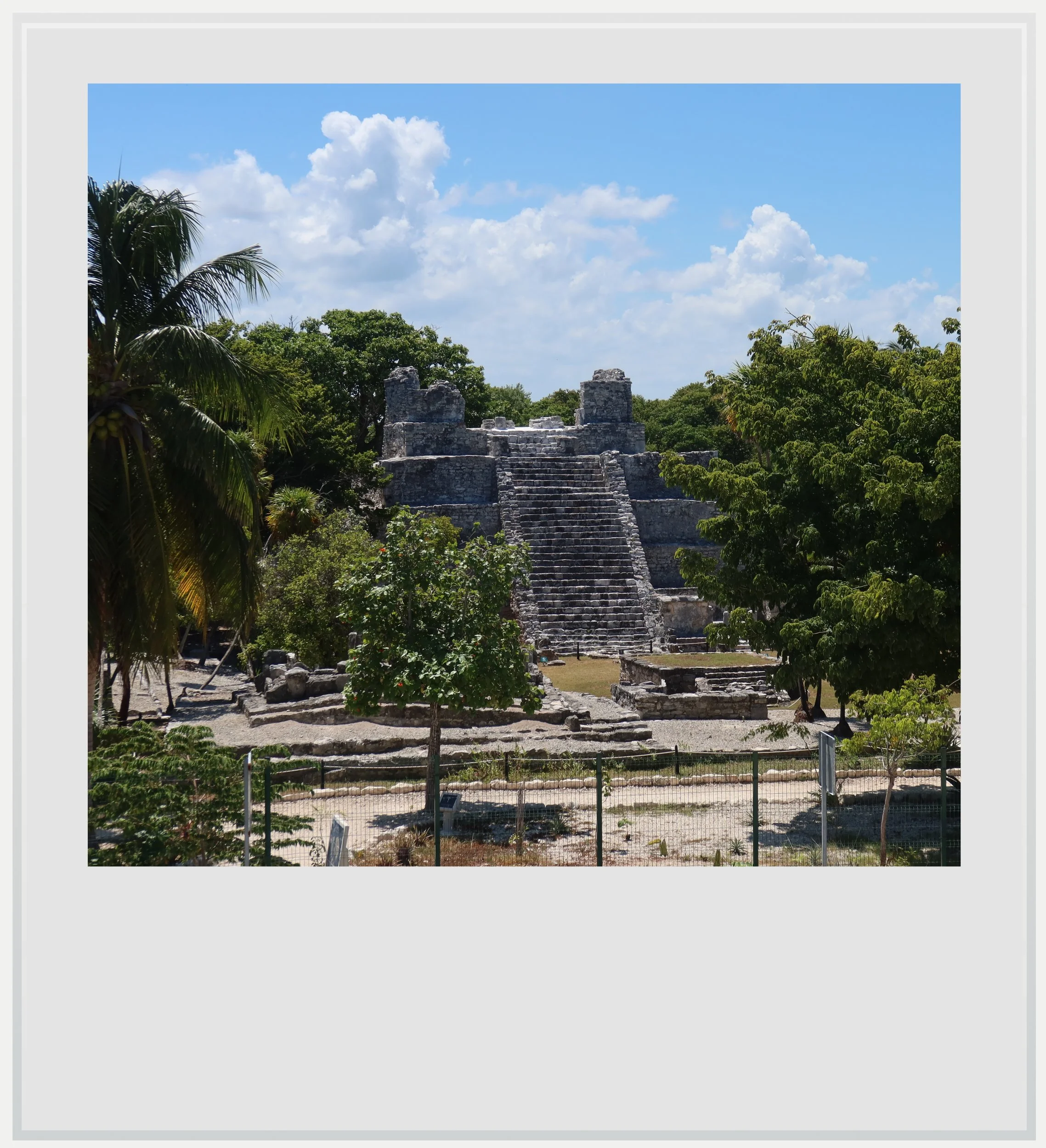
El Castilo seen from the entrance bridge.
I realized I had probably misunderstood the relationship between El Meco and its surroundings. From the bridge, the Maya city didn’t feel surrounded by Cancun - although it clearly was. It was instead oriented towards the water.
I turned around to look at El Meco one last time, and the temple at the top of the Castillo seemed to be at eye level, but looking beyond me, towards the cerulean water. For a fleeting second, the experience of looking at the sea at the same height as the Maya priests several hundred years ago felt extraordinarily powerful.
Practical information
(Everything you need to know about visiting El Meco - updated August 2026)
In a nutshell
El Meco, an ancient Maya settlement north of Puerto Juarez, is a great example of Costa Oriental Maya architecture and features a stunning and well restored temple, less than thirty minutes away from Cancun’s Hotel Zone. It’s an easy immersion into the Maya world that doesn’t require several hours of travel time, and can be a great break between beach days.
Getting to El Meco
How to get to El Meco from the United States: El Meco, close to Cancun, is one of the easiest Maya archeological zones to reach from the US or Canada. Many North American cities enjoy non-stop service to Cancun, at least seasonally. On a typical day in November, 25 cities in the US and Canada can be reached non-stop from the famous Mexican city.
How to get to El Meco from Mexico City: Mexico City to Cancun is one of the busiest air routes in Mexico, with more than 20 flights a day and three airlines (Aeromexico, Viva Aerobus and Volaris). The flight takes approximately 2 hours.
How to get to El Meco from Cancun airport: from the airport, El Meco is easy to reach by rental car (about 30 minutes) or by taxi (rideshare services are more complicated as Uber and the like are technically not allowed to pick up from any of the terminals). Google Maps directions are straightforward, and the archeological zone offers parking. Note the car park and the ticket office is located on the right of the road coming from Cancun, while the actual Maya buildings are on the other side - you cross through a pedestrian bridge affording beautiful views of the old settlement as well as the Caribbean sea.
It is also technically possible to get to El Meco using public transport. From the airport, take an ADO bus to the Cancun ADO station (MXN 170, every 15-20 minutes, trip duration 45-60 min), then a R1 city bus (MXN 12, every 10-15 minutes) all the way to El Crucero, where colectivos going to Punta Sam depart when full, and can drop you off by El Meco for MXN 15. It will take significantly more time than a taxi or a rental car, but it can be done.
Can I get visit El Meco on a tour: tours including El Meco are available on many global tour websites, but most pair El Meco with other stops that may not suit you. In any case, it is possible to visit the archeological zone with a tour.
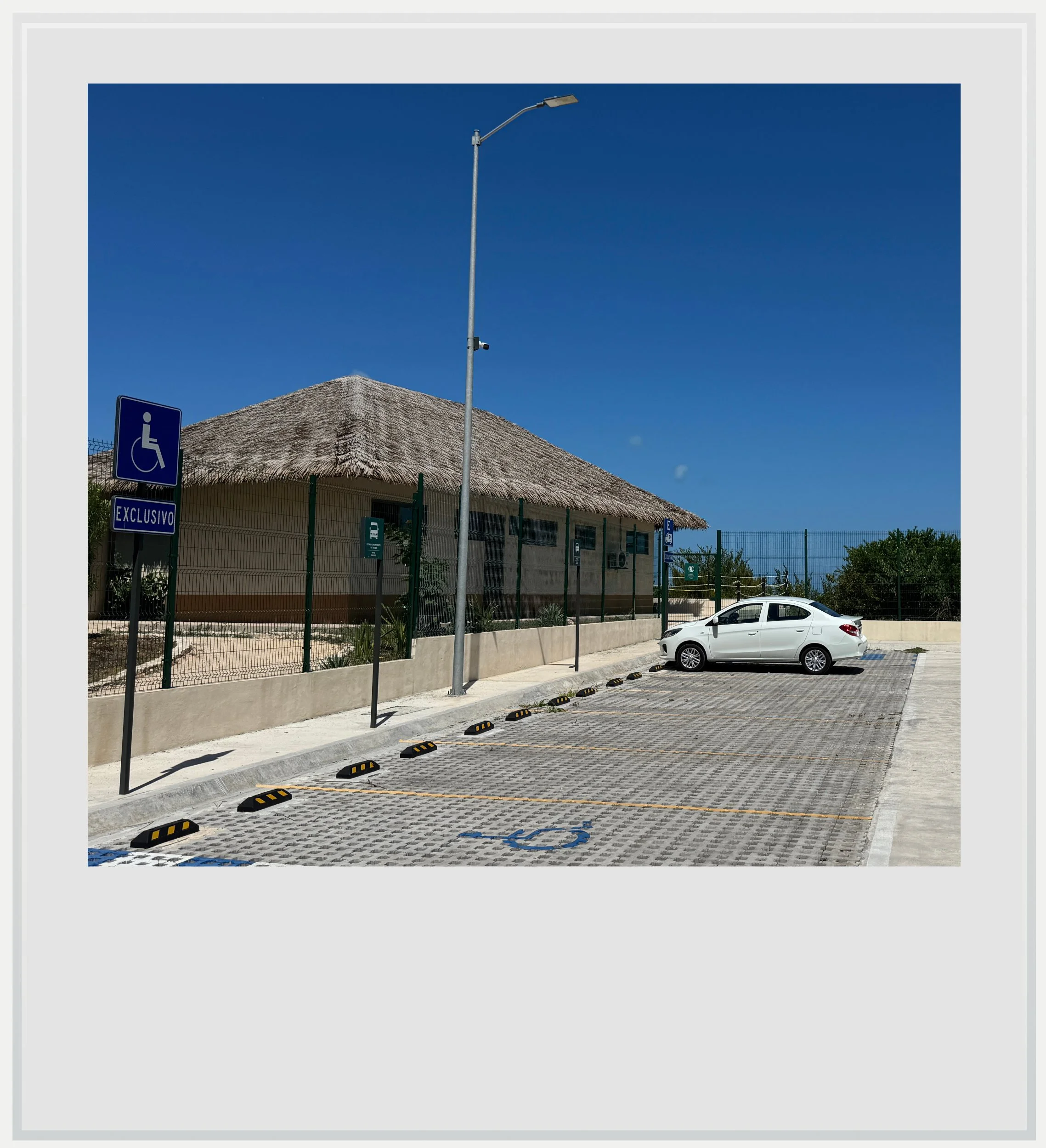
El Meco’s shade-free parking lot.
When to go to El Meco
The best months weather-wise to enjoy El Meco are during the dry season, between November and April. This is also peak season but the site doesn’t see many visitors, so it is unlikely to ever get crowded (the parking area has less than 20 spots). I went to El Meco in August, at a time when the heat and humidity in Quintana Roo can feel too much, and while I would suggest to avoid a visit during the hottest hours of the day, getting there early in the morning or after 3pm should be manageable.
Very few services are offered on the site except bathrooms and a lovely viewing area overlooking the Caribbean sea.
What’s the best time of day to visit El Meco
Given the site’s orientation, it is best to hit El Meco in the morning, when the main façade of El Castillo, its most important building, catches the morning sun. An afternoon visit will still be nice (I can attest), but the best light conditions will occur in the morning.
How much does it cost to visit El Meco
The entry price was MXN 145 for foreigners and MXN 80 for Mexican citizens and official Mexican residents, with proof of residency, at the time of my visit.
How long should I plan to visit El Meco
Plan to spend 30 minutes to an hour on site, as it isn’t very big. Beyond El Castillo, its main attraction, the site offers several other buildings in various states of preservation to look at. The site was recently renovated and includes benches, located in the shade, which can make for a nice break.
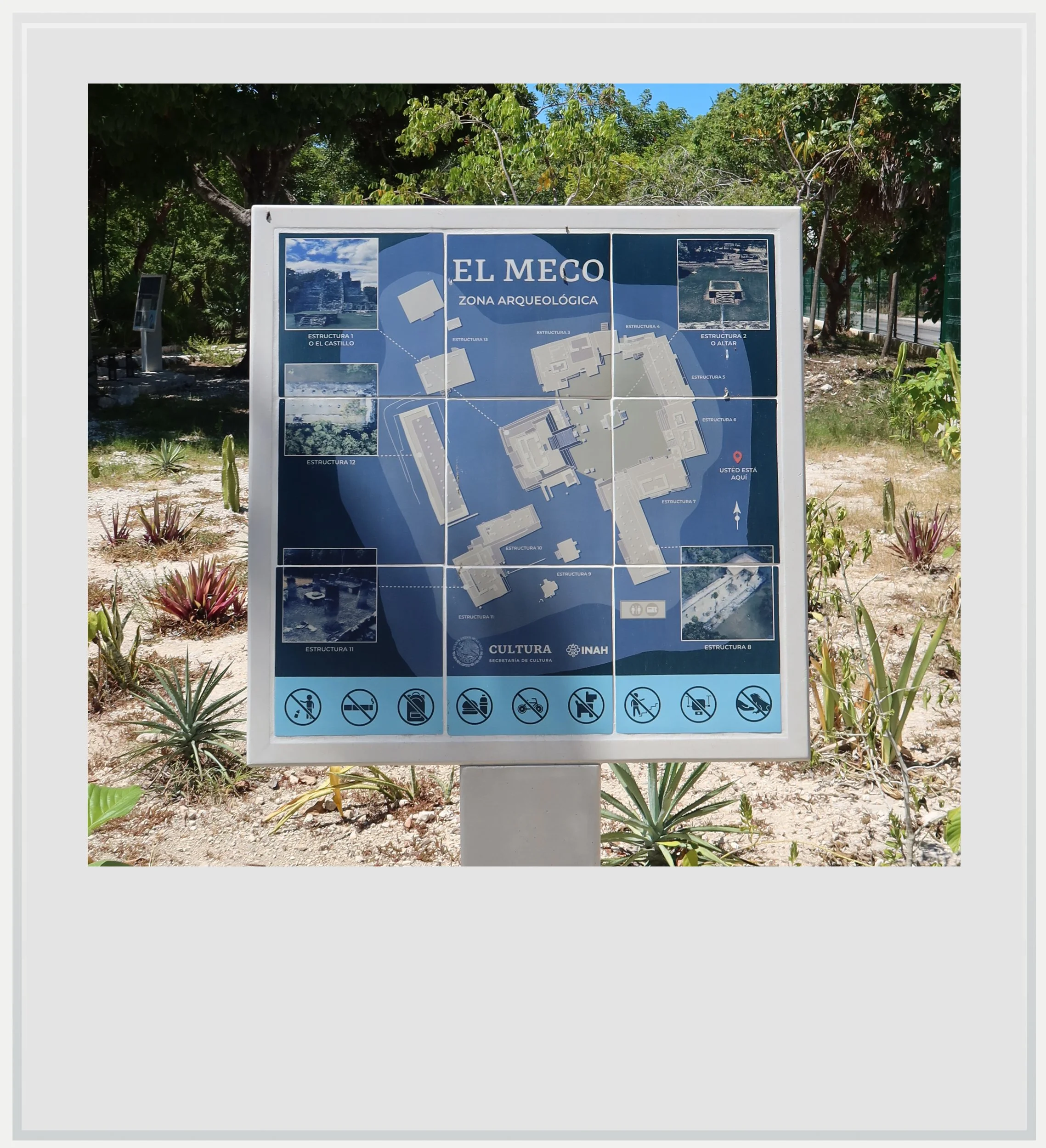
The orientation map at El Meco.
What are the opening times of El Meco
The site is open every day from 8am to 4.30pm with entry allowed until 4pm.
Safety at El Meco
The Yucatan peninsula is one of the safest areas in Mexico. The U.S. State Department currently classifies Quintana Roo as Level 2, meaning travelers should “exercise increased caution.” This is the same warning level as Mexico as a whole, and similar to the level assigned to several European countries such as France, Germany and Italy.
Quintana Roo, however, has been in the news because of a few highly publicized violent events in recent years, from a shooting at the Xcaret hotel in 2022 to the murder of a Canadian citizen in a Cancun gym in 2023.
In these highly publicized cases, it is understood tourists weren’t targeted and foreigners involved in these incidents had, according to Mexican authorities, links to organized crime. It would not be truthful to write Quintana Roo is a state devoid of violence, but it is also fair to observe it is highly localized and extremely unlikely to affect a trip to the state.
Keep in mind these travel tips
SPF will be your best friend. The UV index may be lower in the morning and evening, but during the day, it gets pretty high.
Do not forget to hydrate. OXXO and GoMart convenience stores are ubiquitous in and around Cancun, and always stock cold water and drinks. Make sure you always have water handy and drink regularly to make the heat more bearable.
Every photo caption appears when hovering over it (on a computer) or clicking on it (on a smartphone).
All photos are mine and copyrighted.