Calakmul, Mexico.
The Great Maya Capital Guarded by the Forest.
Looking for directions, opening hours, or where to stay and eat? Head straight to the Practical Information section.
I had been driving west on Mexico’s highway 186 for more than thirty minutes, barely seeing any traffic on the straight, monotonous road stretching through the tropical forest, when I arrived at the intersection with the spur to Calakmul.
Turning left wasn’t just leaving the main road behind. It meant entering a whole different world. The first clue was the massive gate, reminding me of the entrance to safari camps in the Kruger National Park. The imposing wood structure was topped by a thatched roof marking a threshold to what lay behind it.
My second clue, a few miles later, was how the forest, a passive backdrop earlier, was closing in. It began to take center stage, the trees thicker and taller, almost threatening to swallow the road that was drawing us deeper into the woods.
I had read horror stories about how that access road was unfinished and in poor quality, but as of late 2025, it was in a perfect condition, with smooth asphalt all the way to the Mundo Maya hotel, the closest accommodation to Calakmul’s archeologocial zone, and my destination for the day. Speed limit was initially set to 60 km/h (37 mph) as the road narrowed and winded through the lush vegetation. I was half hoping to see a jaguar or two crossing the road, but I knew these creatures tended to avoid humans, and settled on the endemic Ocellated Turkey as well as a few scary Tarantulas Yucatecas the size of a dinner plate.
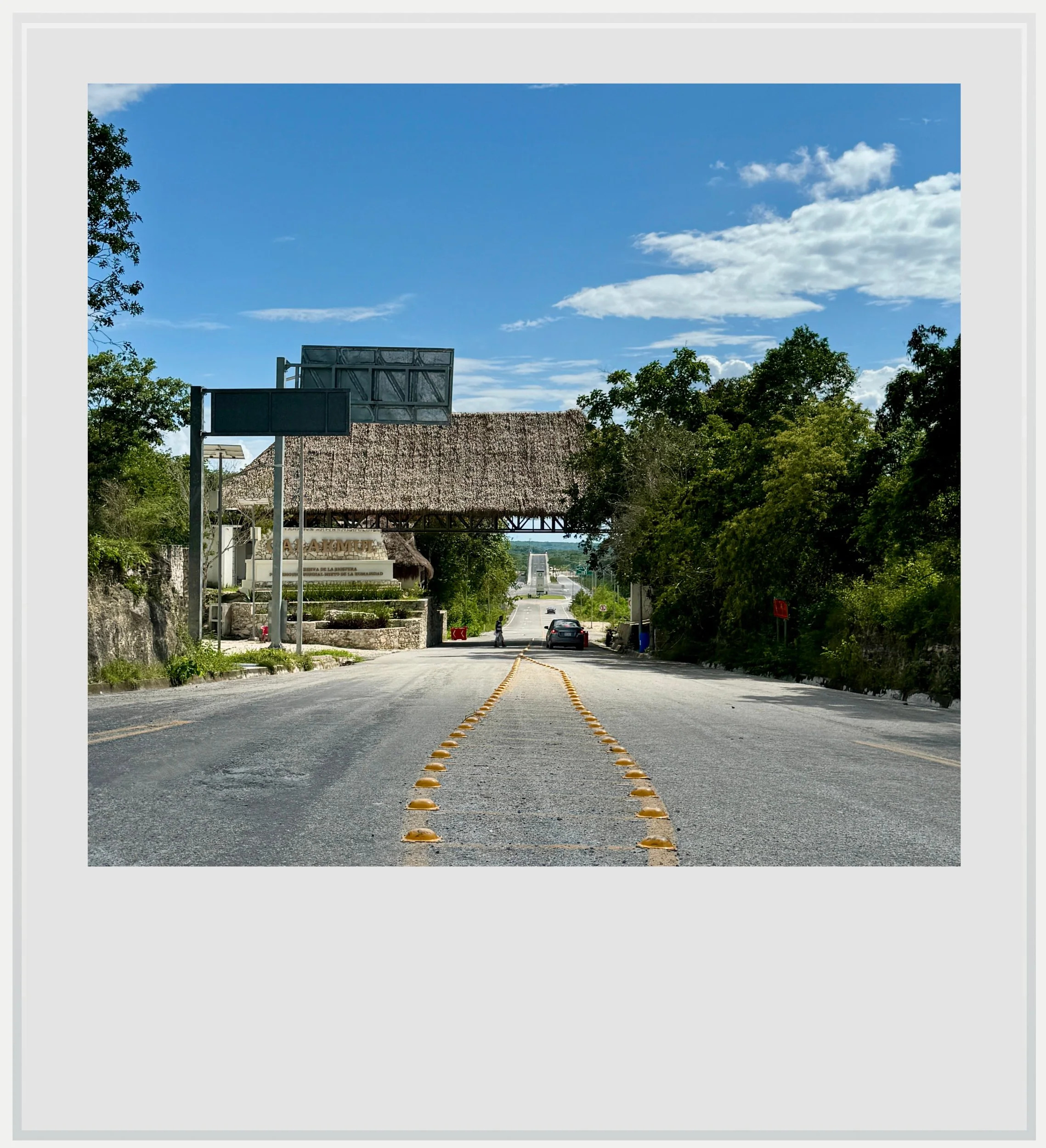
The entrance to the Calakmul Biosphere Reserve off highway 186.
About halfway through the drive, I stopped at another check point, next to the recently opened Museo de la Naturaleza y Arqueología, and continued on. The road kept narrowing, the speed limit now 30 km/h (19 mph), while fallen branches littered the roadsides more and more heavily - the forest patiently reclaiming the man-made path. I hadn’t seen a single vehicle but was forced to slow down, not only because of the signs, but because of the curves, and the numerous animal sightings at this late hour of the day.
Access to the reserve is possible until 4 PM, and the Mundo Maya hotel had emphasized it was imporant to be at the hotel by sunset. I now understood why, as driving here after dark may have been treacherous.
Along the way, small wooden signs alternated between inviting me into the forest and warning me away from it. First came the Monkey Sleeping Grounds hiking trail on the left. A few miles later, on the right, a second sign read: “Restricted Area. Do Not Enter,” beneath the silhouette of a jaguar.
It reinforced the impression that this wild forest was a wonderful place full of life, and, at the same time, a dangerous one best observed from the safety of my own rental car.
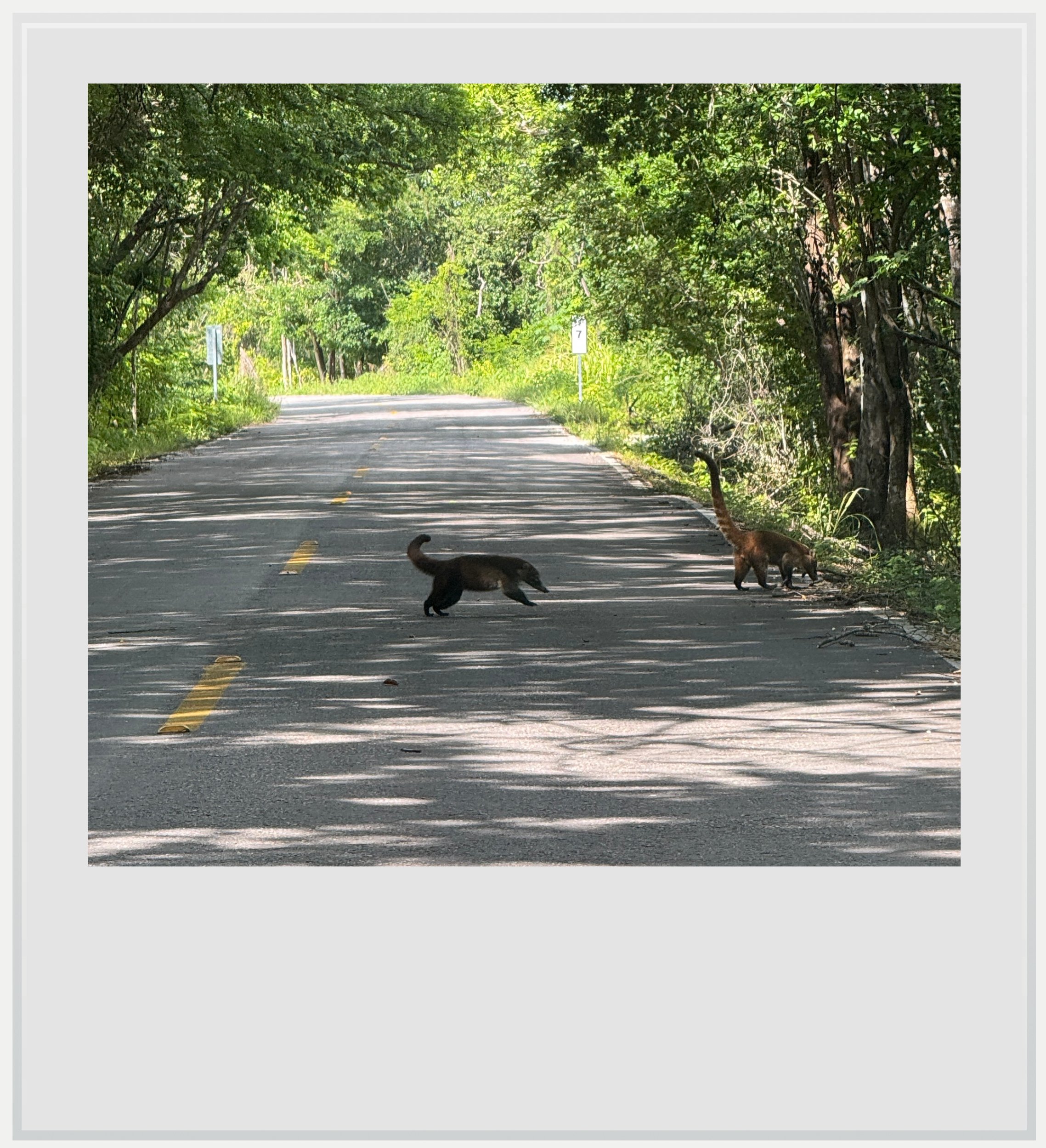
Coatis crossing the road.
I arrived at the Mundo Maya Calakmul hotel after a good hour of cautious driving on the road through the forest, with a sigh of relief. I was no longer alone in the middle of the second largest natural forest in the Americas.
The hotel impressed me by its grandeur, and the care with which architects had integrated it into its surroundings. All wood and thatched roof, still feeling new and perfectly maintained, it reminded me again of the rest stops in the African savanna, an oasis of safety among untamed nature.
Walking from one structure to the next felt like stumbling upon a lost city in the jungle.
Strangely enough, Calakmul wasn’t on my radar when I drafted my first itinerary in southern Yucatan. It was proof of how little known the site was. Despite its UNESCO credentials, it is fairly hard to get to and as a result, is overshadowed by other sites, like Chichen Itza or Tulum, that can be reached easily from major tourist centers on the Riviera Maya.
Though now in Mexico, Calakmul formed part of the wider Peten lowlands that linked many of the great Classic Maya capitals, from Tikal to El Mirador. Today, the site is one of the most remote Maya outposts in Mexico, surrounded by the Calakmul Biosphere Reserve, an immense native tropical forest home to many endangered species.
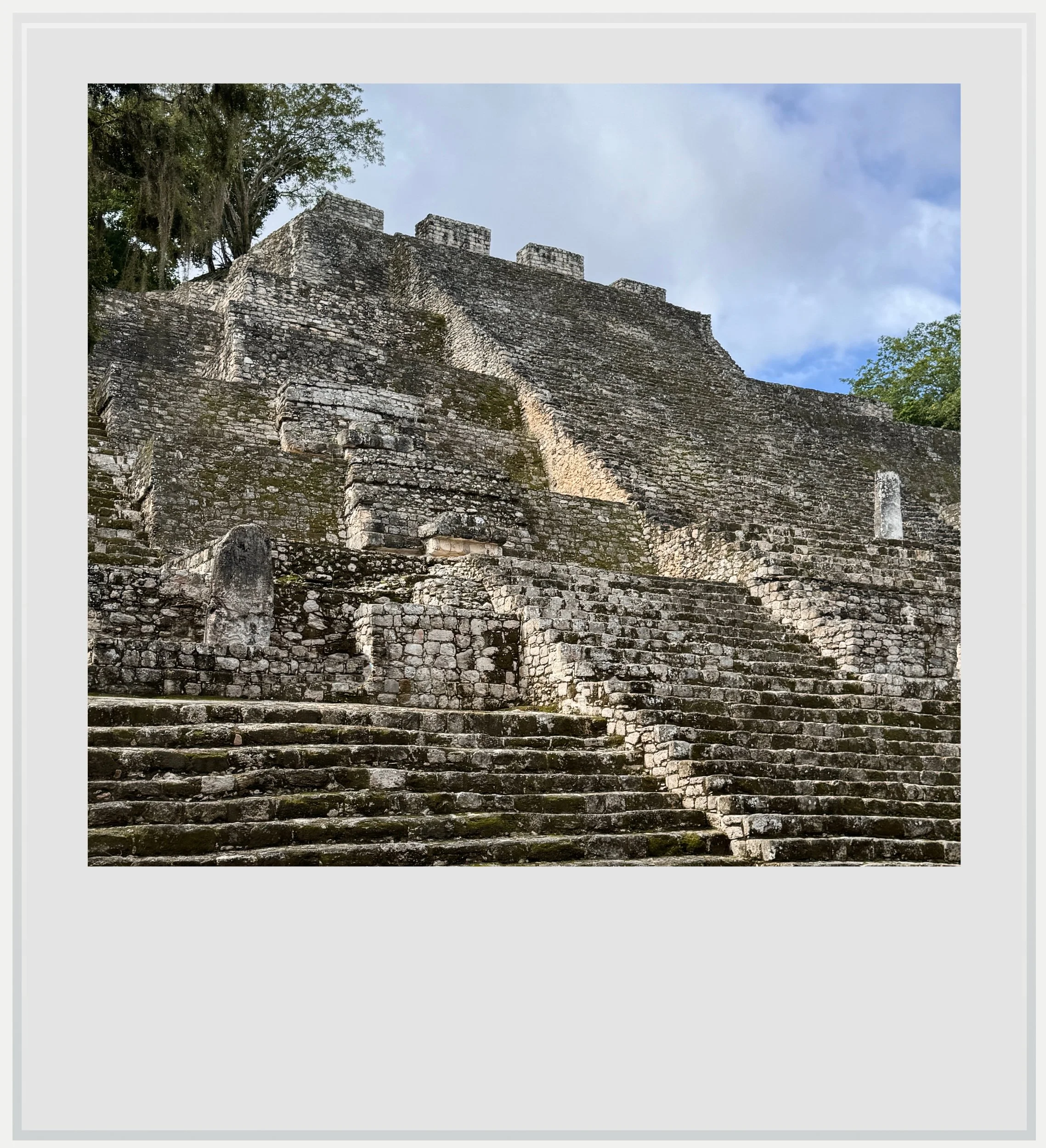
Structure 2 in Calakmul - the top pyramids aren’t visible form this angle.
In Maya times, Ox Te’ Tuun, as the city was then known, was one of the most important city-states of the Maya civilization, in a near-constant struggle against its arch-rival, Tikal, for a good portion of ancient Maya history.
During the classic period (600-900 CE), Calakmul was ruled by the powerful Kaan dynasty, also known as the Snake Kings. While little is known about them, it it believed they originated from another Maya city to the east, Dzibanche and moved to establish their power in Calakmul. Proof of occupation from as early as the 6th century BC have been found on site, though, highlighting the permanence of the settlement for centuries before that.

All of this was on my mind the next morning as I drove along the secluded road from the hotel to the archaeological zone. The stretch from the highway to the hotel had been smooth asphalt, but the final few miles shifted to a single-lane concrete track best taken slowly. It was a surreal sensation to be so far from any human settlement, the hotel the only beacon of human life for miles.
I was the first visitor on the premises, and quickly checked the recently remodeled interpretative center, which was very informative - I didn’t see any guides in Calakmul, probably because of both the lack of constant tourist flow and the site’s remoteness. In any case, the center’s explicative panels did a great job giving context and perspective. Soon I was on my way to the ruins.
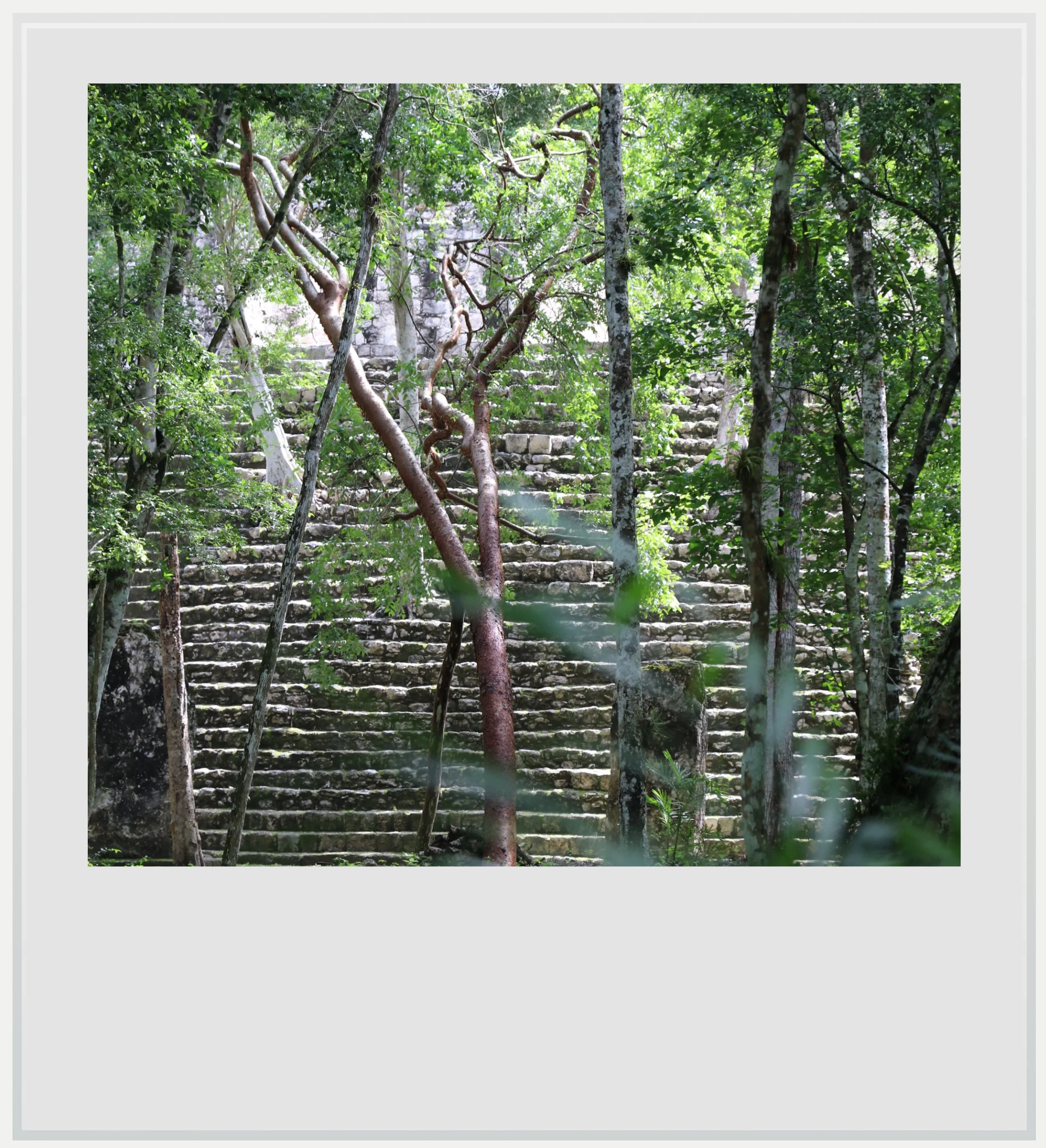
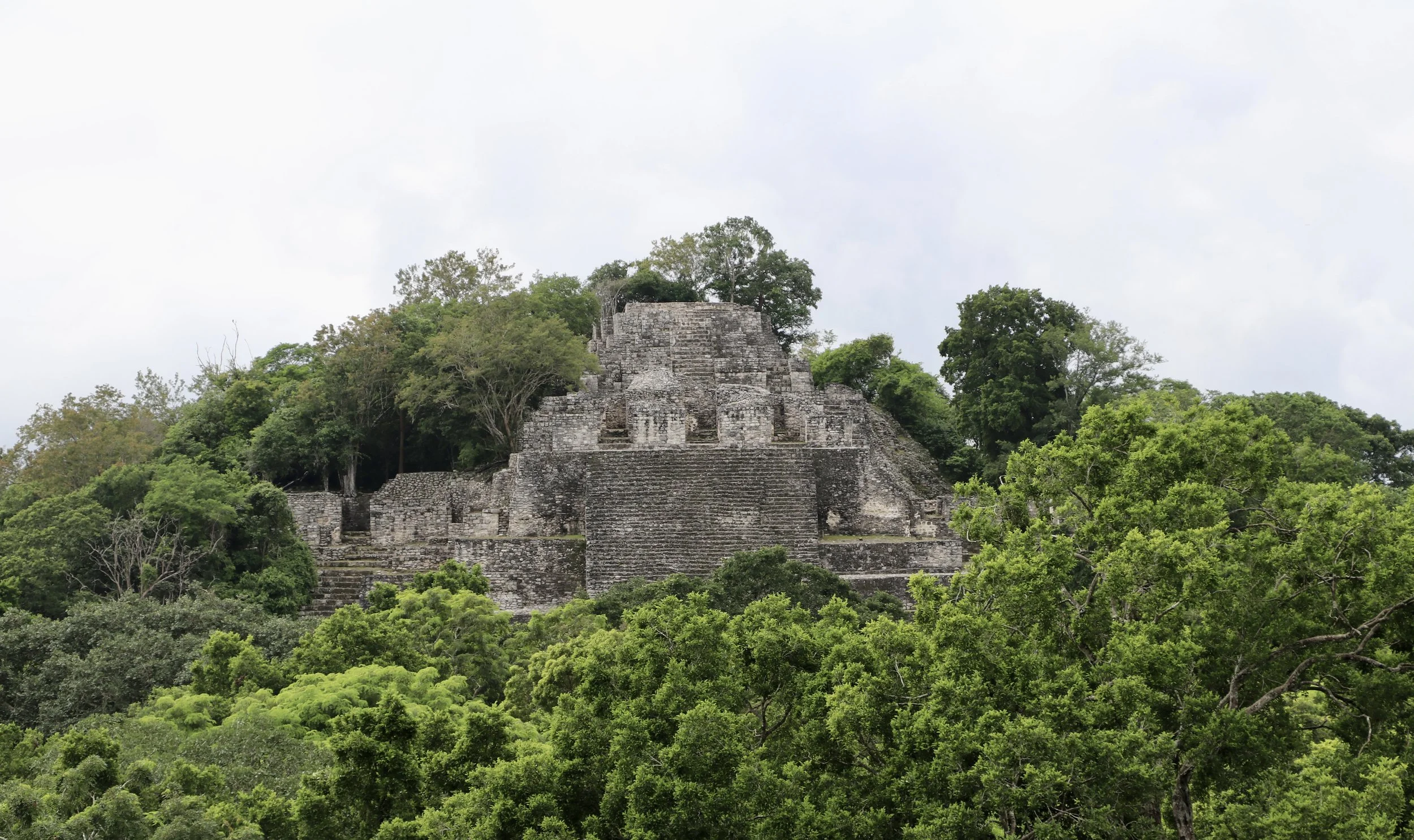
A pyramid among the trees in Calakmul.
I had seen impressive Maya sites before, like Chichen Itza or Becan, where sheer size was designed to project power, but nothing could have prepared me for what I discovered on the site. It was striking for two main reasons: first, the sheer amount of massive buildings, concentrated in the city’s core, was dizzying. It was hard to imagine so many grand temples and pyramids built so tightly beside one another. The effect was humbling.
Then, what really struck me was how much of the tree cover around the temples had been left intact. While the pyramids themselves had been excavated and partially restored, most of the plazas around them still lay under canopy, and walking from one structure to the next felt like stumbling upon a lost city in the jungle, much as early twentieth-century explorers must have done.
From the top, the relationship between the city and the forest seemed to reverse itself.
The combination of size and forest-guarded setting was what made my visit unforgettable. That this ancient city, hidden in the forest and invisible to the outside world, still stood there was an incredible sensation.
I wasn’t truly alone though. Being in the middle of this wild, protected forest meant that spider monkeys were almost everywhere, and I saw several groups during my walks. They seemed utterly uninterested in my presence, but I enjoyed seeing them in the canopy, swinging by their limbs and tail to jump from tree to tree, playing or eating berries.

A spider monkey on a tree in the tropical forest near Calakmul.
The area open to the public is the core area of the ancient city, and the most impressive part for me was the Grand Plaza, surrounded by tall temples rising above the tree line, and anchored by Structure 2 to the south.
Structure 2 was the highlight of my visit. It is the biggest and tallest structure on site, and a marvel of architecture and engineering. The pyramid was erected in seven different phases, each one adding to the original edifice, over several hundred years. From the ground, it was hard to judge the pyramid’s true height, since perspective was deceptive and the tallest temple at the top sat recessed from view. I felt so small in front of this gigantic structure that, for a moment, I wasn’t sure if I dared climb the steps to the top. The scale made me feel I should not trespass casually.
Like many Maya temples, Structure 2 served as the resting place of several Calakmul rulers. One of them was Yuknoom Yichʼaak Kʼahkʼ, who ruled in the later part of the 7th century CE. His funerary jade mask, one of the most sophisticated Maya artifacts ever excavated, was found in one of the chambers here. The mask is currently exhibited in the Maya Architecture Museum in San Francisco de Campeche, the state capital.
Only when I made my way up the pyramid on the other side of the Grand Plaza, Structure 7, did I fully realize the scale of Structure 2. From above, it almost looked like two pyramids on top of a bigger one - a giant feat of engineering in the middle of the jungle. Two visitors had climbed it and, from where I stood, looked like tiny dots swallowed by the stones.
Climbing on top of some of the tallest pyramids is allowed in Calakmul, and this enabled me to sit atop the tree line, where the city and the surrounding forest revealed themselves differently. Instead of being down on the ground among the trees, the higher vantage point let me look upon miles and miles of uninterrupted greenery, grasping the immensity of the Biosphere. A few of the tallest buildings peeked through the canopy, hints of a city whose mass still lay underneath.
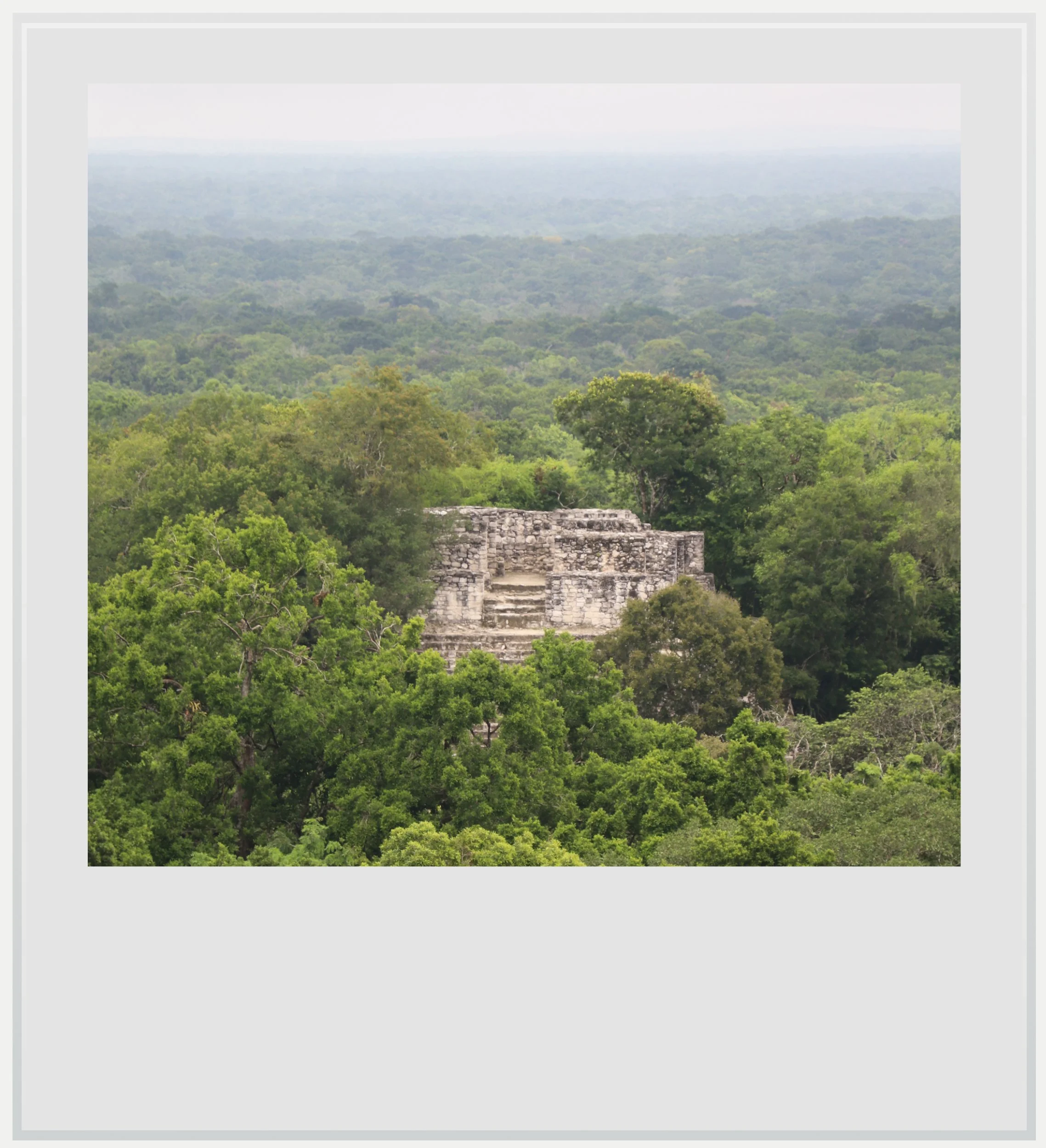
Maya ruins in the forest in Calakmul.
It was hard to express how I felt at the top: peering at the immensity of the tropical forest around me, I kept on thinking I might see other Maya cities in the distance, perhaps in Guatemala. For a moment, I felt strangely powerful - wasn’t I dominating the forest after all? Even spider monkeys, playing in the trees, were now below me. What stayed with me, however, was how, from the top, the relationship between the city and the forest seemed to reverse itself. The temples were now guarding the forest, not the other way round — from where I stood, they rose like lookouts above the trees.
Calakmul was much more than its Grand Plaza. The site featured more pyramids and two acropolises that were partially open to the public, and I spent some time checking out every path marked by an official sign - the site is big enough that one could get lost in it for hours, but way finding has been upgraded and was very well done at the time of my visit.
While visiting Calakmul was an incredible journey, it lacked the immediate visual impact I experienced in more famous sites like Chichen Itza or Uxmal, where architecture and urban design felt easier to read. These sites were built later and benefited from techniques that made them more expressive. They were also thoroughly cleared of trees to more closely reflect how the ancient Maya might have experienced them.
Calakmul was different. The architecture was more about size as a projection of power: its monumental pyramids were supposed to impress through sheer volume. Keeping the trees here must have been a conscious choice. It highlighted the symbiotic relationship between nature and the recovered buildings, each one protecting the other.
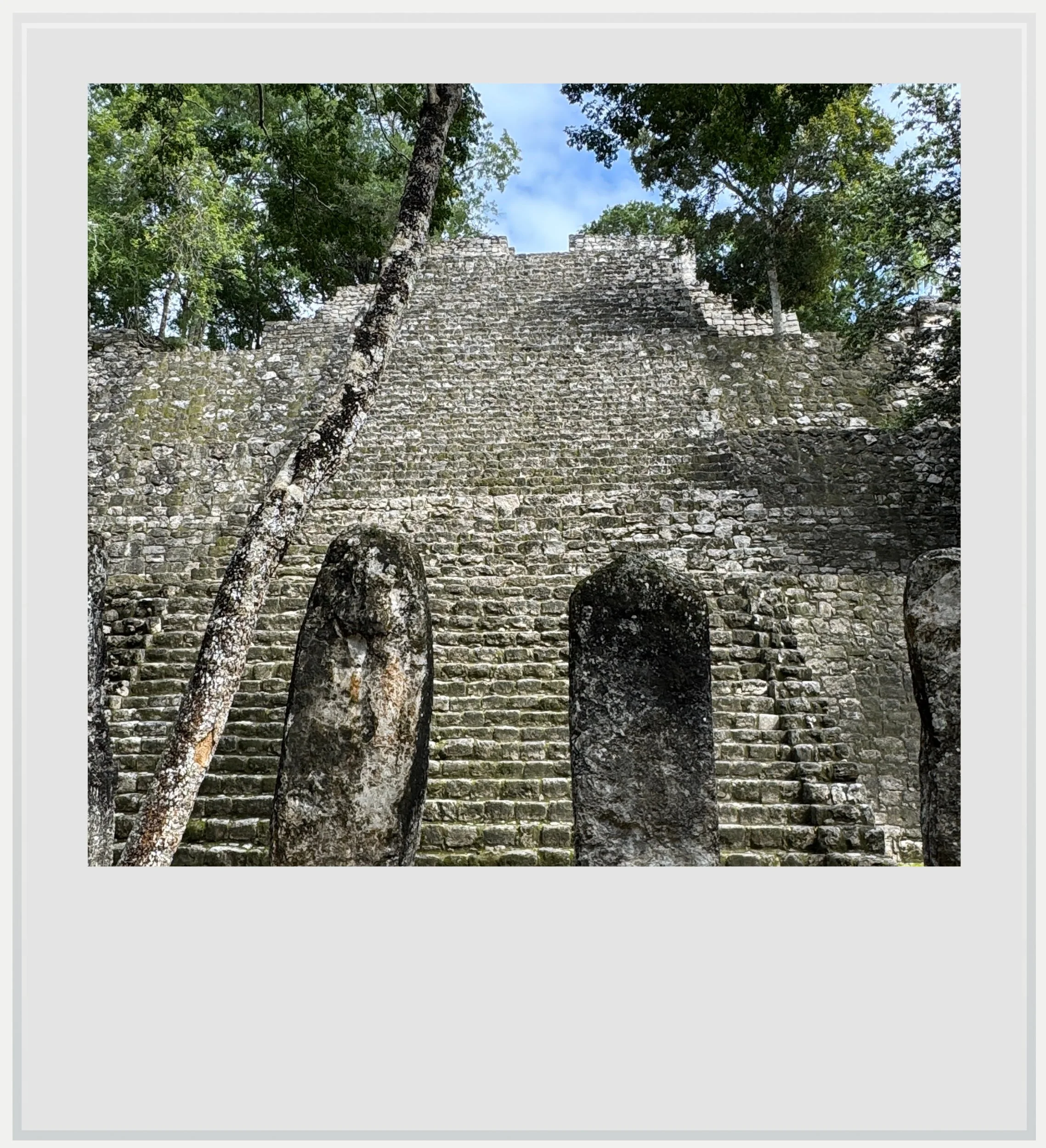
Another of the many Peten-like pyramids in Calakmul.
For all its recent tourism infrastructure improvements, Calakmul remained a very remote site where the experience was, by design, an effort. It still asked something of you before revealing itself. It did not give itself easily. That was precisely why it stayed with me.
Practical information
(Everything you need to know about visiting Calakmul - updated April 2026)
In a nutshell
Calakmul is a UNESCO World Heritage Site, recognized both for its historical significance as a major Maya city and for its location in the middle of the second largest tropical rainforest in the Americas after the Amazon.
The archaeological zone is rarely crowded, even during high season (November–February). Entry cost MXN 100 as of my visit in late 2025 (but travelers need to also pay MXN 305 to access to the Biosphere Reserve). I did not see any tour guides on site, as is common at places like Chichén Itzá or Uxmal, so if a guide is important to you, plan ahead. Unlike many other Mexican sites, Calakmul has numerous contextual signs that help make sense of the ruins, and the visit begins with a well-designed interpretative center.
Plan to spend at least three hours on site to see everything, and more if you stop for monkey sightings or climb some of the structures.
Bathrooms are available at the site entrance, next to the interpretative center.
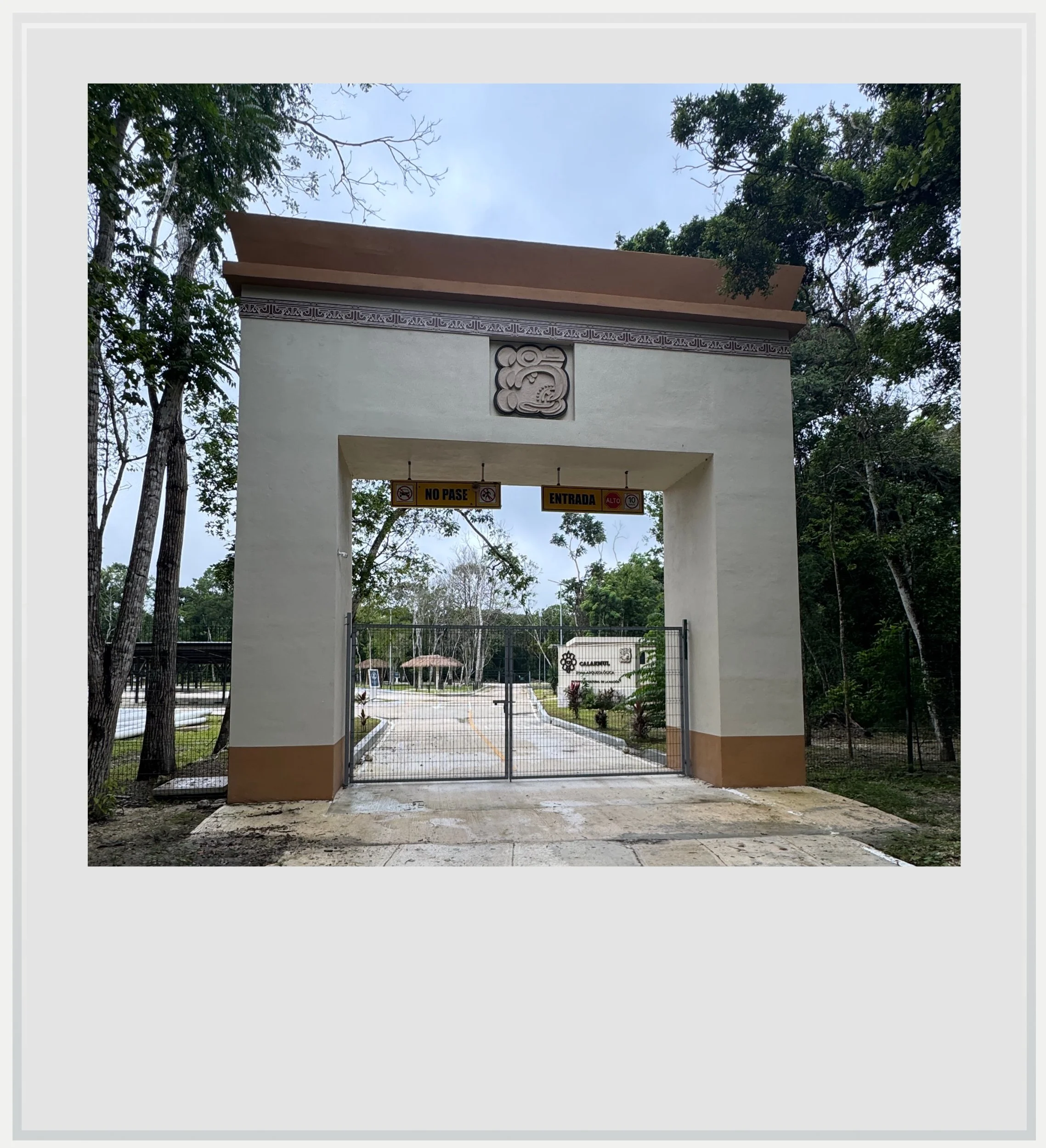
The entrance of the site, just before opening time.
Getting to Calakmul
How to get to Calakmul from the United States: deep in the Maya jungle, Calakmul, isn’t easy to reach from the US. The closest airport is Chetumal (CTM) which is located almost 4 hours away by car and lacks direct flights to the US, making a connection in Mexico City (MEX) indispensable. Campeche airport (CPE), to the north, is 4h45 away, but only receives a couple of domestic flights a day.
If, like me, your visit to Calakmul is part of a broader southern Yucatán itinerary, it makes sense to fly into Chetumal and rent a car there, as a lot of interesting Maya sites are scattered between Chetumal and Calakmul (see the Itineraries section of the wesbite for more insights).
Another option could be to fly into Tulum (TQO) or Merida (MID), if planning a trip spanning more of the Yucatan peninsula, as US and Canadian airlines fly non-stop to both, but travel time is around 6 hours from each airport.
Car rental is your best bet to visit the region, and whatever airport you land it will have local and international options, which were fairly priced at the time of all my Yucatan visits (provided you don’t fall for the pushy additional insurance coverage every single rental agent is incentivized to sell you).
How to get to Calakmul from Mexico City: the best way to reach Calakmul is to fly into Chetumal airport (CTM), from Mexico City’s main airport (MEX) or its secondary airport (NLU). Aeromexico, VivaAerobus and Volaris operate once a day between MEX and CTM while Mexicana and Viva fly several days a week from NLU to CTM, with base prices starting around USD 75. Car rentals are widely available at Chetumal airport, from a variety of Mexican and international companies. Calakmul is about 4 hours west of the airport, along Federal Highway 186, a well-maintained, straight-through-the-jungle two-lane road, but again, if your trip includes more stops, you may use Xpujil as a base for a few days, and that is only 2 hours away from CTM.
Note that there is no accommodation close to the site (see Food & Lodging section below) except for the nice Mundo Maya hotel, deep in the Biosphere and about 30 minutes from the ruins. So getting to Calakmul may involve staying far outside the immediate area if you choose a more affordable accommodation.
How much does it cost to access the Calakmul archeological zone
Calakmul sits deep in the jungle, at the heart of the UNESCO-protected Calakmul Biosphere Reserve, which requires paid access. Access to the site is done just off federal highway 186, where you pay MXN 305 a person for access (at the time of my visit, in October 2025). The access is open from 6 AM until 4 PM unless you have a confirmed stay at the Mundo Maya hotel. In any case, the hotel recommends you get in no later than 5 PM, to avoid driving in the reserve at night (and I can understand why, as I saw many animals on or near the road during the day, and avoiding them at night could be complicated).
Once at the entrance of the archeological zone, you’ll pay another MXN 100 per person to get in.
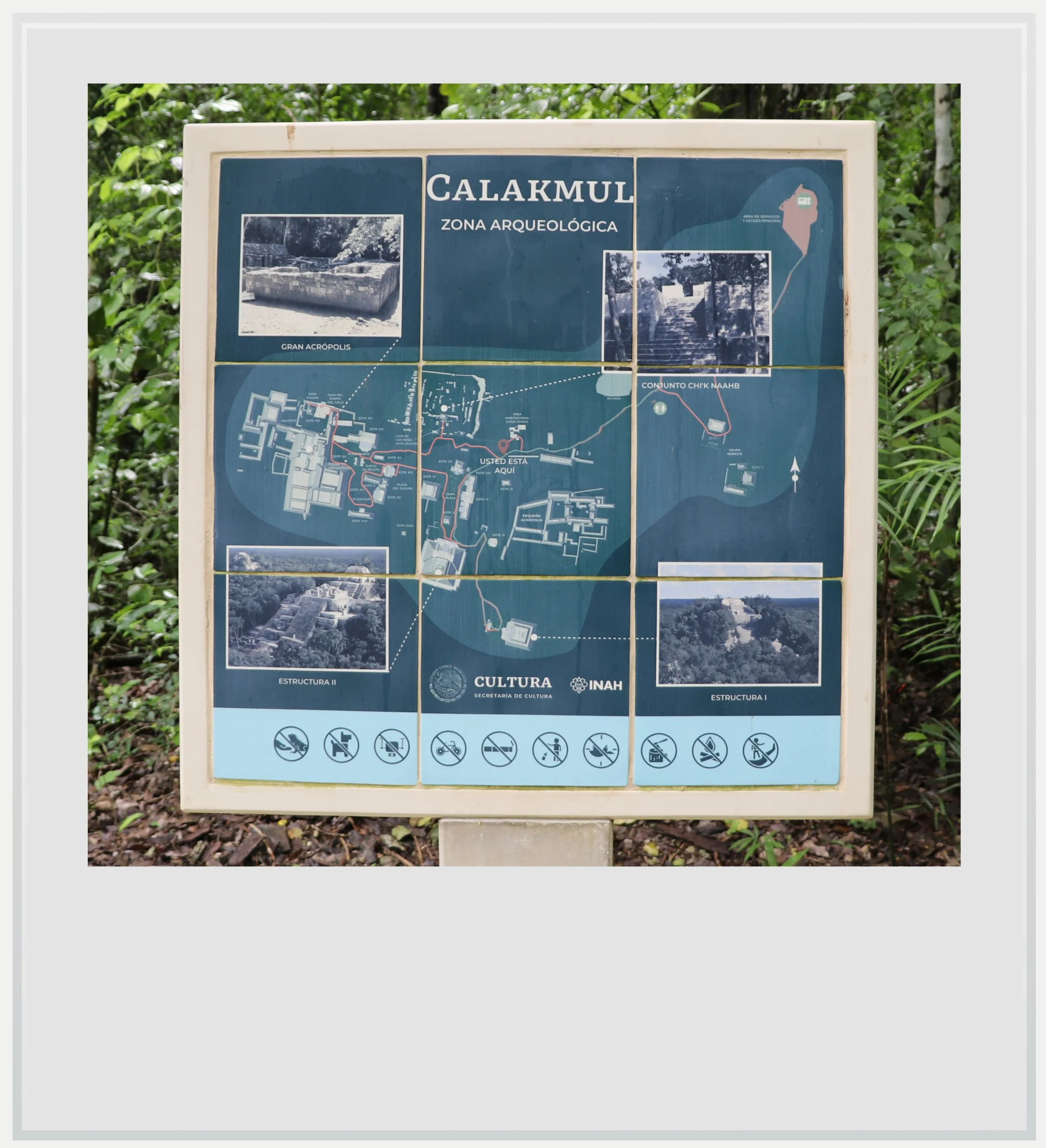
Calakmul’s site map.
When to go to Calakmul
The best months to enjoy Calakmul weather-wise are those of the dry season, between November and April, with January and February the (relatively) coolest months. This is also peak season so the site may be a little crowded, but that’s all relative. I went in mid October, and did get a little rain every day of my trip around 4pm but the crowds were thin. There were about 10 cars in the parking lot when I left, around noon, on the day of my visit. Compare this to the amount of buses getting into Chichen Itza every day.
How long should I plan to visit the Calakmul archeological zone
Aim to go to the site early (it opens at 8 AM) and plan for at least three hours to see all the buildings. The site is pretty large, and even without stopping too long here or there, it took me the whole three hours to check them all out.
The afternoon can be spent relaxing at the Mundo Maya Hotel, a gorgeous building whose design evokes a classic safari lodge, adapted to the Yucatan jungle. From there, guided tours are available to explore the dense protected forest surrounding the ruins.
Safety in Calakmul
The Yucatan peninsula is one of the safest areas in Mexico, and Campeche is one of the few Mexican states with no travel advisory: it is labeled a level 1 “Exercise Normal Precautions” state, just like anywhere in the US.
On top of this, Calakmul is very isolated, in the middle of a lush jungle and the area is never really busy - it is definitely not a place that’s tempting to thieves, so you can relax and pretty much let your guard down. Your biggest threat will most likely be getting hit by falling fruits from nearby trees (still highly unlikely).
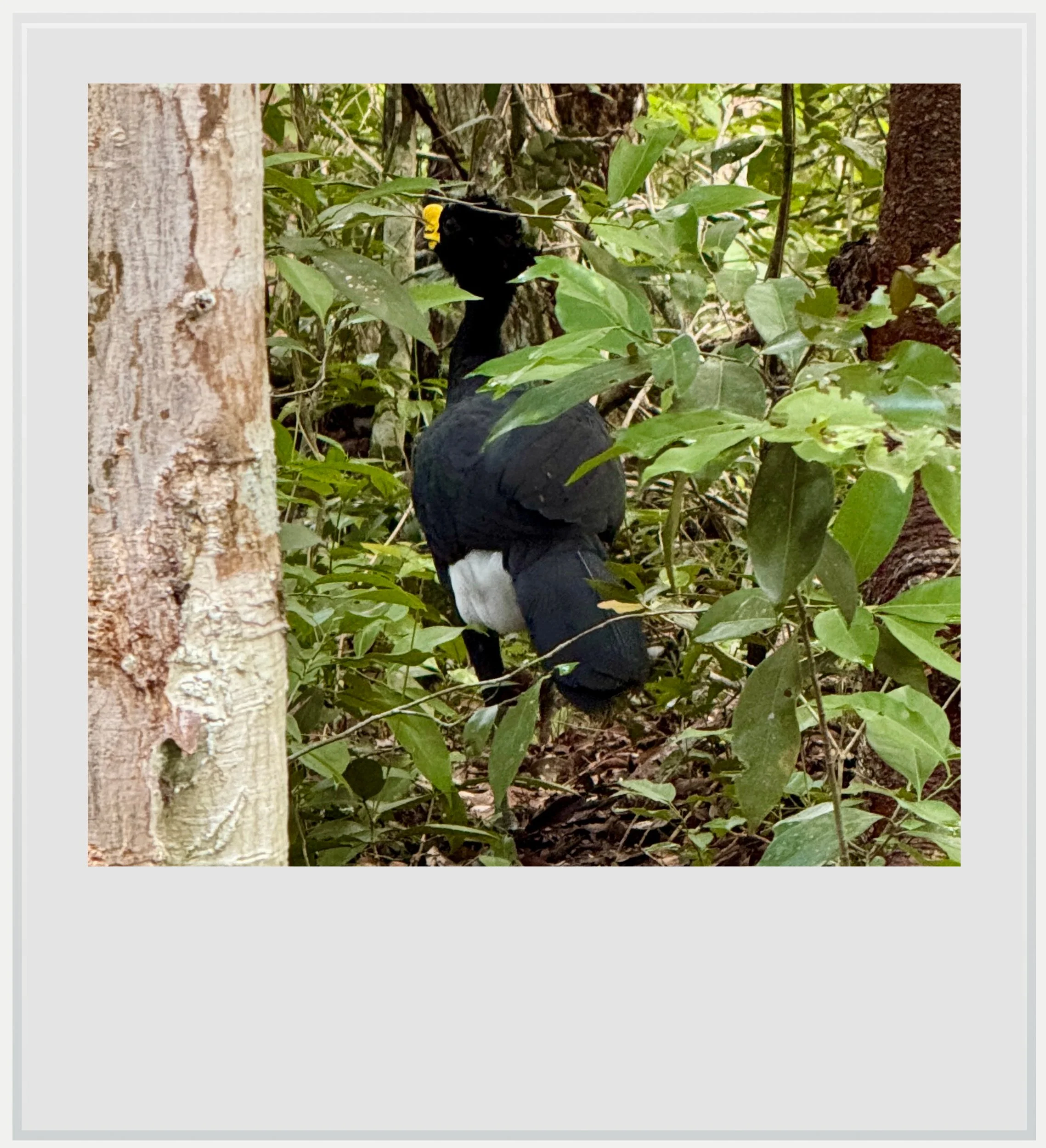
A male Great Curassow in the forest near Calakmul.
Food & lodging near Calakmul
Calakmul, deep in the southern Campeche jungle, is a fairly isolated place, and the only hotel relatively close is the new, fancy Hotel Mundo Maya Calakmul. While not cheap by any means, I recommend it for the ease of getting to the ruins. It takes about 30 minutes of slow driving to get to the archeological zone’s entrance, meaning you can get up around 7 AM and be at the ruins when they open, at 8 AM.
No other accommodation exists within the core of the Calakmul Biosphere reserve, so the next closest hotels would be in Conhuas, more than 90 minutes away from the archeological zone. Most accomodations are actually located in Xpujil, more than 2 hours away to the east (see accomodation recommendations for Xpujil in the eponymous article here). If you want to be at the ruins when they open, to maximize your chances of seeing more wildlife than people, that means getting up before 5 AM, which can be tough.
Food options are pretty limited as well. The Mundo Maya hotel is decent but by no means extraordinary, yet it’s pretty much the only game in the jungle just before or after your visit to the archeological zone. If not, Conhuas has limited options, and Xpujil is the recommended back up, but that’s far from Calakmul, so you may stay hungry a while.
I stayed in Xpujil before driving to Calakmul and spending a night at the Mundo Maya hotel. The hotel will offer you adequate food options for breakfast, lunch and dinner, but it could be smart to stop at an Oxxo in Xpujil to grab snacks to tie you over.
Keep in mind these travel tips
The Yucatan peninsula is one of the safest regions in Mexico, and its main roads are well maintained. This isn’t enough to forget the #1 driving advice in Mexico: do not drive at night. Driving at night, on poorly lit roads means you won’t see the motorcycles without lights, the potholes and the ubiquitous topes, these notoriously hard speed bumps that spring out of nowhere. You may encounter wildlife or, more prosaically street dogs crossing right in front of you. Plan your itinerary to be at your next destination before night fall. It’s important.
No matter what the season, there will be bugs in Yucatan. While you may only see the gigantic Tarantula Yucateca spider on the roads through the jungle leading to Calakmul, you’ll find mosquitoes pretty much everywhere, and especially in the shaded forests surrounding the Maya ruins. Be ready with repellent at any time of the day. It’s also a good idea to wear clothes that cover your limbs (pants, high socks, long sleeve t-shirts) while you’re in the jungle. Mosquito-borne diseases are fairly uncommon in the state of Campeche, but not unheard of.
SPF will be your best friend. The UV index may be low in the morning and evening, but during the day, it gets pretty high.
Do not forget to hydrate. While OXXOs aren’t as ubiquitous in this rural region than in other ones, you’ll find plenty of abarrotes, these tiny stores selling cold water and sodas along the way (but none once you hit the turn off to Calakmul and pay the fee to enter the biosphere, so plan accordingly). Make sure you always have water handy and drink to make the heat more bearable.
Cell service is spotty at best in southeastern Campeche and absolutely non-existent in the jungle surrounding Calakmul. You will only get service back once on highway 186 (the main road between Chetumal and Villahermosa), and only with Telcel. Near Calakmul, your only connection will be the free WiFi at the Mundo Maya hotel, about 30 minutes from the ruins. Think about downloading maps for offline use while in or around Calakmul, it will prove very useful.
Every photo caption appears if you hover over it (on a computer) or click on it (on a smartphone).
All photos are mine and copyrighted.