Ek Balam, Mexico.
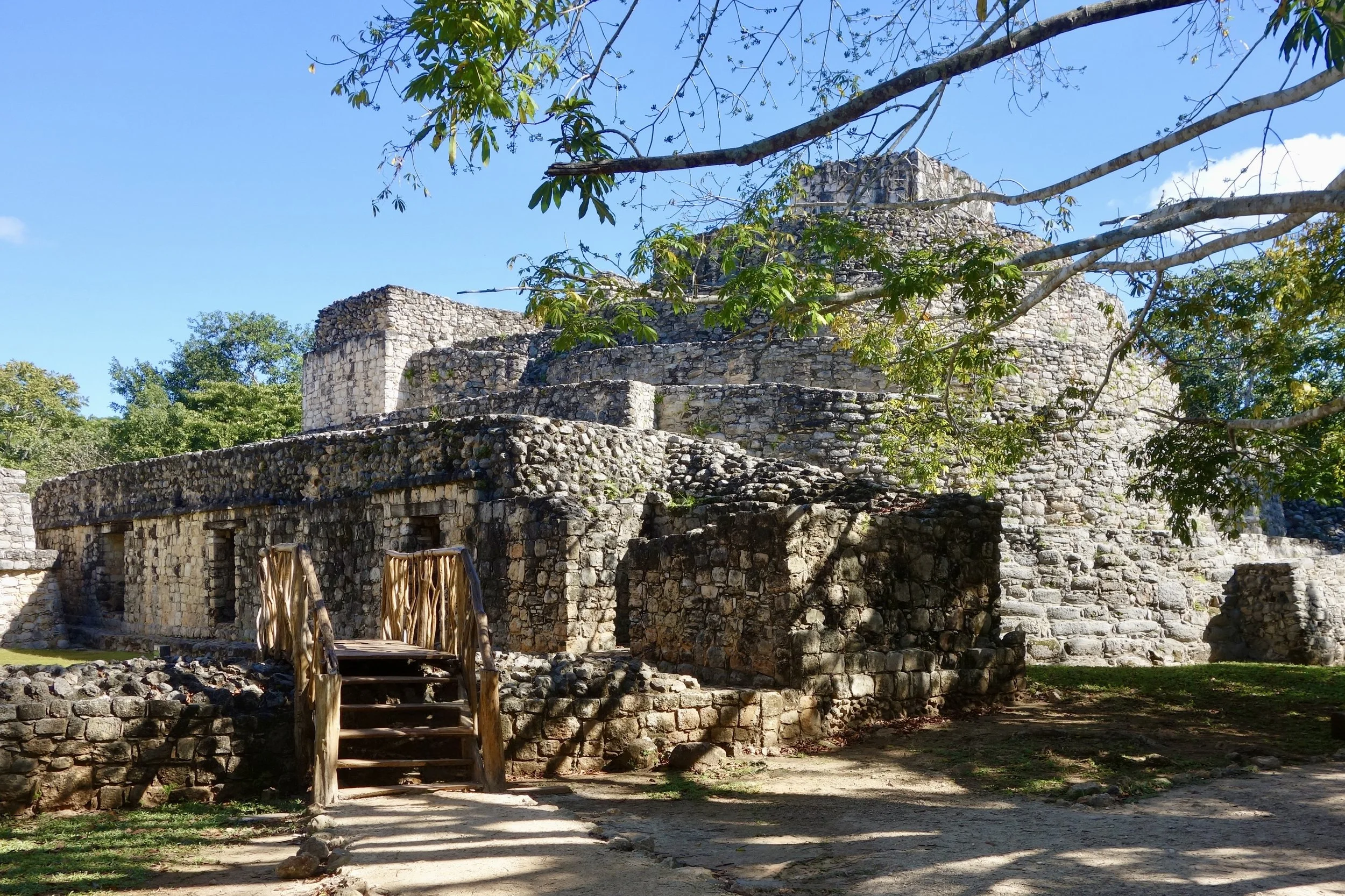
The Acropolis and the Doorway Within.
Looking for concrete details and tips? Go straight to the Practical Information section.
The morning we drove to Ek Balam in northern Yucatan was a gorgeous one, the bright early sun feeling almost gentle against the car’s windscreen, a few harmless clouds floating in the air and a nice breeze passing through the shrubs along the road.
Far from the narrow roads of the Puuc hills a few days ago, this stretch of asphalt seem to unfold boldly along the low trees, with a resolve that made me go a little too fast. The drive was easy and smooth. This should have been my first clue the experience would be different.
Ek Balam tends to be framed less on its own terms than for where it sits, a convenient addition to a visit to Chichen Itza, often paired with Valladolid on a single-day itinerary.
Our initial contact with the site wasn’t exactly smooth. The first thing we saw was a beautifully restored arch, next to a small bridge with a sign showing this was the exit route for the visit. I instantly tensed. A sign like this usually meant the site was crowded enough that flow control was necessary, and I immediately assumed we might not have chosen a site like the ones I enjoyed most: remote and devoid of people.
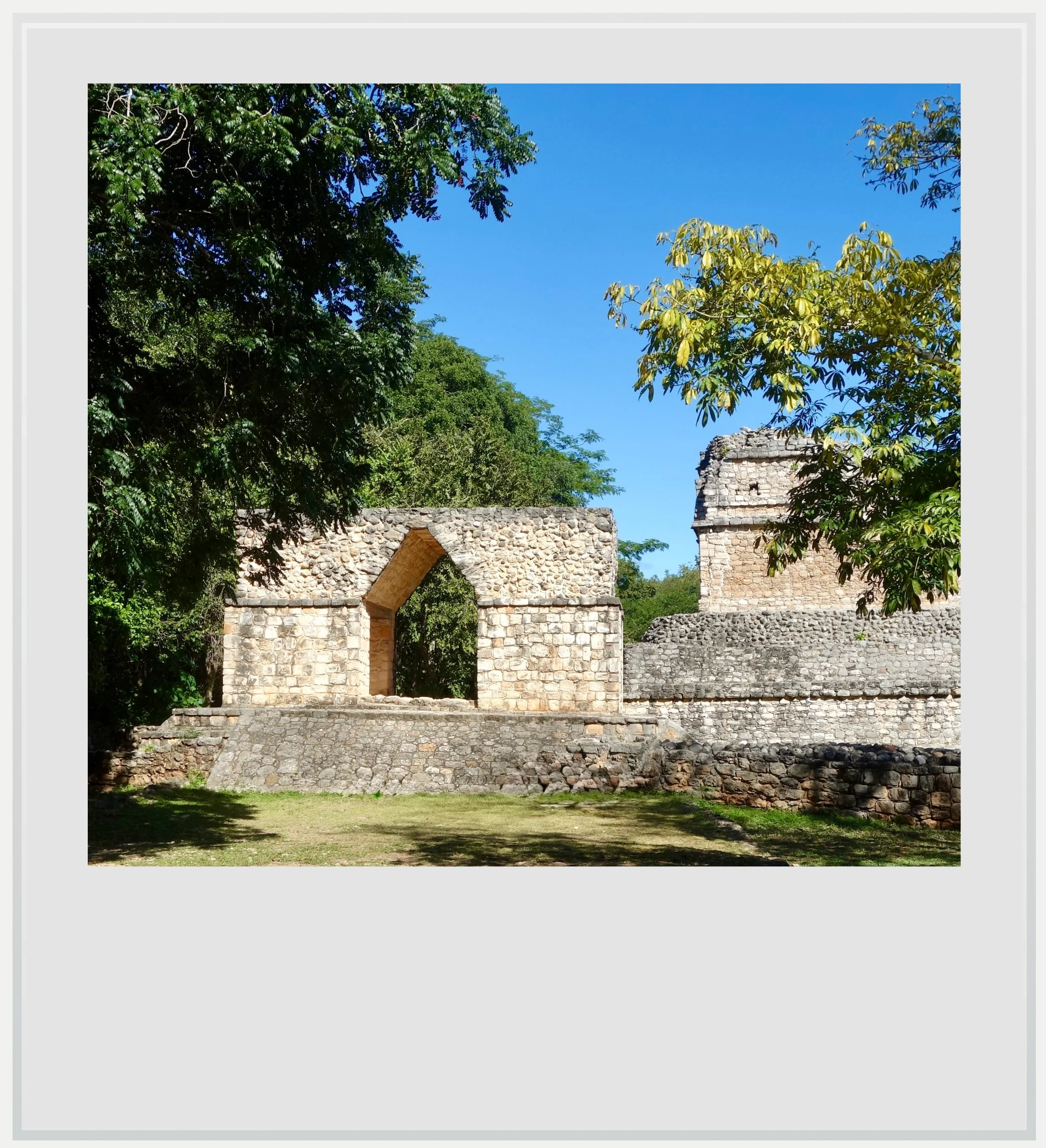
The arch at the entrance of the site.
It didn’t help that the first look at the site felt underwhelming. There were none of the usual markers of a Maya site of importance, only a compact, round building that didn’t read as anything significant.
I kept my thoughts to myself - I wasn’t going to communicate to my friends I might have brought them to a site that I didn’t really feel was delivering on my promise of stunning Maya monuments hidden in the jungle, and we continued, along the directed route, around the building.
It looked like a beautiful Maya landscape, the kind I knew my friends would appreciate.
It turned out my impatience was unwarranted. We quickly arrived on a wide plaza, the site’s central one, and everything started falling into place. We had stopped at what I assumed was the core of the ancient site. In front of us, we could distinguish the outline of a ball court - a fixture in Maya urban planning. To the left, a climbable structure - which turned out to be the Oval Palace, the first structure we had seen upon arriving to the site. The Oval Palace wasn’t actually fully oval: from the main plaza, it read as a more classic, rectangular Maya temple.
Climbing it suddenly made the appeal of Ek Balam more obvious to us. Just above the tree line, we could now see the massive Acropolis building emerging from underneath the forest on the opposite side of the plaza, its impact partially held back by the thatched roofs protecting some of its façades. Its sheer size clearly made it the city’s anchor.
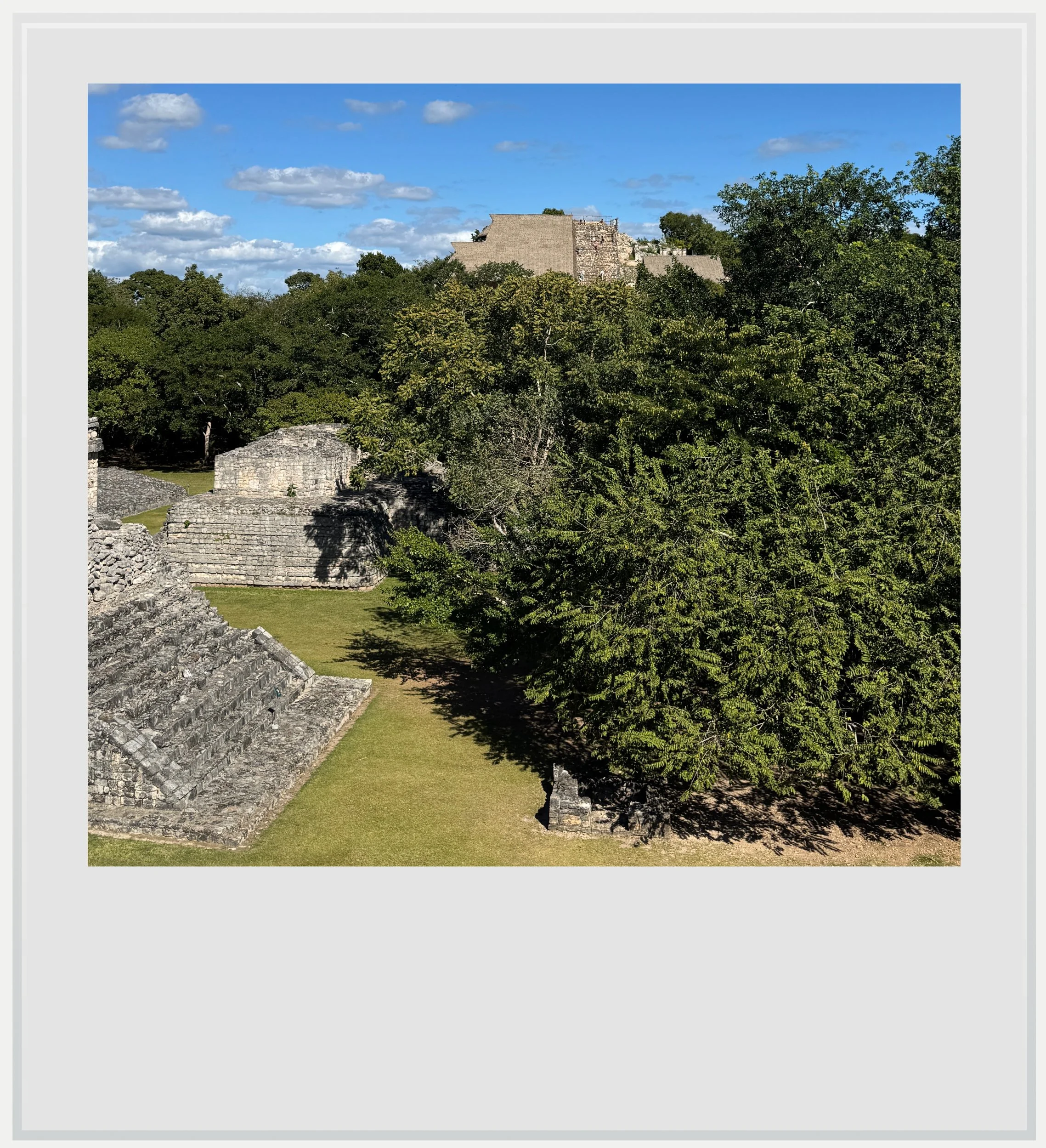
The view from the Oval Palace over the Acropolis.
Keeping it for last, we walked around the rest of the ancient settlement, along the posted route, before getting to the Acropolis itself.
It is hard to describe how monumental the structure felt, probably because it was built differently from some of the biggest Maya edifices. A large elite complex, it broke from the familiar pyramid form. Its base rose in tall, vertical walls, giving it a more architectural presence, closer to a stacked structure than a triangular one.

In many ways, the bottom floors read more as a foundation wall, much like the ones at the base of the Great Acropolis of Edzna, although, unlike Edzna, it read as inhabited from the ground up, with lower floors dotted with doors leading to small rooms.
Also unlike Edzna, this acropolis was only made up of one building, and its height, with the perspective, looked staggering. We started climbing it - many buildings in Ek Balam allow it - and after a few breaks, made it to the top.
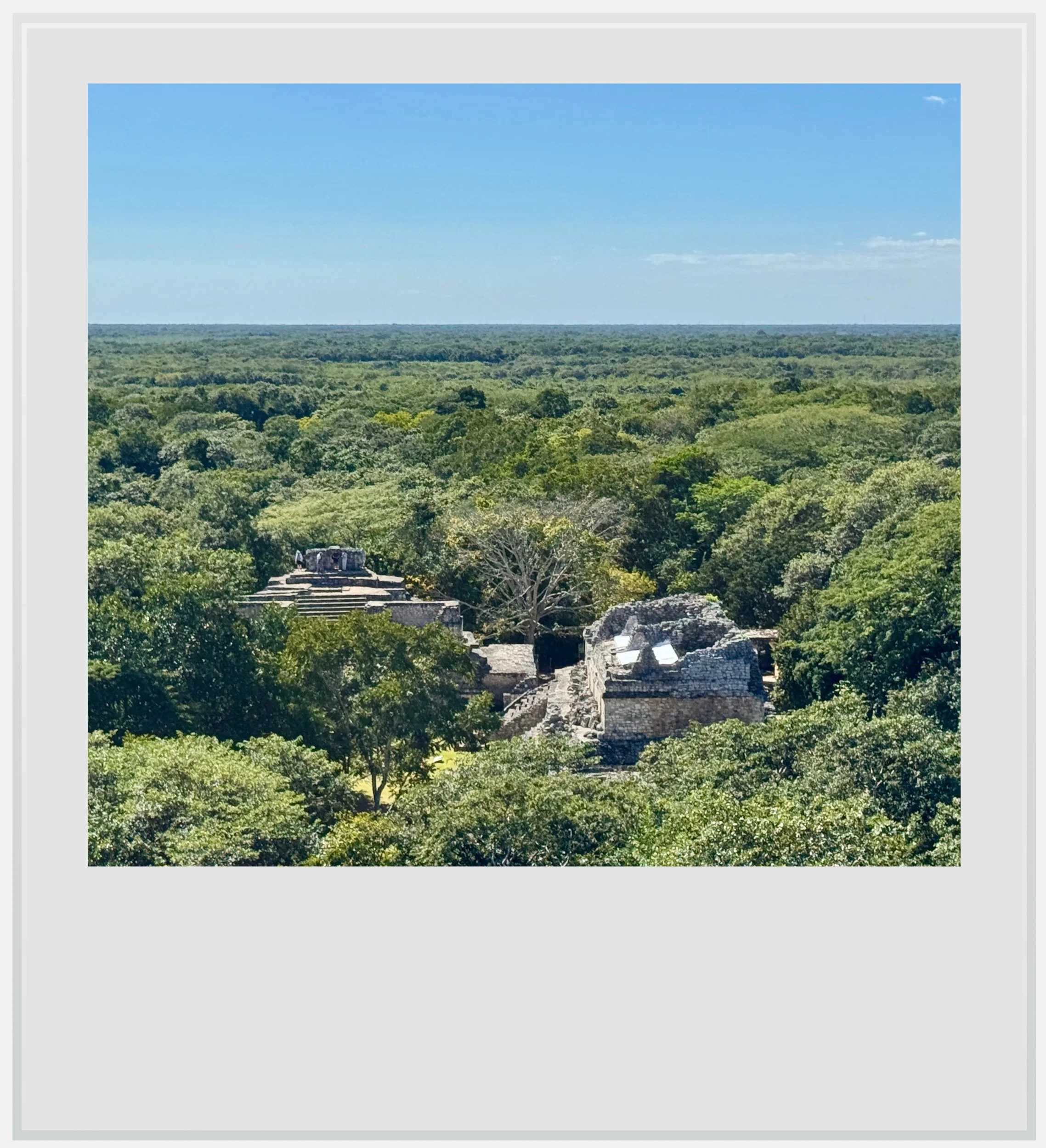
The view from the top of the Acropolis.
The view was even more impressive than on top of the Oval Palace, for the simple reason we had reached the settlement’s highest vantage point. The landscape unfolding in front of us was both striking and, at this point, expected. Miles and miles of dense forest as far as the eye could see, with a few buildings piercing through the canopy veil below us, a city mostly hidden by the trees that had patiently reclaimed their territory century after century.
At that point, I felt reassured. Even if nothing else followed, the site had already delivered a familiar Maya experience. It may not have seemed that unique to me - after all, similar views were offered in Calakmul, or in more midsize sites like Becan or even Kinichna - but it looked like a beautiful, classic Maya landscape, the kind I knew my friends would appreciate.
The directed path ended up shaping the experience.
What I didn’t expect was that the highlight of our visit would occur once we started descending. In our haste to get to the view, we hadn’t stopped at the structure’s intermediate floors, and missed what, in hindsight, made the whole visit more than worth it.
About midway through walking down, under yet another thatched roof protecting it from the elements, sat the entrance to the burial grounds of Ukit Kan Lek Tok, a Maya ruler at the turn of the 9th century CE.
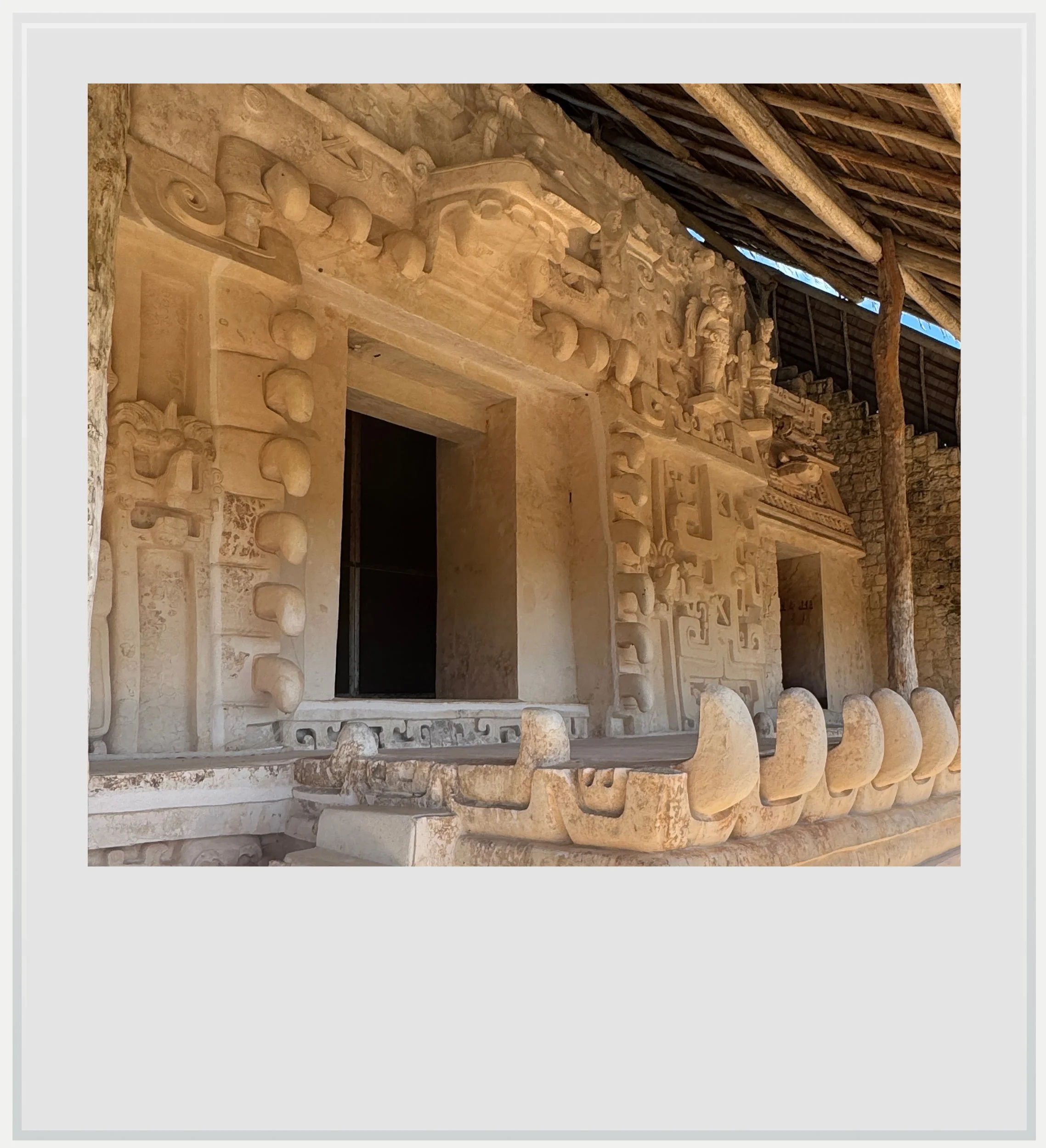
The monster-mouth door in the Acropolis.
I was instantly reminded of some of the massive monster-mouth doors I had seen in Chicanna. The entrance was shaped as the mouth of a Maya deity. While it was tempting to read it as a jaguar mouth (after all, the modern name of the site, Ek Balam, is believed to mean Black Jaguar or Bright Star Jaguar in Yucatec Maya), historians prefer to refer to it as zoomorphic monster jaws representing the symbolic entrance to the Underworld, a figure not tied to a specific animal.
The door was discovered in a remarkable state of conservation, as subsequent building layers had preserved it well, and it only required limited reconstruction to present this stunning work of funerary sculpture. It oddly read as too perfect at the time of my visit, probably because the restoration work had been completed recently, and in contrast to the rest of the edifice, which showed subtle signs of wear.
We left Ek Balam by crossing the bridge near the remains of the defensive walls that once surrounded the city’s core, and that had ticked me the wrong way upon arrival to the site. I couldn’t help but smile at my visceral reaction, back then, when I had assumed the “do not enter” sign on the bridge was going to mean a very guided route into a busy site, with less room for discovery.
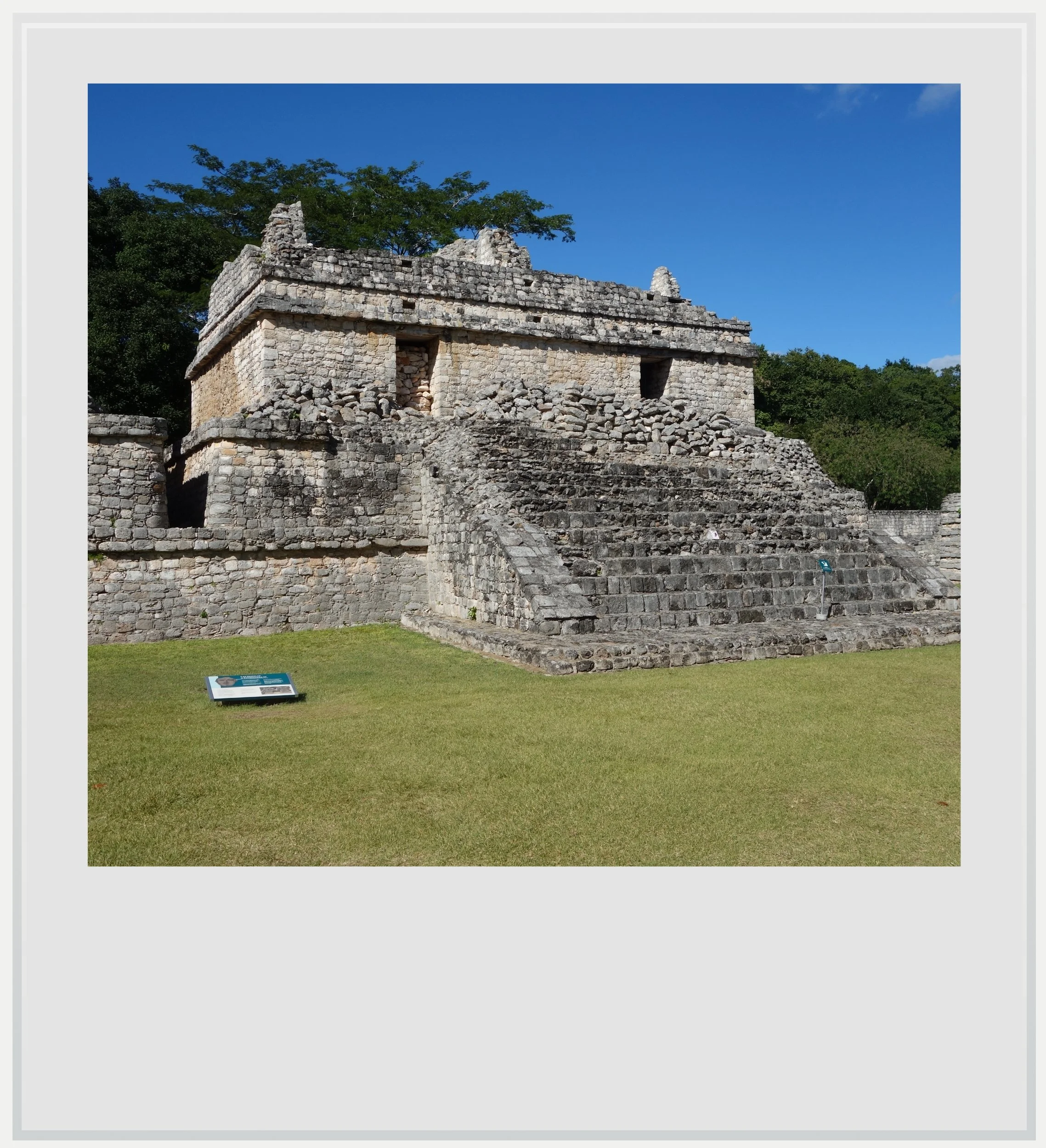
The Twin Temples, on the main plaza.
In fact, the directed path ended up shaping the experience, delaying the site’s impact until the final moments. What had seemed too accessible at first revealed itself in sequence, culminating in the stucco-covered doorway.
That delay helped explain why Ek Balam never quite imposed itself the way other sites did. But the reward for patience was an experience that moved beyond the expected “tall pyramid in the forest,” offering something more gradual, and ultimately more fulfilling.
Practical information
(A complete set of practical details for visiting Ek Balam - updated May 2026)
In a nutshell
Ek Balam is often framed as an easy addition to Chichen Itza, but its experience is more nuanced. The site stands apart not through scale or remoteness, but through the way it is experienced. Its layout and guided path structure a gradual reveal, culminating in the Acropolis and its preserved stucco façade, offering a more sequential and deliberate encounter than most Maya sites.
How to get to Ek Balam
How to get to Ek Balam from the US: the easiest way to reach Ek Balam from the US is via Merida. There are about 15 flights a day from Mexico City, making connections through the capital straightforward. Alternatively, several airlines provide non-stop service between Merida and the US: United Airlines from Houston (IAH), American Airlines from Dallas (DFW) and Miami (MIA), VivaAerobus from Miami and Orlando (MCO). See below for instructions once in Merida.
How to get to Ek Balam from Mexico City: the capital sees around 15 flights a day to Merida’s airport, either with its flag carrier Aeromexico, or with low cost airlines VivaAerobus and Volaris. Flying is more convenient than taking a bus. ADO links Mexico’s TAPO station with Merida’s TAME terminal up to 8 times a day, but the travel time is 17 hours and prices not that much cheaper than flying.
How to get to Ek Balam from Merida: there are a few options to get to the Maya site.
rental car - this is the most convenient way to visit the area. Car rentals are widely available at the Merida airport and in town, from a variety of national and global brands. Price should hover around USD25 to 50 per day for an economy car. Driving to Ek Balam from Merida is fairly easy as it happens mostly on a toll highway (tolls can be paid with a credit card, on top of cash). It should take approximately two hours. Note that typing Ek Balam in Google Maps will lead you to another Ek Balam, further south, so make sure you input Zona Arqueológica de Ek Balam in the search box.
bus from central Merida. ADO links Merida with Valladolid, the closest town to Ek Balam, in around 2h20. Buses are frequent and the service is a first-class one (assigned seats, good legroom, AC - more details about service levels in Mexican buses here). They leave from the TAME terminal in Merida, and drop you off at the ADO station, in Valladolid, for around USD 15-20 one-way. From there, you can take a shared taxi to Ek Balam (about MXN 80 per person, usually sits 4 people plus the driver, leave when full, leave from here) or a regular taxi from the ADO station to the ruins (MXN 300-350). On the way back, there is a taxi station in the parking lot for the ruins, and it is possible to catch a ride from there, but it may be more reliable to negotiate with the driver getting you to the ruins to wait for you and bring you back.
find a tour. Many options are available on global platforms like Viator or GetYourGuide, and full-day outings usually include Valladolid and/or Chichen Itza. Tour prices start around USD 100 per person.
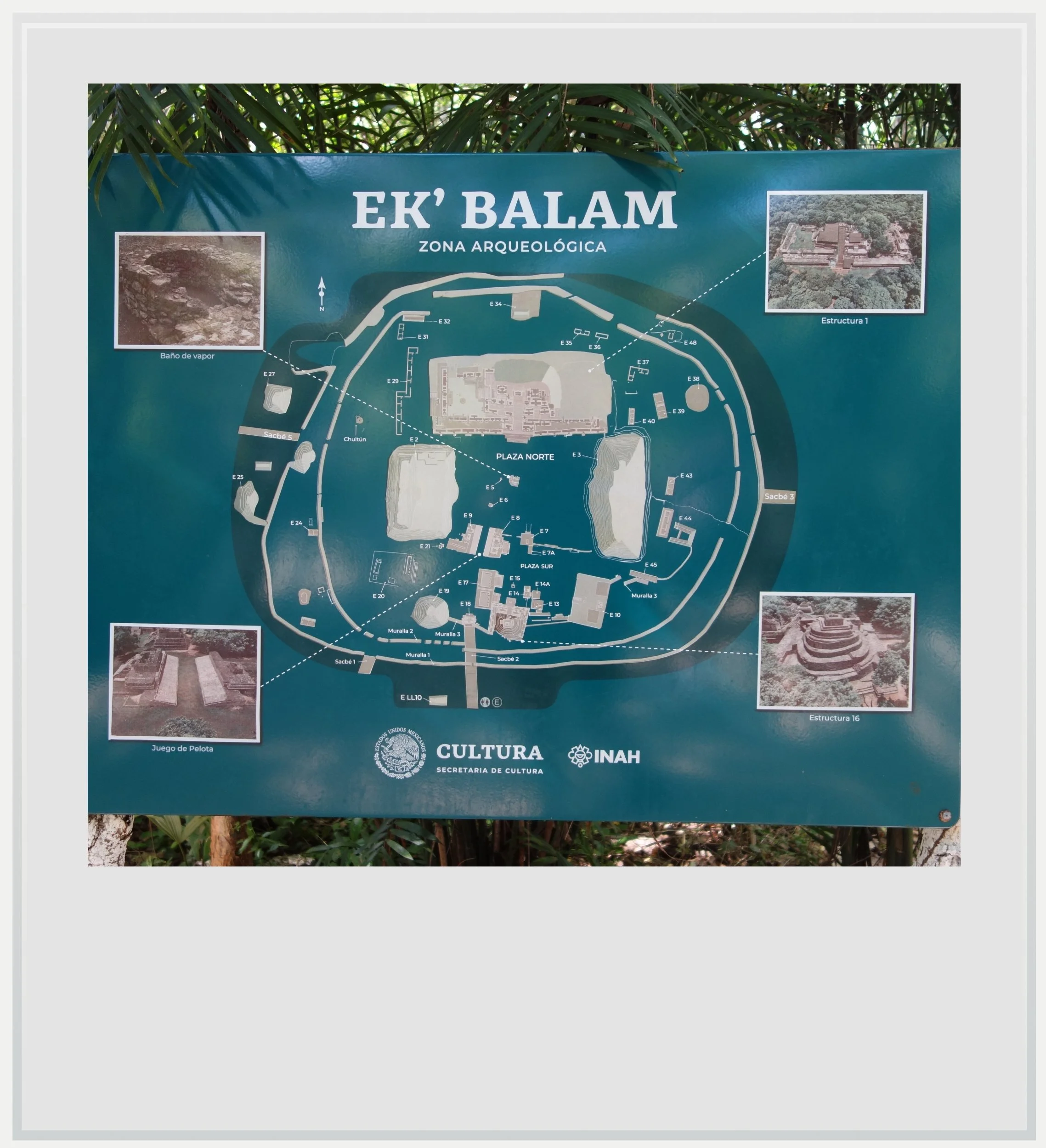
Ek Balam's site map.
When to go to Ek Balam
The best months weather-wise to visit Ek Balam are during the dry season, between November and April, with January and February the (relatively) coolest months. This is also peak season, but Ek Balam, although visited by a healthy number of travelers, doesn’t ever get as crowded as Chichen Itza.
If Ek Balam is your only visit of the day, timing doesn’t truly matter - although you will feel the heat more if you visit between 11 AM and 2 PM. If your plan calls for both Chichen Itza and Ek Balam in the same day, it makes sense to do Chichen Itza first, at opening time, and then head to Ek Balam, or alternatively to visit Ek Balam late morning, have lunch in Valladolid and head to Chichen Itza after 2 PM. The Kukulkan pyramid and the other buildings on the most famous Maya site in the world get really busy between 11 AM and 2 PM, and visiting it before or after this time slot will ensure a better experience.
I visited Ek Balam in late December, during the peak season. We arrived from Merida around 11 AM. There were about fifty other people with us on the site, but it never felt overwhelming.
How much does it cost to visit Ek Balam
To enter Maya sites in the State of Yucatan, visitors have to pay a federal fee to INAH, Mexico’s National Institute of Anthropology and History (MXN 210 for foreigners, MXN 105 for Mexican citizens and official residents with credential) as well as a state fee (MXN 481 for foreigners, MNX 132 for Mexican citizens and official residents), a total of MXN 691 for foreigners and MXN 237 for Mexican citizens.
An additional MXN 100 fee per car is due for parking, and an optional MXN 70 per person to check out the Xcanche cenote (see below).
All prices were valid at the time of my visit (December 2025).
What are the opening times of Ek Balam
Ek Balam is open every day from 8 AM to 5 PM, with entry allowed until 4 PM.
How busy is Ek Balam
Ek Balam is both a great archeological site and a convenient add-on to the trip to Chichen Itza. It is the seventh most visited Maya site in the country (based on full-year 2025 figures, the latest available at time of writing). 150,000 visitors went through its gates in 2025, or an average of 412 per day. This seems like a lot until you realize there were about 6,000 visitors a day in nearby Chichen Itza and 2,800 in Tulum. To enjoy a more solitary visit, it is recommended to come at opening time or in the late afternoon to avoid the bulk of the tour-bus groups ( many offer a combined Chichen Itza - Ek Balam itinerary with Ek Balam the afternoon stop).
What else to see near Ek Balam
Beyond the well-documented itineraries grouping Ek Balam with Chichen Itza and the charming magical town of Valladolid, it is rather easy to see the Xcanche cenote, a typical sinkhole with cristalline water surrounded by trees, that’s a nice contrast with the old Maya city. The cenote is actually located within the limits of the complex, about one mile (1.7km) to the east, and accessible with an additional MXN 70 fee. It is possible to walk the dusty path, but free bikes are available
Food & lodging in Ek Balam
Hotels
For most people, accommodation in Merida will make the most sense, if a visit to Ek Balam is part of a bigger Yucatan trip. There are plenty of hotel and Airbnb options in the Yucatan capital.
If you would rather stay closer to the archeological zone, say, to save on drive time in the morning, I recommend a base in Valladolid, the colorful pueblo magico, which is worth a visit for itself as well.
We picked Casa Tia Micha for our one-night stay after Ek Balam and Chichen Itza, both for the location near the town’s central square and the glowing reviews, and weren’t disappointed. The hotel is located in a old colonial house with a vast, lush garden, and provided comfortable quarters, and a delicious breakfast. Dinner in the attached restaurant was included in our fare, and the food was excellent as well. I’d definitely return.
Safety in Ek Balam
The State of Yucatan is considered a safe state by the US Department of State, which lists the State under a Level 1 travel advisory meaning “Exercise normal precautions” when you travel. In other words, it is considered as safe as the USA as a whole.
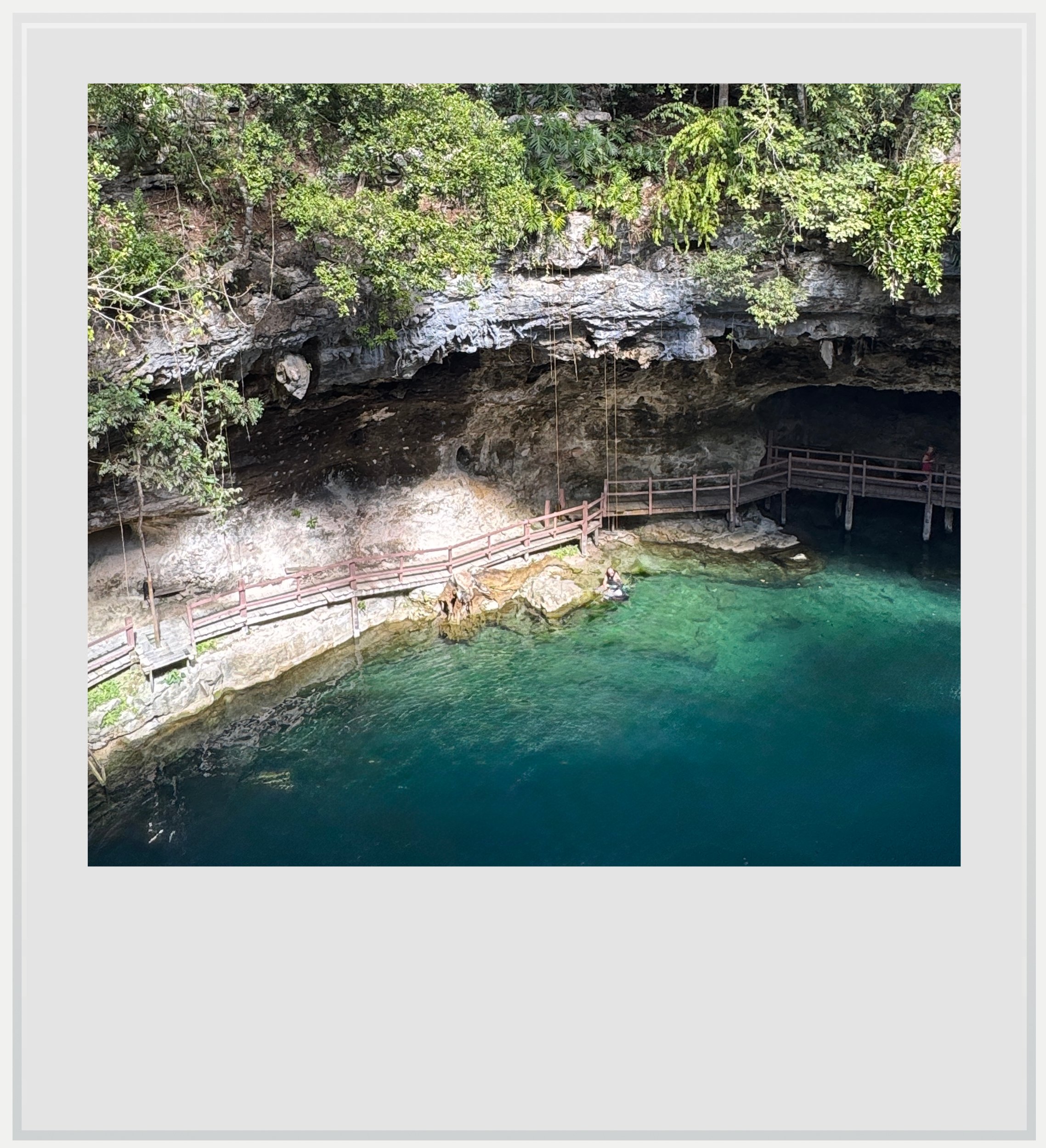
Cenote Xcanche near Ek Balam.
Keep in mind these travel tips
Heat isn’t a joke in Yucatan, and even in the dry season, temperatures can reach very high around midday. Make sure you hydrate regularly and keep a water bottle with you.
The UV index may be low in the morning and evening, but during the day, it gets pretty high. Wear SPF.
Bring cash. While many shops accept foreign credit cards, bus companies, taxi drivers, and many smaller boutiques do not. Some restaurants were cash-only as well.
Cell service can be spotty outside of cities, and although Telcel signal was strong overall in Merida and Valladolid, it disappeared approaching Ek Balam (unless you count sporadic 3G service). No other provider covered the old Maya settlement either but all of them provided some sort of connection on the main highway. Telcel is always the safest bet, though. If you’re roaming, check that you can roam on Telcel, or investigate a Mexican eSIM that uses this network. Telcel coverage is independently mapped here. Change the network in the drop down menu at the top to see other companies.
Every photo caption appears if you hover over it (on a computer) or click on it (on a smartphone).
All photos are mine and copyrighted.