Aubusson, France
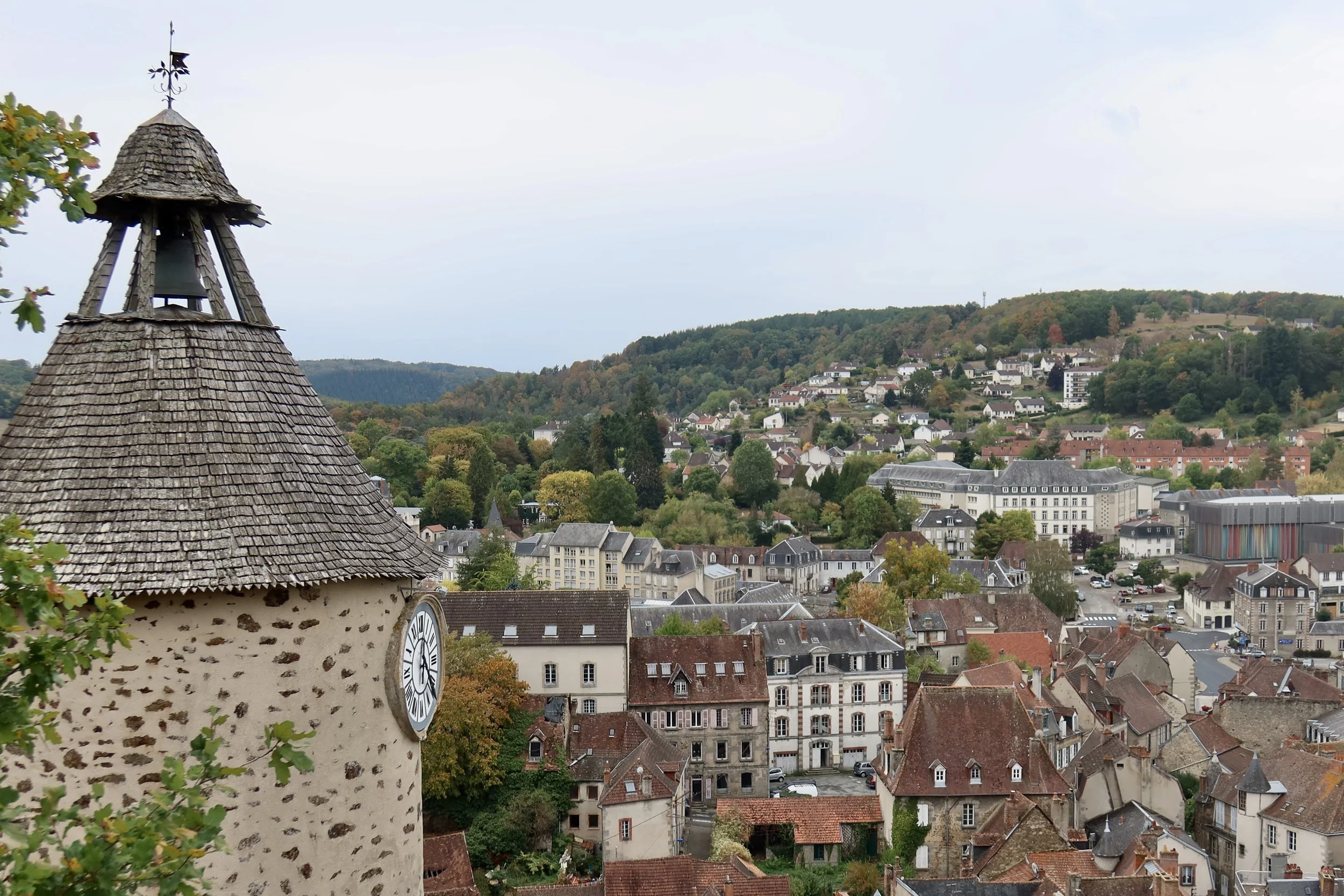
A Town’s History Woven in Tapestry.
Looking for transport options, places to stay or tips for visiting Aubusson? Head straight to the Practical Information section. In the story below, linked place names take you a map of Aubusson’s main sights.
It’s hard to explain why I had wanted to visit Aubusson for several years, but it probably had something to do with two of my interests: history and relatively isolated places, far from France’s best-known destinations.
There was something else: I love rail travel and was excited to take a French regional train to Aubusson. The line belongs to a dwindling rail network in the Massif Central, the ancient mountain range in central France.
What I hadn’t anticipated was that services on the Guéret-Aubusson-Felletin line had been suspended indefinitely in late summer 2025. As I was looking for train schedules between Guéret and Aubusson, only buses appeared. I had missed reaching Aubusson by train by just thirteen months.
That the rail link had been recently suspended wasn’t a complete surprise. The Creuse department, in which Aubusson is located, is the second-least populous in metropolitan France and has lost about one fifth of its inhabitants in the past fifty years, while France’s population has grown by twenty-five per cent.
Our main goal was to visit the Cité de la Tapisserie, a museum devoted to the craft that made Aubusson and the region famous across Europe. In 2009, UNESCO recognized Aubusson’s tapestry as part of the Intangible Cultural Heritage of Humanity. We made our way there, only to discover it was about to close for lunch. It made more sense to come back in the afternoon. That forced change of plan would shape everything we discovered afterwards.
We parked along the Creuse River and started making our way towards the historic center. Walking along the river, we began to understand Aubusson’s unusual setting. Here the Creuse valley broadens where several rivers join it. Their valleys provided natural routes converging on Aubusson.
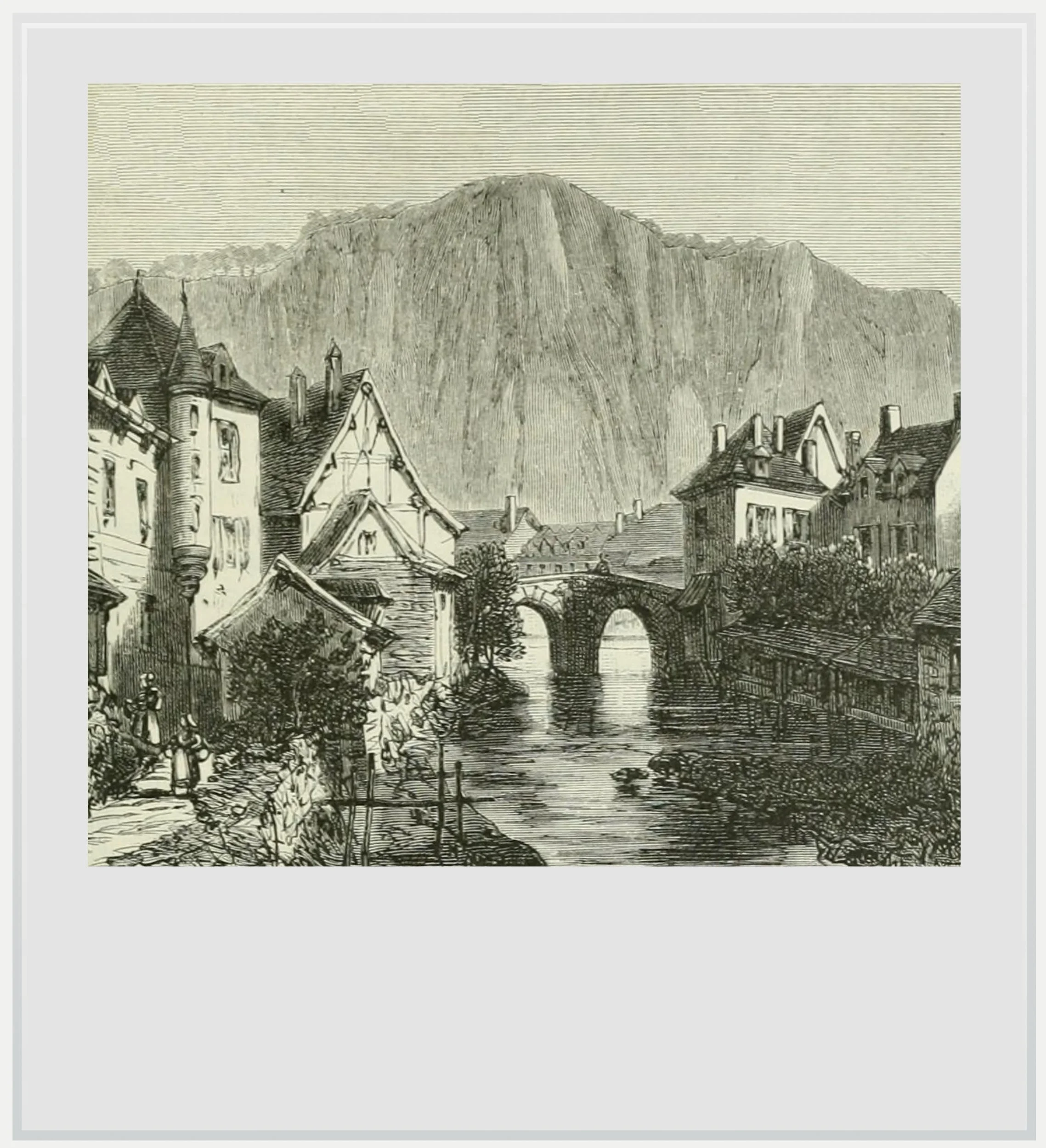
Aubusson — engraving from V.-A. Malte-Brun’s La France illustrée (Jules Rouff, 1881), vol. II, “Creuse,” p. 9, via Internet Archive.
The singular topography also meant that a river crossing there could be monitored by a fortress, built on one of the surrounding hills. The remains of Aubusson’s castle stand on the Chapitre hill, where human activity has been recorded since Roman times. A natural meeting point, a river crossing and a way to monitor and defend it from above: Aubusson could thrive.
For all my excitement about the oldest part of Aubusson, I had everything wrong.
It’s unclear when a bridge first replaced the ford, but we do know that the Terrade Bridge, first a wooden construction and, since 1631, a stone one, was the first modern crossing linking the two banks of the Creuse river. Seeing it was an experience in itself: from the east, with tall hills behind us, the bridge is flanked by two houses and I imagined the older one, to the right, might once have collected duties on goods entering the town.
More striking, however, were the streets beyond the bridge: the roads to the front and to the left seemed almost comically narrow for the 21st century, as though they belonged to an old movie set. The picturesque buildings, with matching shutters and flowerbeds at the windows, were showing the care with which they had been preserved.
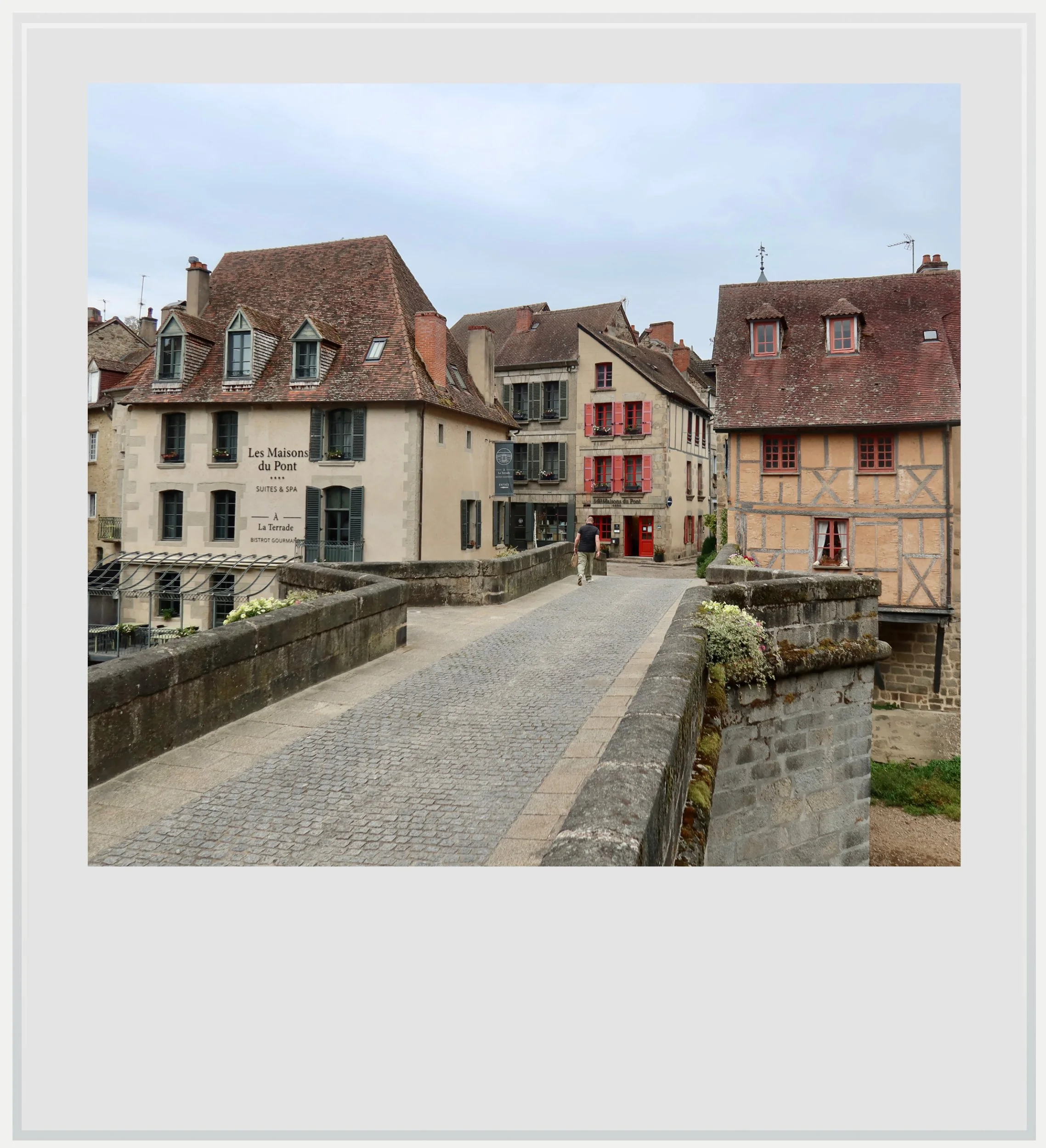
La Terrade Bridge, above the Creuse river, in Aubusson.
For all my excitement about getting into the oldest part of Aubusson, I had everything wrong. The neighborhood we were entering, on the southern bank of the Creuse, was in fact Aubusson’s medieval suburb, La Terrade. Most of its buildings date from the 17th and 18th centuries, when the permanent stone bridge encouraged development.
Travelers arriving from the west crossed the bridge to enter Aubusson. After walking around La Terrade for a bit, we turned around, crossed the river and finally entered Aubusson’s historic core.
Establishing the town on the northern bank of the Creuse river made a lot of sense. It would be protected from invaders by the steep valley wall to the north, and the river to the south. As we saw, the Chapitre hill, overlooking the valley, was a great natural lookout, and a fortress was eventually built there, along with defensive walls that protected the small town.
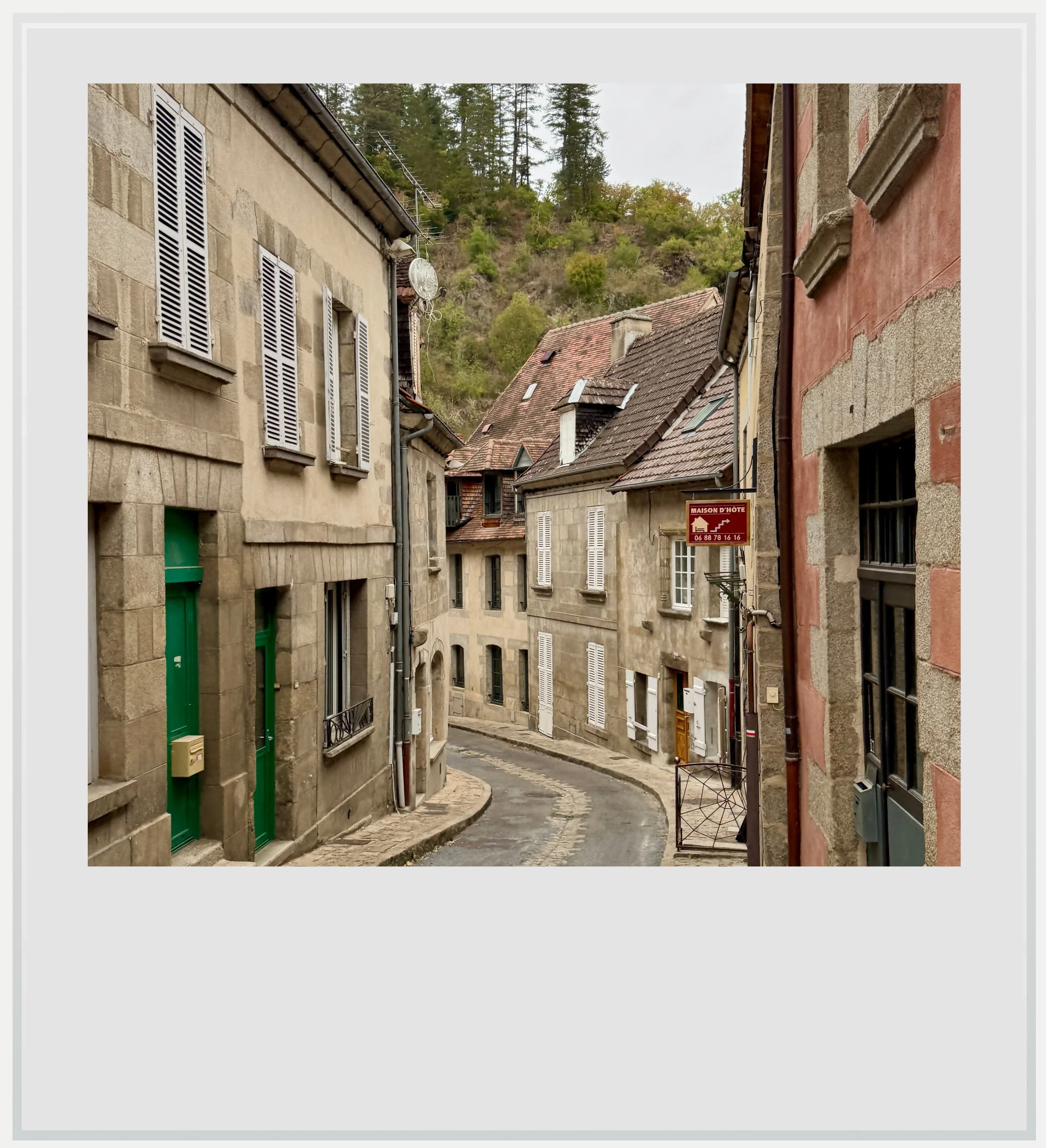
Alfred Assolant street in Aubusson’s La Terrade neighborhood.
This explains why the center of Aubusson felt remarkably compact. This wasn’t a complaint: I loved how the narrow streets lined with ancient buildings gave the place a cosy, close-knit feel. It was easy to imagine that, living so close together, everyone knew everyone else.
Aubusson originally developed along Rue Vieille, beneath the fortified castle. It still follows its original medieval alignment and retains beautiful buildings from the 15th and 16th centuries, such as the Maison Corneille, one of the town’s oldest surviving houses.
The missing piece of Aubusson’s history was its tapestry industry.
Aubusson’s current main street is roughly parallel to Rue Vieille. A small stream once ran through what is now Grande Rue, with houses gradually rising along its banks - this helped explain its meandering shape. The stream was covered around 1770, allowing the widening of Grande Rue, which became Aubusson’s main thoroughfare
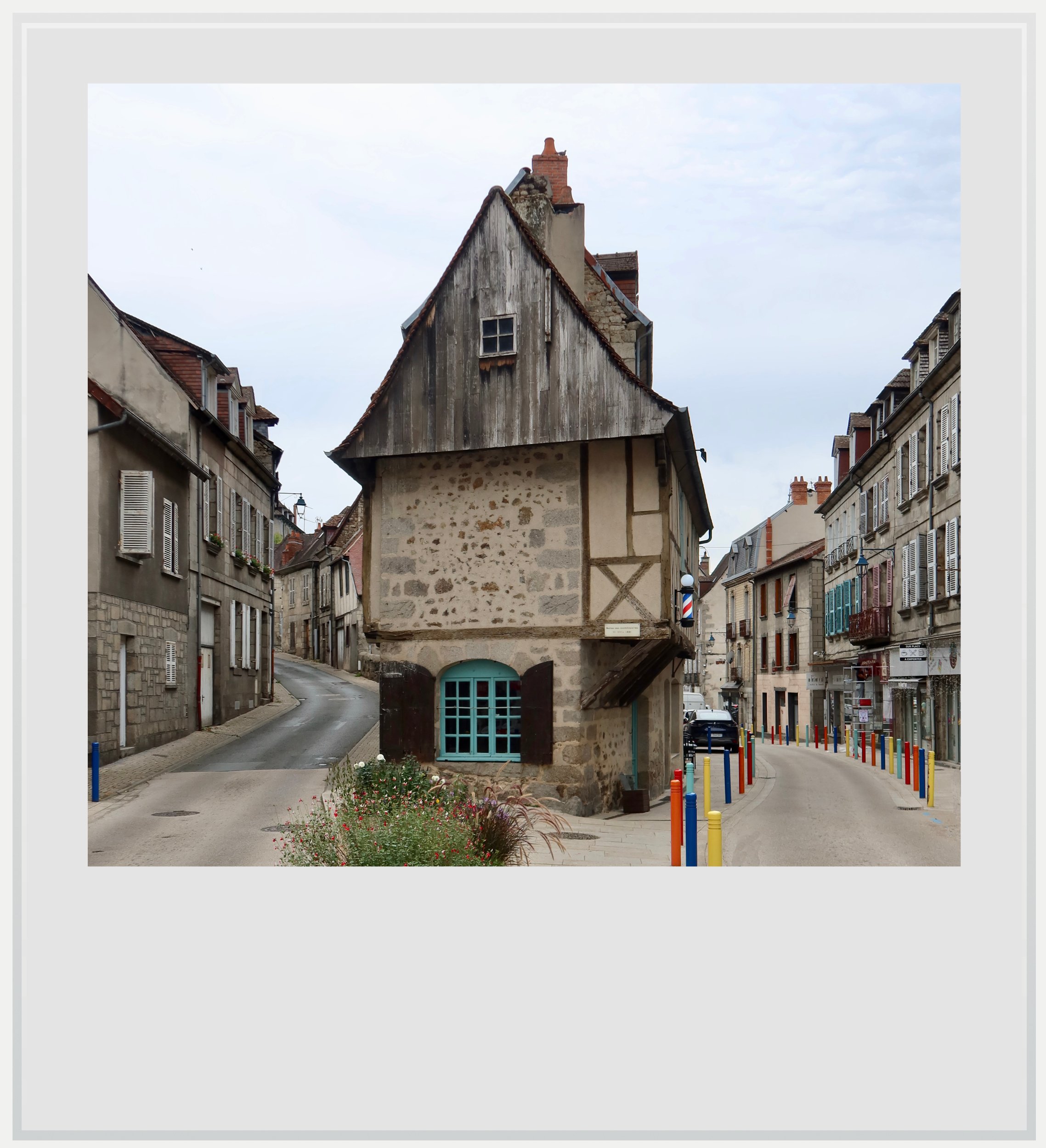
One of Aubusson’s oldest house on Place du Général d’Espagne.
The buildings along the street reflected how prosperous Aubusson was during the 18th and 19th centuries. Although one of its most remarkable edifices was the earlier timber-framed house at the corner with Rue Chateaufavier, most of the buildings along Grande Rue were rebuilt after the stream was covered. They all project the image of a wealthy provincial town, with their tall, shuttered windows, wrought-iron balconies, steep roofs and occasional architectural flourishes.
Aubusson’s wealth continued during much of the 20th century, and its beautiful Art Deco town hall, inaugurated in 1937 on Grande Rue, embodies the town’s economic revival post World War I.
While admiring the building’s grandeur, I remembered seeing a sign directing visitors to the town hall on the opposite bank of the Creuse. I had stumbled upon the first sign of Aubusson’s more recent decline, and suddenly my first impression of the town was replaced by one slightly less rosy. The town hall was indeed moved to a more utilitarian building, La Passerelle, in 2018, because the municipality couldn’t afford the upkeep of the older one. Since its inauguration in the 1930s, the city had lost about forty per cent of its population. The imposing building now sits mostly unused, save for regular council meetings and occasional ceremonies.
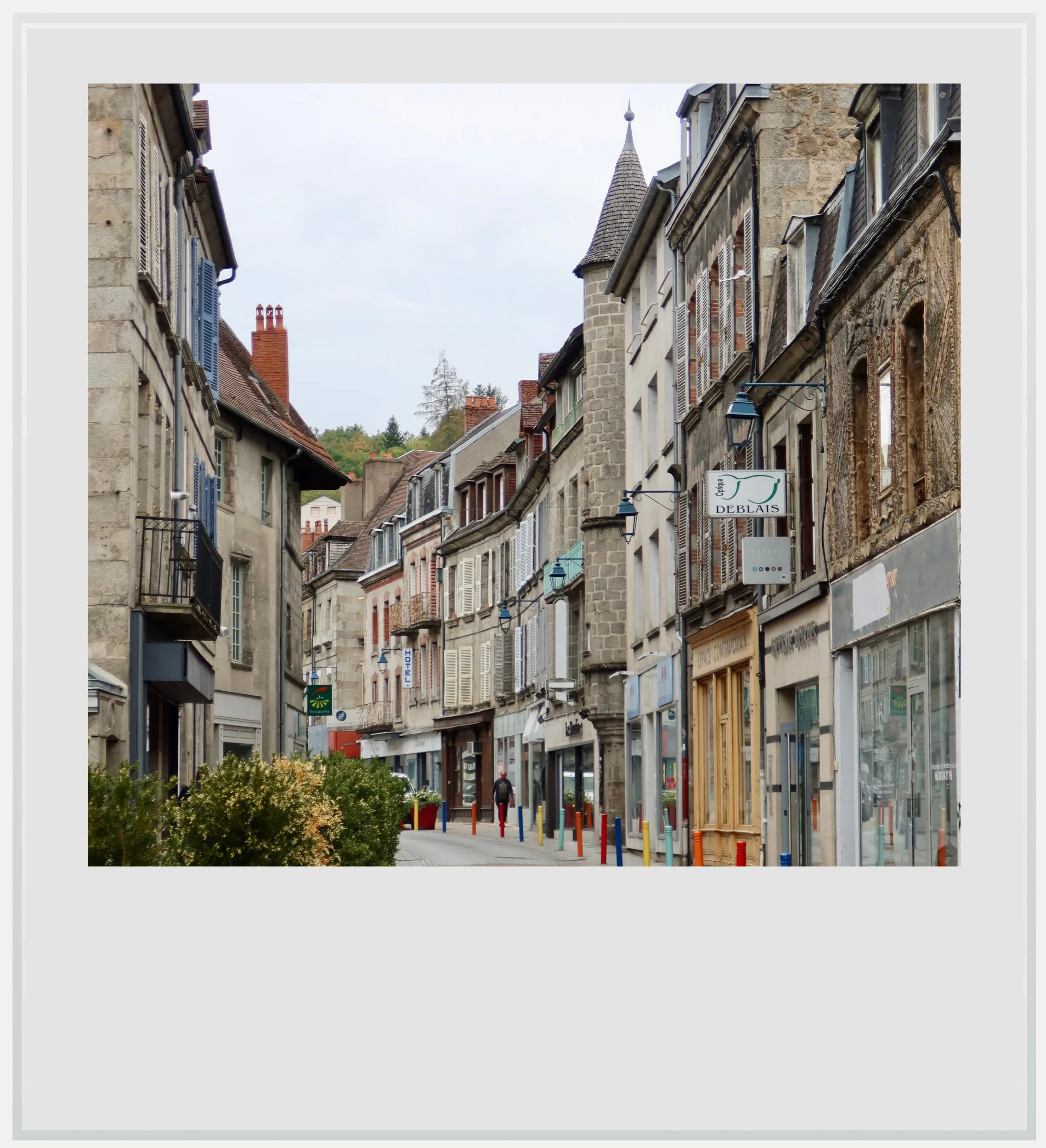
Grande Rue in Aubusson.
From that moment, I started seeing a slightly starker reality around me: the empty storefronts here and there, the lack of foot traffic on the main street, a diffuse sense of slow abandonment I hadn’t perceived previously. Aubusson wasn’t exactly the same as it was during its heyday. It would be tempting to blame the combination of France’s deindustrialization that started in the 1970s and the long-term depopulation of rural France, but that would only be telling part of the story.
The missing piece of Aubusson’s history was the one we came here to discover, and the reason why the city is so renowned: its tapestry industry.
How did it come to be? The familiar account goes like this: historical ties between local Marche rulers¹ and Flemish nobles may have led to the creation of the first tapestry workshop in the region in the middle of the 15th century. The trade flourished, and Aubusson’s tapestries became sought after throughout France and in 1665, under King Louis XIV, Aubusson's tapestry workshops were granted the prestigious title of Royal Manufacture².
While I had no reason to doubt the usual account, I felt it didn’t really answer the question of why this trade took off in Aubusson. So I looked further.
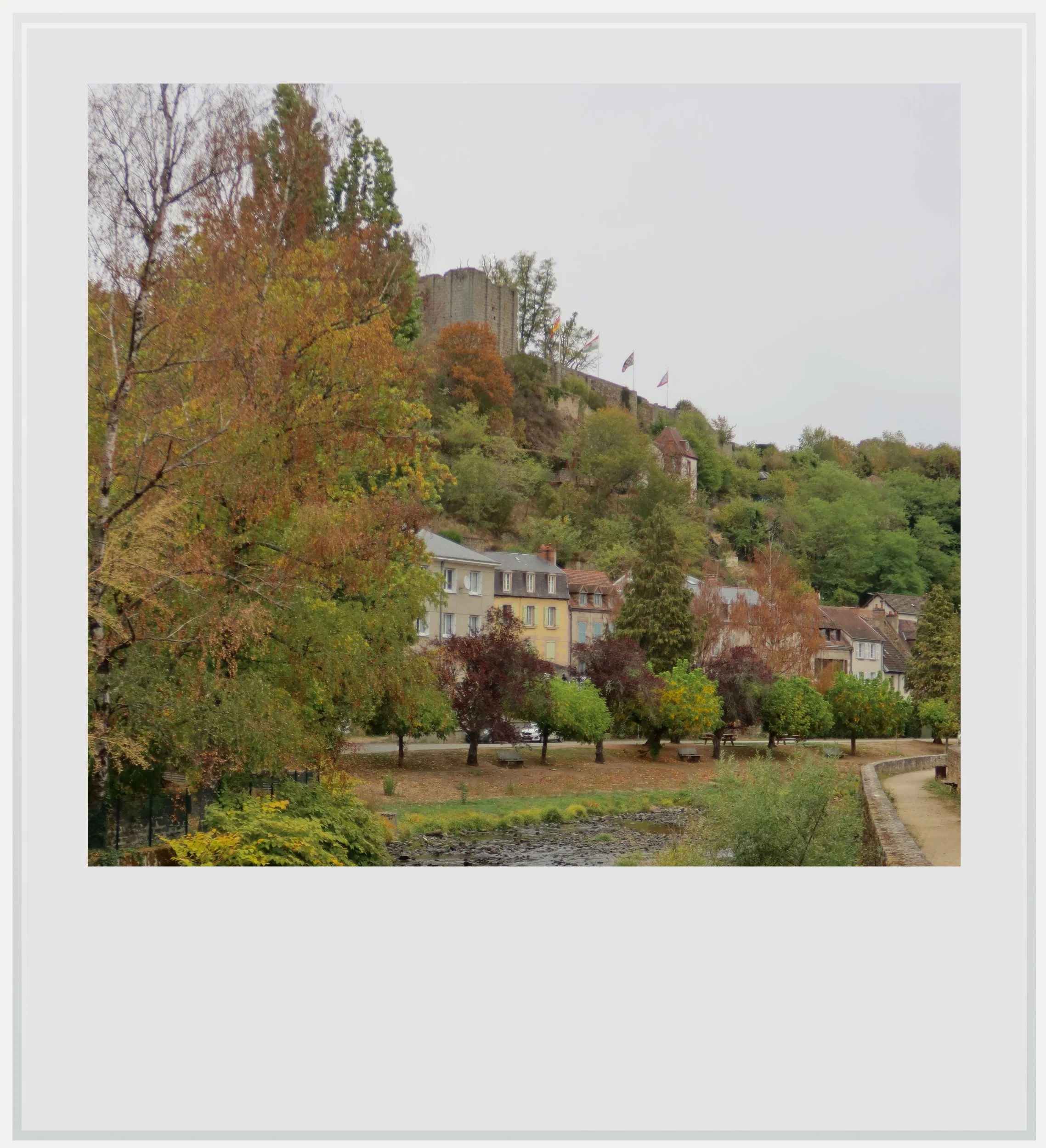
The remains of Aubusson’s castle, overlooking the Creuse River.
It was never formally established that the arrival of families from Northern Europe explains the origins of tapestry-making, although the Cité museum cites it as the most probable theory. What we do know is that Aubusson was home to a flourishing local tradition of making woolen cloth and blankets, thanks to abundant sheep herds and rivers. This meant the area already had lots of skilled textile workers.
It is therefore possible that, when people came from Flanders and brought their specific weaving techniques with them, they helped upskill some Aubusson artisans to the more profitable tapestry trade. That possibility is supported by the fact that the Aubusson technique of basse-lisse (low-warp weaving) was used previously in Flanders. We can’t brush aside the possibility that this effort was entirely homegrown, however, and that Aubusson’s clothing makers found ways to diversify and become tapestry weavers³.
What remains less clear is why, having come upon this new business opportunity, Aubusson and Felletin, where a tapestry workshop is documented as early as 1457, became especially renowned for their production.
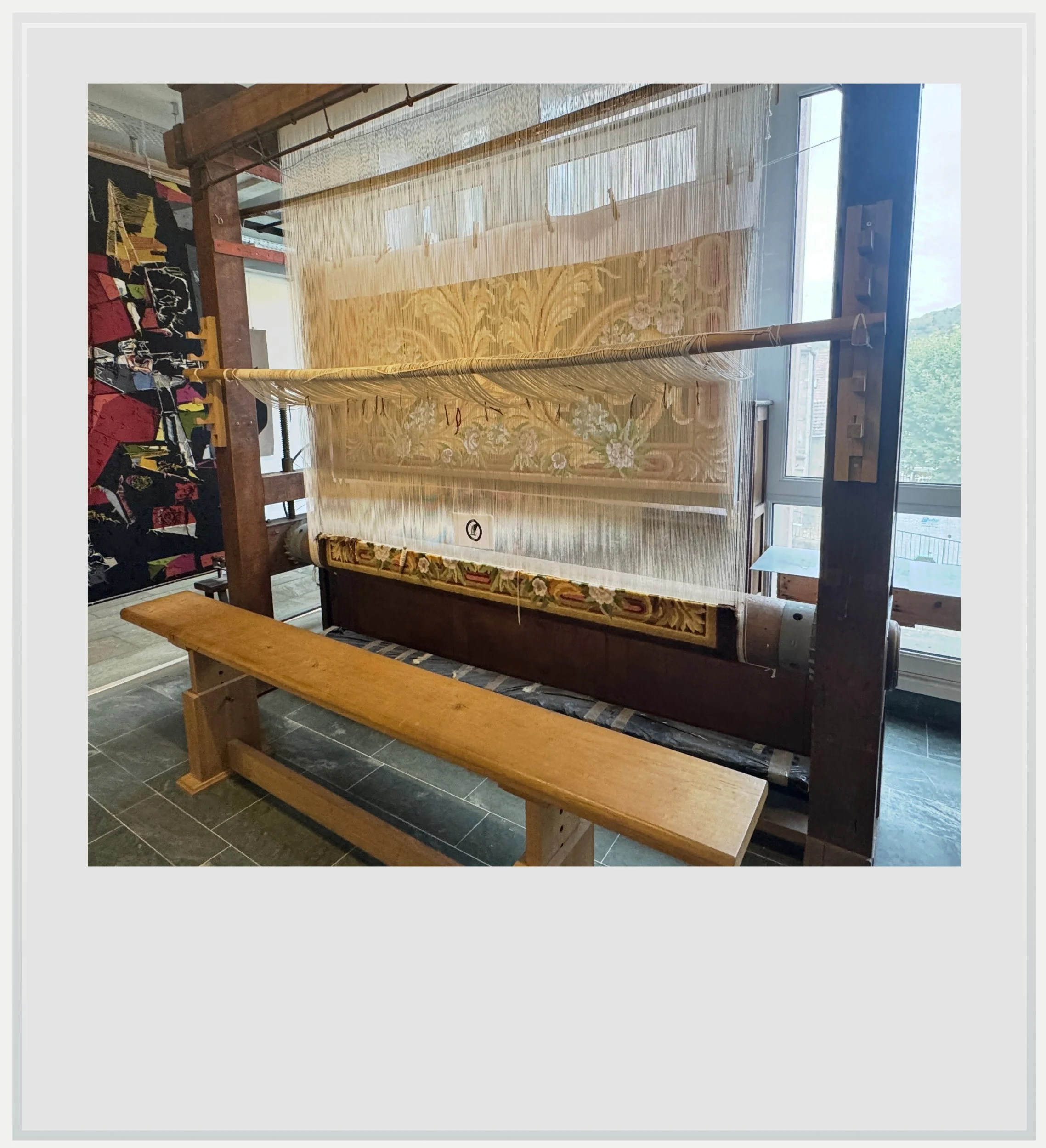
A vertical tapestry loom on display at the Cité de la Tapisserie in Aubusson.
One explanation is that the Aubusson and Felletin makers may have been commercially astute. Early tapestry work from the region wasn’t as refined as tapestries woven by more prestigious manufactures in Northern Europe⁴. Its relative simplicity may have been a commercial advantage: lower prices put these tapestries within reach of prosperous households beyond the nobility.
Here again, history refuses to run in a straight line.
Flemish immigration to the Marche region was recorded in the late 16th century, so it is also possible that Flemish weaving techniques helped strengthen a developing industry, and enabled Aubusson and Felletin weavers to produce higher-quality work⁵.
The spread of Aubusson’s tapestry across France could have been helped by existing commercial networks selling woolen goods. Aubusson’s position at the meeting point of routes running north-south and east-west gave local textile makers access to buyers farther afield.
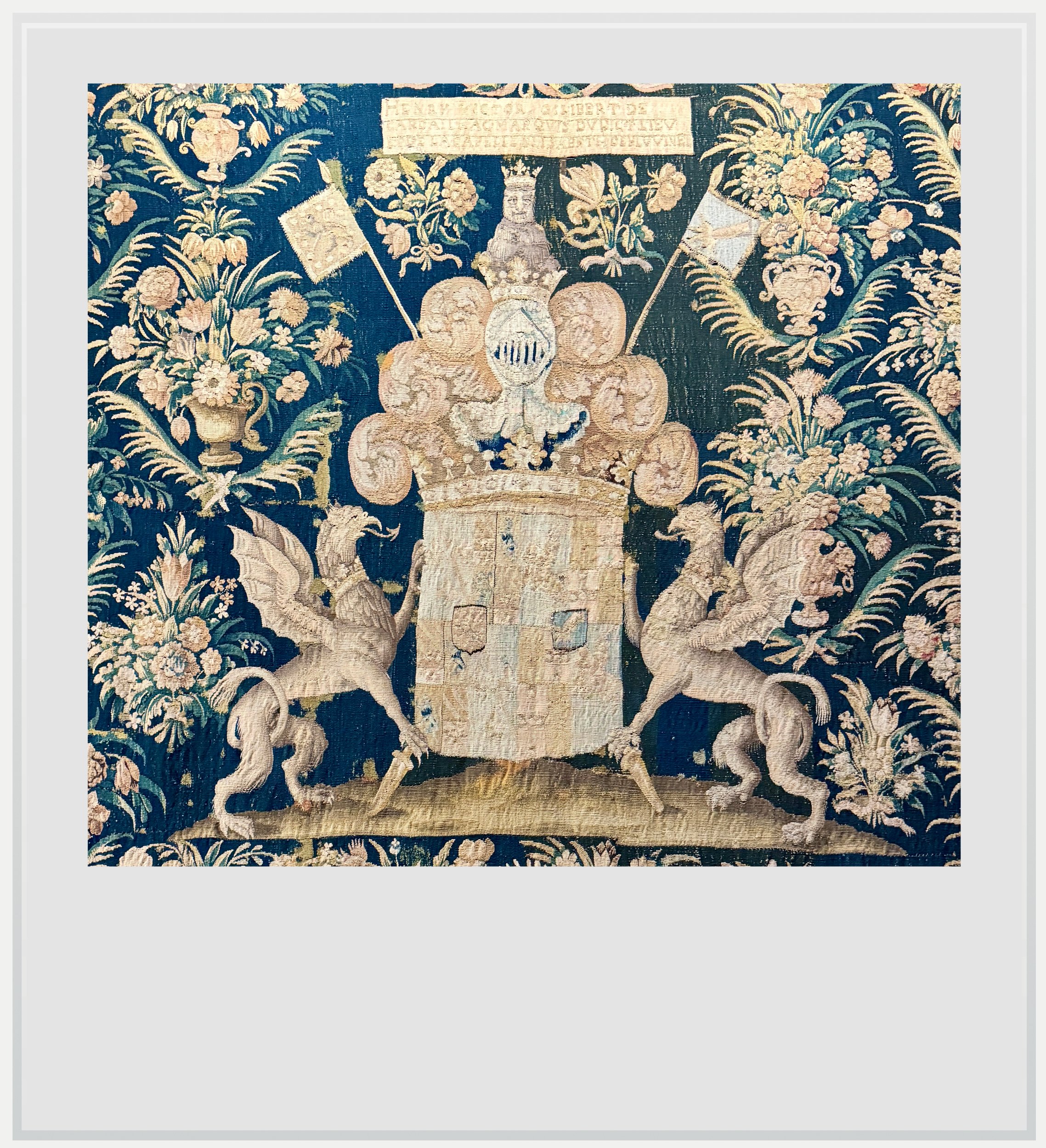
Detail of a 17th-century Aubusson tapestry.
In every good story, chance makes an appearance: in Aubusson, it showed up in 1601, when the administration of King Henry IV restricted the import of foreign tapestries into France, likely benefiting French producers⁶.
Aubusson’s biggest turning point, though, seems to have taken place in 1665, when the city’s tapestry workshops were awarded the title of Royal Manufacture. In the usual telling, this was Aubusson tapestry’s crowning moment: a royal endorsement of its quality.
Here again, history refuses to run in a straight line. In fact, the 1665 decision was primarily made to help a then-struggling industry. The 1665 edict was requested by the town to help turn it around: the designation introduced regulations and quality standards. It was less a reward for excellence already achieved than a commitment to improve quality and establish Aubusson’s reputation.
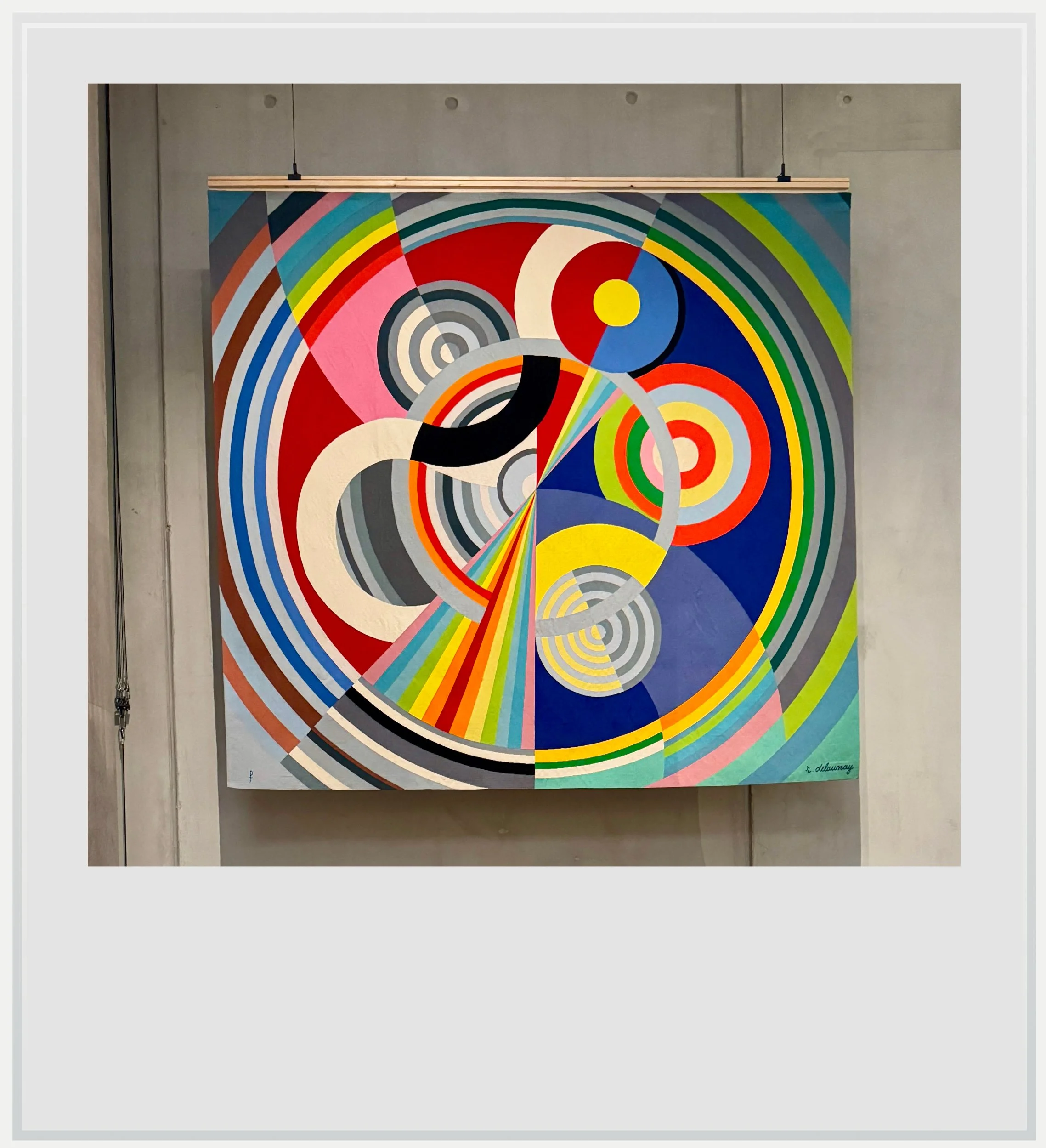
Rhythm #1, from an original painting by Robert Delaunay.
The subsequent history is one of repeated expansion and decline, sometimes within a few decades. By the mid 18th century, after an infusion of creativity courtesy of the French king’s official painter, Aubusson’s tapestry trade lived its Belle Époque, with production booming until the French Revolution in 1789.
The nineteenth century brought another period of expansion, with larger workshops producing both tapestries and carpets. By the beginning of the 20th century, however, the tapestry trade was in decline. What it needed, just like in the 18th century, was an infusion of innovation that could help shake off its image as an old-fashioned craft.
What started in the late 1910s marked one of the industry’s most stunning reinventions. A new artistic vision took shape with Antoine-Marius Martin, then director of Aubusson’s national school of decorative arts (ENAD) and then Jean Lurçat, a painter who, along with other artists, worked on modern designs made specifically for tapestry and encouraged the workshops to stop copying older paintings. Collaborations with famous artists such as Braque, Calder and Le Corbusier opened new aesthetic possibilities and infused tapestry designs with a modernity that had been sorely lacking.

Les Mains, by Le Corbusier & Atelier Picaud (detail).
The economic growth that ensued helped explain the building of the Art Deco town hall in the 1930s - it was fascinating to connect the dots one by one. The trade thrived through postwar reconstruction, which provided ample demand for tapestry. Aubusson was flourishing again.
That wouldn’t last. The 1960s marked the start of a difficult period. Aubusson lost its biggest champion with the death of Lurçat in 1966. The economic crisis of the 1970s and the drop in public commissions led to several major workshops closing during the 1980s (another major employer in town, Philips, closed its light bulb factory in 1988). Revival attempts in that decade didn’t last. In the 1990s, the ENAD merged with its Limoges counterpart.
It was hard to ignore the paradigm shift the Cité de la Tapisserie embodied.
This time, it seemed like the end of an era, as though a vicious circle would finally doom the tapestry trade. It was less in vogue, which meant lower demand, fewer jobs for graduates and, in turn, a weaker school. At stake was more than the industry: the skills themselves might no longer be passed on. Aubusson had lost most of its tapestry workshops. Would it let the tradition itself disappear?
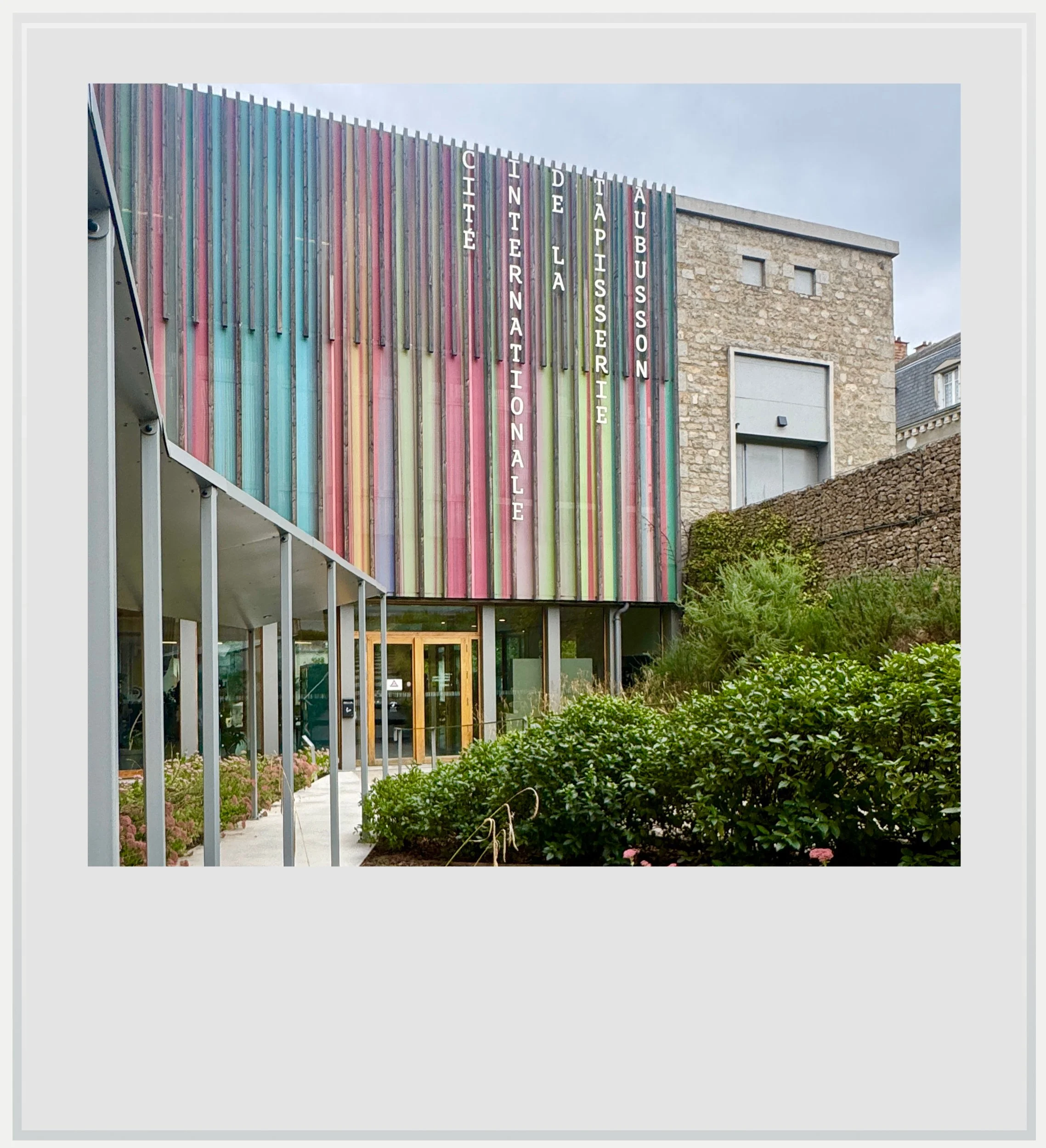
The Cité Internationale de la Tapisserie, in Aubusson.
Local initiatives to preserve it started at the worst time of the crisis. The most visible of these efforts happened in September 2009, when UNESCO added the Aubusson tapestry to its List of the Intangible Cultural Heritage of Humanity. This created commitments from the French state to finance lifeline measures to safeguard the craft. The most concrete act was the opening of the Cité de la Tapisserie in 2016, symbolically reusing the building that used to house the ENAD school.
When we finally visited the Cité, in the afternoon, I realized it was more than a museum: it houses a training program for weavers, a national restoration workshop for tapestries and a specialist research library. It also commissions large-scale tapestries, inspired by contemporary artists, which aim to show the craft is still relevant today. We saw a few of them on display, including one inspired by Studio Ghibli.
While the Cité seemed to be the institution leading efforts to keep the tapestry tradition alive, it was hard to ignore the paradigm shift it embodied. The tapestry trade is no longer what drives Aubusson’s economy. The goal of the museum is to explain and promote the tradition, and keep it alive, thanks to state commitment. It made me realize that Aubusson’s tapestry industry might never again support thousands of jobs, but its craft could still be passed on, practiced and renewed.
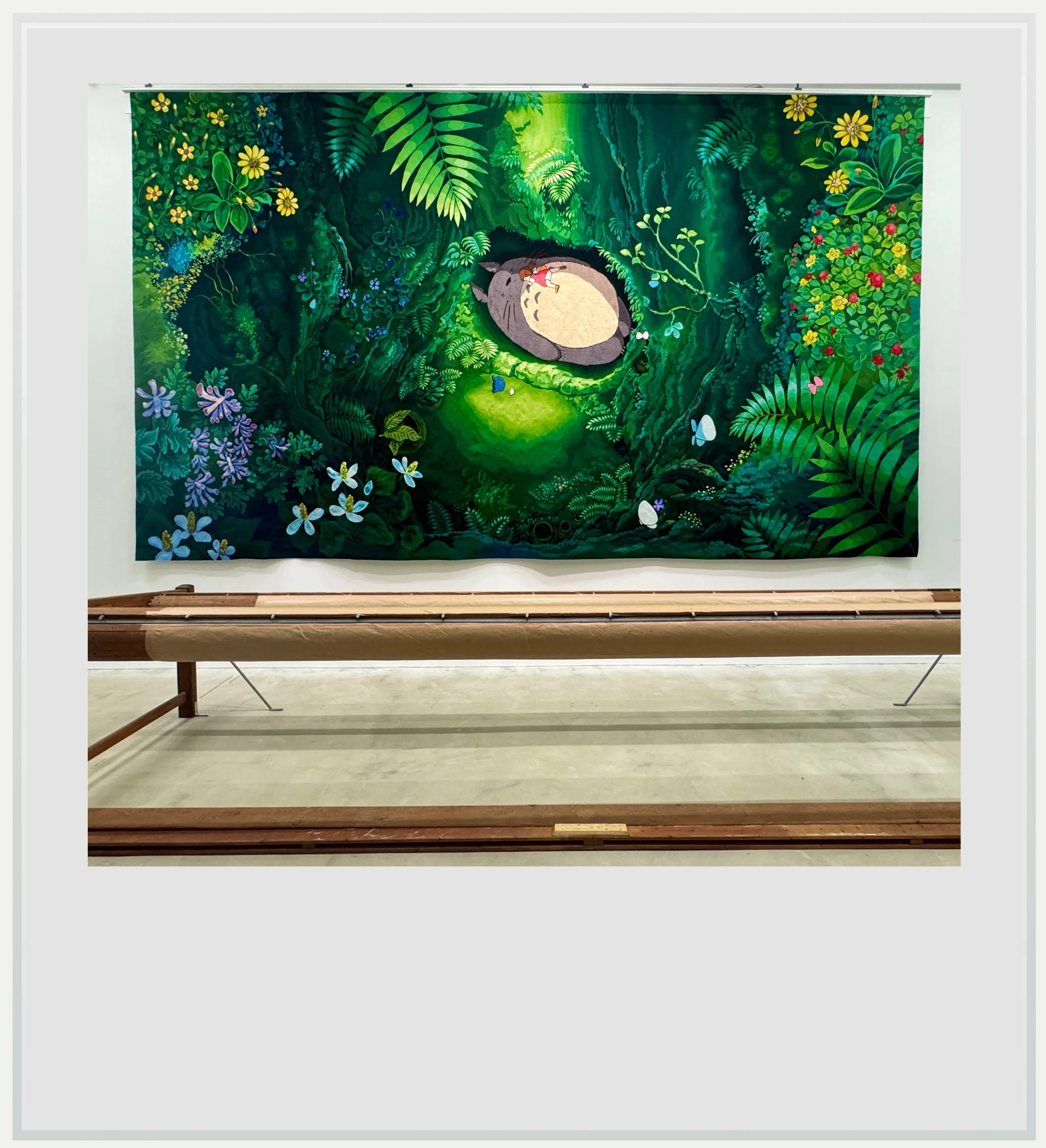
“La Sieste de Mei et Totoro”, after Hayao Miyazaki’s My Neighbor Totoro (© Studio Ghibli). Loom shown in the foreground for scale.
Beyond the interpretive rooms dedicated to the techniques of the trade, what impressed me most was the soaring, double-height gallery housing tapestries from across the centuries. The early work showed considerable skill, but what really held my attention were the more modern interpretations of the medium. Some of the works by Braque or Calder were on display, and it changed my perception of tapestry from somewhat old-fashioned wallpaper to an incredible art medium.
My first explanation, that color changed tapestry, did not survive for long. The early tapestries shown in the museum were beautiful but all seemed to favor muted colors and faded tones, in contrast with some of the most recent work on display, which used bright, luminous hues. It would have been easy to imagine that tapestry became modern when it overhauled its color palette, but the reality is a little different. It is likely that original tapestries from the 16th or 17th centuries were much brighter when woven, and that the particular dyes used back then faded over time.
The tapestry trade was at its best when new creative visions nourished the weavers.
If not color, then what helped tapestry reinvent itself several times over during its centuries of existence in Aubusson? The answer seemed to lie in the cartoons (cartons in French). Behind this seemingly unassuming word lies a crucial part of the creative process, which was well illustrated in the Cité. Like clothing, a tapestry is made according to a pattern, in this case called a carton, which represents the painting which the weaver will aim to recreate. In fact, the Aubusson’s UNESCO nomination was built on the idea that a tapestry is a “four-hand work”: the painter provides the vision and the weaver translates it into wool.
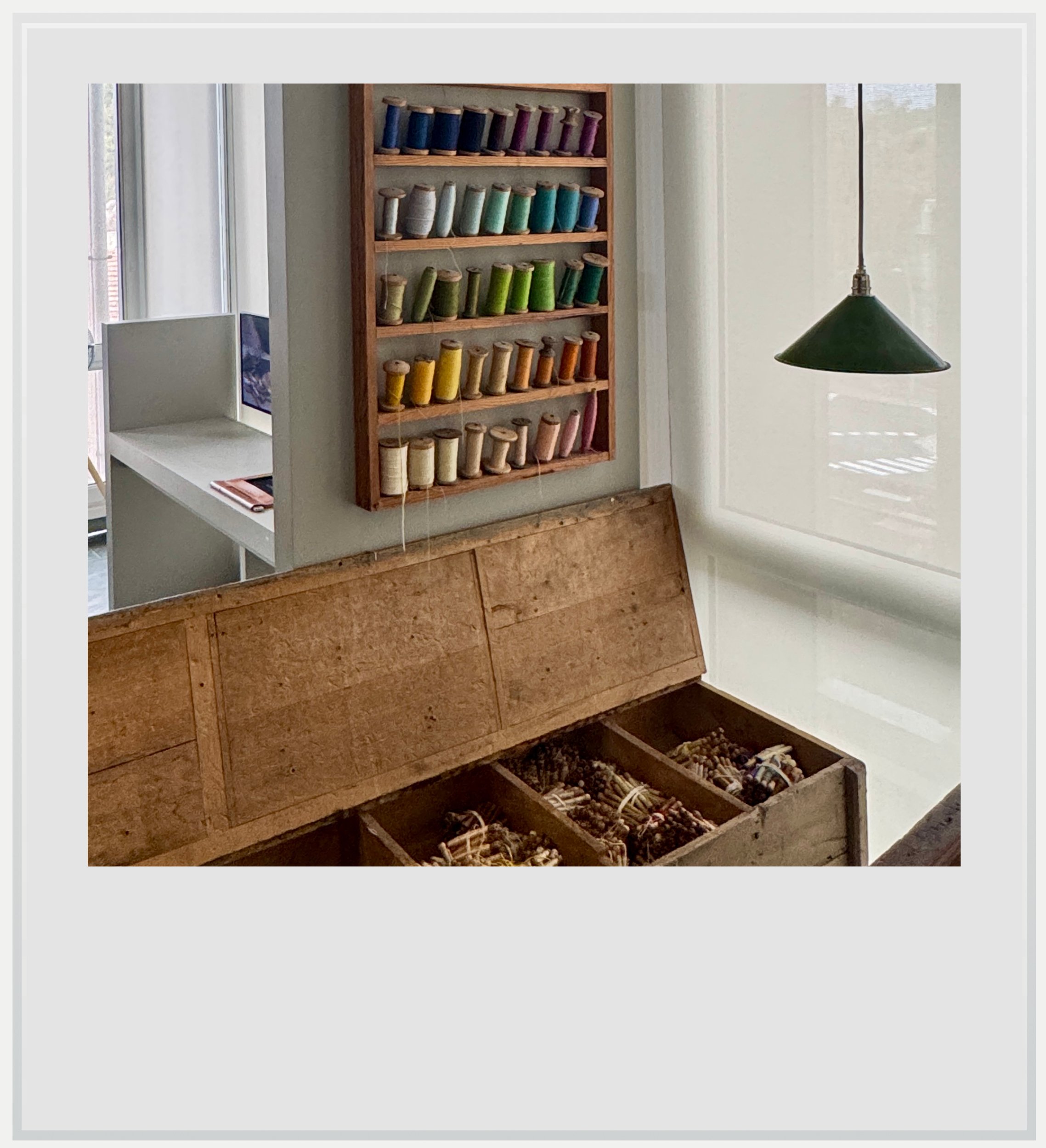
An interpretive room in the Cité de la Tapisserie in Aubusson.
It would be easy to dismiss the weaver as someone merely carrying out the artist’s instructions, but the balance of creative control has shifted over the centuries. Turning a painted image into tapestry leaves room for interpretation: brushstrokes cannot simply be reproduced in wool, colors have to be translated into combinations of threads, and the thickness of the yarn affects the texture of the finished work. These choices shape the result, making the passage from painting to tapestry a creative process in itself.
The Cité describes Aubusson tapestry as interpretative tapestry: the distinct roles of designer and weaver are at the core of its identity. This helped solve my biggest lingering question: the tapestry trade was at its best when new creative visions came to nourish the weavers. It happened with the court’s painter in the 18th century, and with Martin and Lurçat in the 20th century.
It made me regret my decision to skip the Cartoon museum (Atelier-Musée des Cartons de Tapisserie), located right by the Terrade bridge. At that time, I hadn’t understood how critical this four-hand process was in explaining the continuing relevance of Aubusson tapestry, and I wish I had been curious enough to step inside.
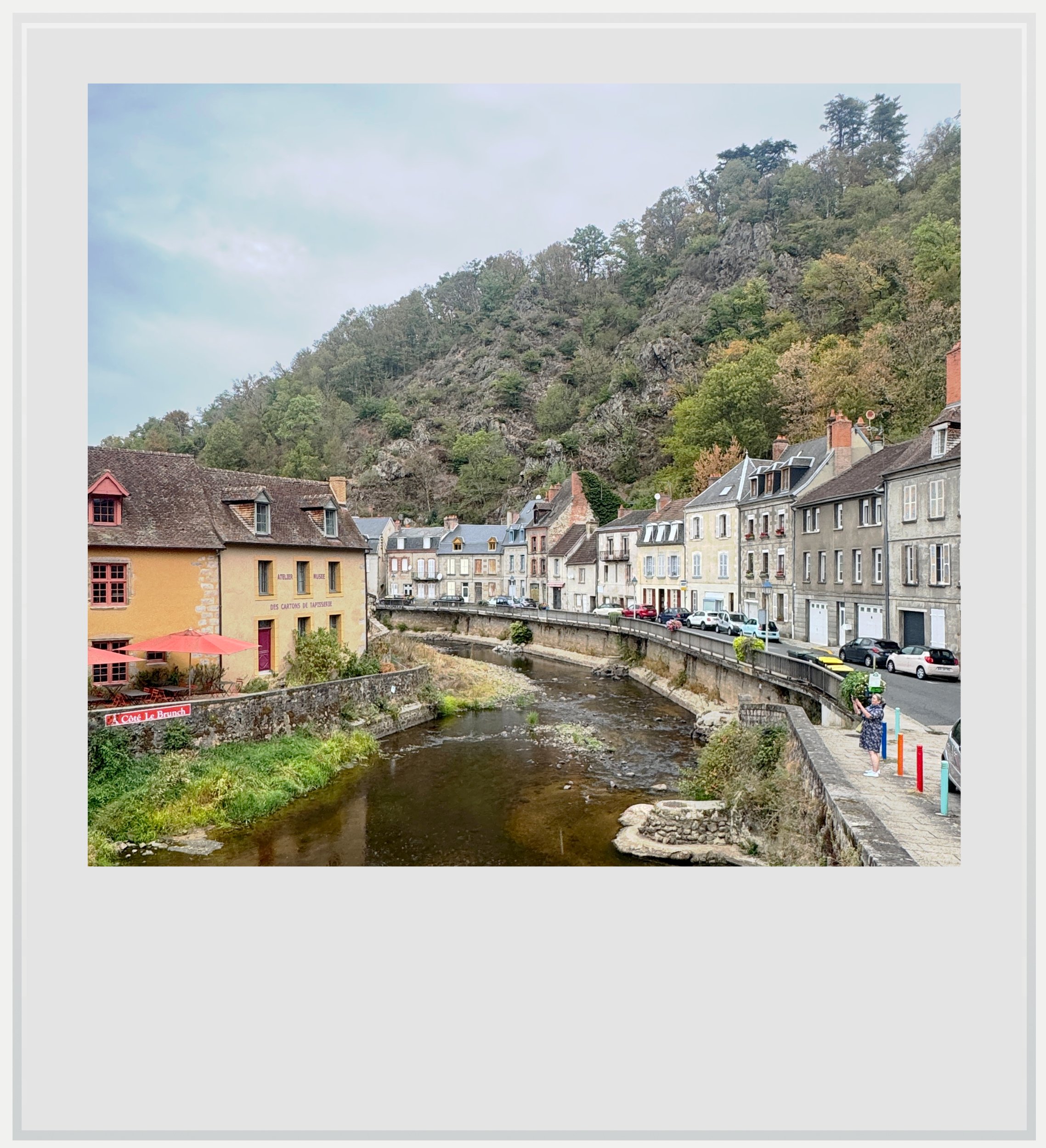
View on the Creuse River from the Terrade Bridge in Aubusson.
The Tolkien and Studio Ghibli collaborations of the past ten years show the Cité’s understanding that to survive, the tapestry trade needs to draw its inspiration from contemporary culture.
Exploring the town before the museum had been a stroke of luck. Now, it looked like we could piece together the town’s evolution alongside that of the industry that shaped it.
It was sobering to realize how the changing fortunes of the tapestry trade could apply to the town. With less than half of the population at its peak, in a remote part of France, Aubusson looks like one of the many small French towns that economic growth has left behind, with few prospects of recovery. Yet its tapestry tradition has made it internationally renowned, and the city was now relying on the Cité to strengthen its international profile and secure its future.
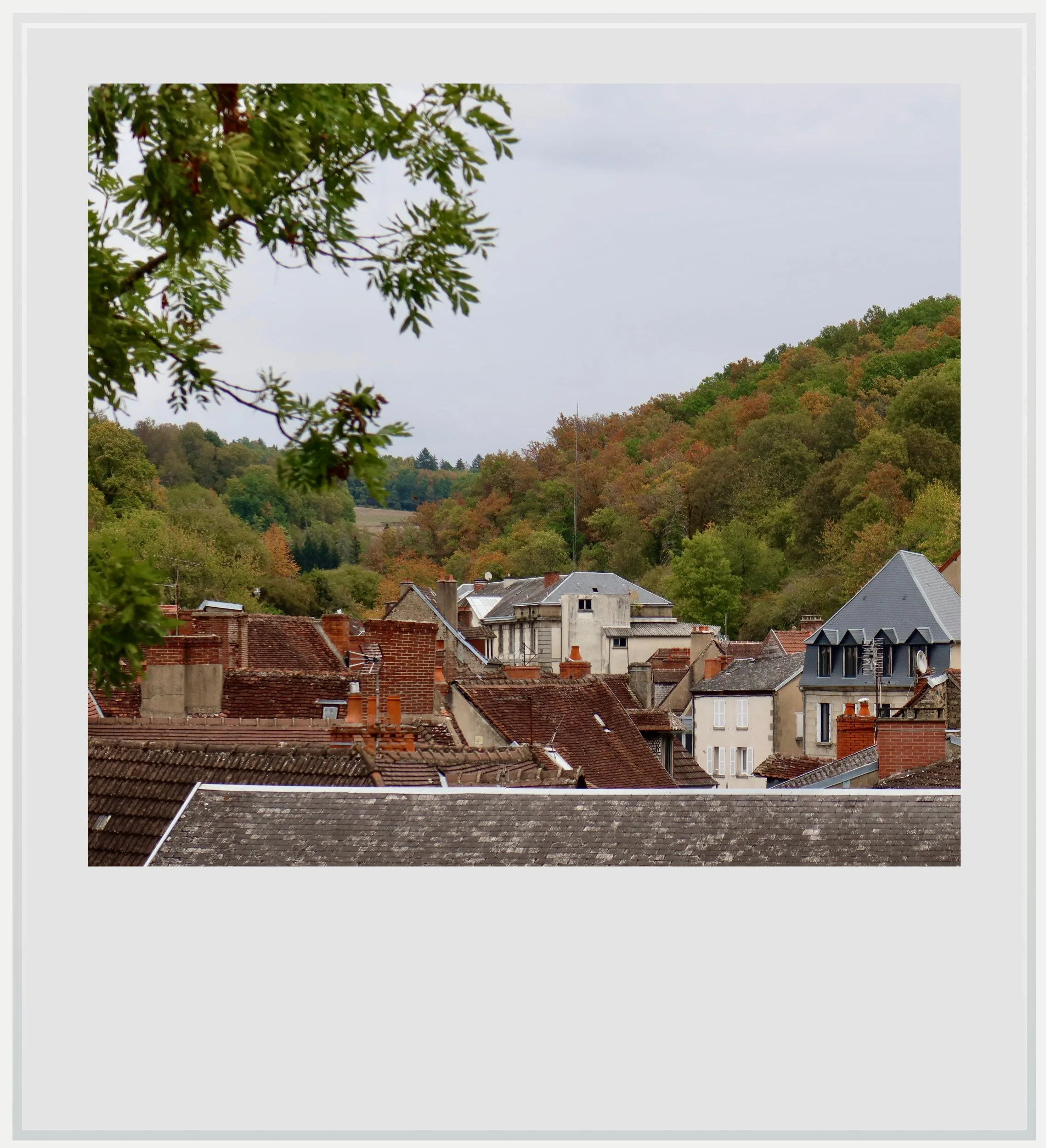
Fall colors above Aubusson rooftops.
We had climbed to the Clock Tower above town before our visit to the Cité. The tower is one of the few surviving features of the old fortified walls. From there, we had seen the whole town. I now understood how the its history had unfolded in front of us. We could almost make out the Creuse river at the bottom of the valley, the narrow sixteenth-and-seventeenth-century streets, the bourgeois mansions of the prosperous merchants and tapestry-makers of the 18th century along Grande Rue. In the background, modern and colorful, stood the Cité de la Tapisserie.
I had arrived in Aubusson with a preconceived notion of what I would find. It was rewarding to leave with a different view: that of a beautiful city whose urban history reflected the booms and busts of its most famous industry, also its beating heart. It was moving to realize that a craft many had left for dead was cherished, protected and nurtured to be ready for a possible new golden age.
Notes
1: La Marche was a historical province in the center of France. It no longer exists officially, but it covers roughly today’s Creuse department plus the northern part of Haute-Vienne.
2: official chronology of Aubusson’s tapestry history from the Cité de la Tapisserie website.
3: source (downloads a PDF file, in French).
4: source
5: Les tapisseries d'Aubusson et de Felletin, Chevalier, Chevalier, Bertrand
6: Henry IV prohibited tapestry imports, mainly to help develop a high quality Parisian workshop that will later become les Gobelins (source).
Practical information
(Everything you need to know about Aubusson and its tapestry history - updated October 2026)
In a nutshell
Tucked away in France's remote Creuse department, Aubusson is a small town with an extraordinary artistic legacy. Famous for its UNESCO-recognized tapestry tradition, it also offers centuries of history, distinctive architecture and a picturesque riverside setting. Discover its heritage, what to see and do, and where to stay.
How to get to Aubusson
Aubusson, located in the southern part of the Creuse department, takes some planning to reach, but the effort is rewarding.
How to get to Aubusson from the United States
The easiest way to get to Aubusson from the United States is to fly into Paris Charles de Gaulle Airport (CDG), the country’s main international airport. It receives an estimated 40 nonstop flights a day from the continental United States.
From CDG airport, two main options are available:
Rental car: faster and most convenient. Renting a car directly at Charles de Gaulle Airport is the easiest way to reach Aubusson, particularly if you plan to explore the surrounding Creuse countryside. The drive takes approximately 5 hours, covering roughly 400 km (250 miles). Most of the journey is on highways. Expect to pay approximately €33 in tolls and €40–€55 for fuel each way, depending on your route and vehicle, excluding the cost of the rental itself.
Public transport (train + bus services): usually cheaper. From CDG, take the RER B to Gare du Nord, then Métro line 5 to Paris-Austerlitz station (allow approximately one hour). From there, board a direct Intercités train to La Souterraine, a journey of approximately 2 hours and 50 minutes. At La Souterraine, transfer to regional bus 210, which continues to Aubusson via Guéret. Allow approximately 6 to 7 hours for the entire journey from CDG, depending on connections. Budget approximately €60–€100 per person one way, including the €14 airport transfer and the €2.50 regional bus fare. Cheaper train tickets are often available when booked in advance, although they may come with restrictions on exchanges and refunds. Make sure to check the latest bus timetable before booking your train, as services are limited and not all trains have convenient onward connections. Buses drop you here in Aubusson, within walking distance of the historic town and the Cité de la Tapisserie.
How to get to Aubusson from Paris
From Paris, two main options are available:
Rental car: faster and most convenient. Driving from Paris to Aubusson takes approximately 4 hours to 4 hours and 30 minutes, covering roughly 370–400 km (230–250 miles). Most of the journey is on highways. Expect to pay approximately €33 in tolls and €35–€50 for fuel each way, depending on your route and vehicle, excluding the cost of the rental itself. Having a car is particularly convenient if you plan to explore the surrounding Creuse countryside.
Public transport (train + bus services): usually more cost-effective. From Paris-Austerlitz station, take a direct Intercités train to La Souterraine, a journey of approximately 2 hours and 50 minutes. From there, transfer to regional bus 210, which continues to Aubusson via Guéret. Allow approximately 4 to 5 hours for the entire journey, depending on connections. Budget approximately €45–€85 per person one way, including the €2.50 regional bus fare. Cheaper train tickets are often available when booked in advance, although they may come with restrictions on exchanges and refunds. Make sure to check the latest bus timetable before booking your train, as services are limited and not all trains have convenient onward connections. Buses drop you here in Aubusson, within walking distance of the historic town and the Cité de la Tapisserie.
What to see in Aubusson
Aubusson’s compact historic center is best explored on foot. Follow Rue Vieille and Grande Rue, cross the Terrade Bridge to wander through La Terrade, and climb to the Clock Tower for a view over the town. Allow time for the Cité Internationale de la Tapisserie, where the craft behind much of Aubusson’s history comes into focus.
How many days to spend in Aubusson
One day in Aubusson is enough to explore the historic town and visit the Cité Internationale de la Tapisserie—that’s how long I spent there. Allow two or three days to explore the surrounding area, including the Creuse countryside, with its rolling hills, forests, villages and hiking trails. Nearby Felletin, just south of Aubusson, is also worth visiting for its architectural heritage and centuries-old tapestry-making tradition.
When to visit Aubusson
June and September offer the best balance of weather and crowds, within the broader visiting season from May through September.
Aubusson sits in the Creuse valley on the edge of the Millevaches plateau, so it's cooler and wetter than much of France. Summer highs are usually in the low-to-mid 70s °F (20s °C) with cool nights. Winters are gray, damp, and frosty, with highs in the low 40s °F (5–8 °C).
The warmest and liveliest months are July and August. Everything is open, the tapestry workshops and the Cité Internationale de la Tapisserie have their fullest programming. It’s busier, but the Creuse department is rarely crowded.
If tapestry your main draw, any season works. For the town itself, the outdoors and the surrounding region, aim for June or September.
Food & lodging in Aubusson
I didn't spend the night in Aubusson, and lunch was a simple affair at a local boulangerie. Although I can't personally vouch for the following establishments, I've selected a few well-reviewed hotels and restaurants that seem worth considering, with options for different budgets.
Hotels
Hôtel La Beauze is a small, three-star hotel a short walk from Aubusson's historic center and the Cité Internationale de la Tapisserie. Its comfortable rooms, garden and free private parking make it a practical choice, particularly for travelers arriving by car. Reviews consistently praise the friendly owners and the quality of the accommodation. Rooms start at around €90 per night.
Les Maisons du Pont is located in La Terrade, the medieval suburb I found so unexpectedly charming, with its narrow streets, carefully preserved houses and picturesque stone bridge over the Creuse. The property occupies several restored historic buildings, offering individually decorated studios and suites, some overlooking the river, as well as a private spa. I didn't stay here, but having explored the neighborhood, I can certainly vouch for the setting. Expect to pay approximately €90–€160 per night, depending on the accommodation.
Restaurants
Le Chant du Monde is a traditional French restaurant on Avenue de la République, serving generous portions of regional dishes alongside more familiar brasserie fare. It's a good place to try fondu creusois, a local specialty made with melted cheese, usually served with fries. Expect to spend around €20–€30 per person.
Le Lissier, on Grande Rue in the historic center, offers a slightly more contemporary take on French cooking, combining traditional dishes and local ingredients with some international influences. Limousin beef and fondu creusois are among the regional specialties associated with its menu. It's a good middle-ground option for a proper sit-down meal.
À La Terrade is the restaurant of Les Maisons du Pont, with a terrace overlooking the Creuse River and the historic bridge I crossed during my visit. It's hard to imagine a more picturesque setting for a meal in Aubusson. The restaurant serves contemporary French cuisine, with an emphasis on charcoal-fired cooking, including meats, fish and vegetables. Menus start at approximately €40.
Is Aubusson safe to visit?
Aubusson is generally a safe destination for visitors, with a quiet, small-town atmosphere and little of the hustle and bustle associated with larger cities. You can comfortably explore its historic center on foot, including its narrow streets and riverside neighborhoods. As elsewhere in France, basic precautions are advisable, particularly when leaving valuables in parked cars, but there are no particular safety concerns that should discourage travelers from visiting.
For broader context, the U.S. Department of State classifies France as Level 2: Exercise Increased Caution, citing potential terrorism and civil unrest. This advisory applies to France as a whole and does not identify any particular risks specific to Aubusson. American travelers can consult the official France Travel Advisory for the latest information before departure.
Cell service in Aubusson
Cell service in France is usually excellent, even in remote areas. Aubusson is covered by themajor French cellular nexworks, and 5G is available. Check the specific coverage for your operator here (the map defaults to the Orange network, the market leader, but you can use the dropdown menu to see the coverage map for other companies).
To see a photo caption, hover over the image on a computer or tap it on a smartphone.
All photographs are my own and are protected by copyright, except image no. 2: an engraving of Aubusson from La France illustrée (1881), via Internet Archive. Public domain in the United States.